Manipur Ethnic Conflict and Peace Process Under Presidents Rule
Source:The Hindu ↗
Why It Matters
This article underscores the complexities of internal security and peace-building in Northeast India, providing relevant case-study material for GS3 topics on the role of state/non-state actors and challenges to internal security, as well as GS2 implications for constitutional mechanisms like President's Rule.
Summary
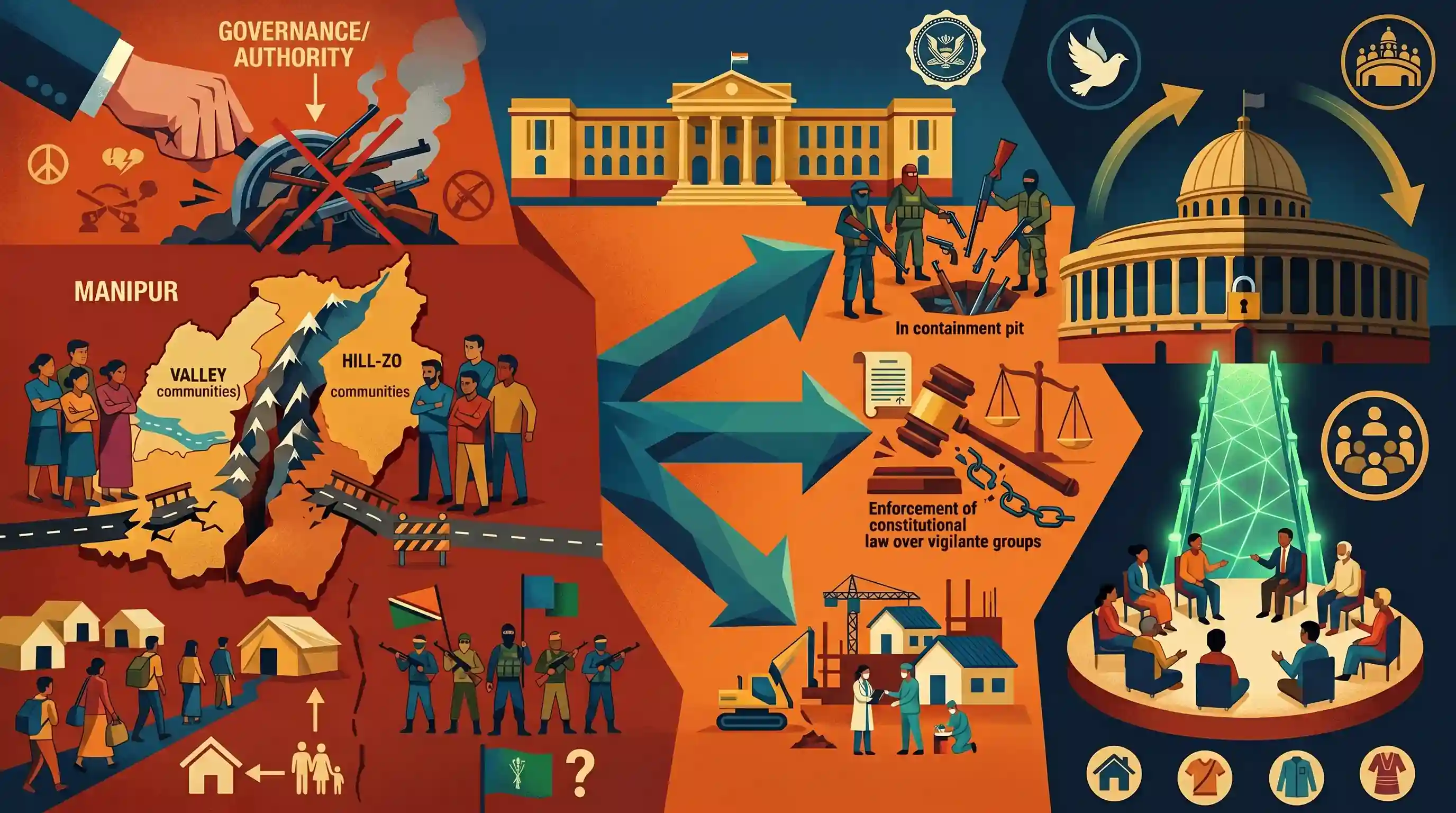
An editorial analysis of the fragile situation in Manipur reveals that while the imposition of President's Rule has reduced gun violence, deep-seated ethnic hostilities between the Kuki-Zo and valley communities continue to obstruct genuine peace. Distrust of state institutions has empowered ethnic partisans, hindering free movement and the return of displaced persons. The Union government faces a complex challenge that requires disarming insurgent groups, upholding the rule of law, and ensuring the rehabilitation of victims. Reinstating the State Assembly should be contingent upon achieving a consensus on normalcy among all affected communities.
Key Points
- While gun violence and arson have abated significantly during the three months of President's Rule in Manipur, genuine peace remains elusive due to persistent hostility between the Kuki-Zo and valley communities.
- Lack of free movement across highways and unabated ethnic tensions have prevented displaced individuals from returning to their homes in the hills and the valley.
- Distrust in state institutions has allowed ethnic partisans to dictate terms, as seen when valley groups protested security personnel aiding safe passage through Kuki-Zo areas during the Shirui Lily festival.
- The Union government must prioritize disarming insurgent and chauvinist groups, implementing the rule of law, and rehabilitating victims before pursuing political resolutions.
- Demands to reinstate the State Assembly and form a new government should only be considered if a consensus on peace-building is reached among community representatives.
Important Terms
President's Rule

Proclamation under Article 356 where the Union government assumes direct control of a state's administration due to the 'failure of constitutional machinery'.
UPSC context
GS II (Polity) and GS III (Internal Security); tests emergency provisions and federal power balance.
Article 355
A constitutional mandate requiring the Union to protect states against external aggression and internal disturbances, often invoked as a precursor to or alongside Article 356.
UPSC context
GS II (Polity); tests the Union's executive obligations and central intervention thresholds.
State Legislative Assembly
The state's legislative body; in Manipur, it consists of 60 members and is currently inactive following the imposition of central rule.
UPSC context
GS II (Polity); tests the structure and function of state legislatures during political crises.
Suspended Animation
A legal status under Article 356 where a State Assembly is temporarily paused but not dissolved, allowing for potential revival without fresh elections.
UPSC context
GS II (Polity); tests nuances of President's Rule and assembly dissolution vs. suspension.
Kuki-Zo and Meitei
The two primary ethnic communities in Manipur's conflict; Meiteis predominantly reside in the Imphal valley, while Kuki-Zo tribes inhabit the surrounding hill districts.
UPSC context
GS I (Society) and GS III (Security); tests ethnic diversity and regional conflict dynamics.
Hill Areas Committee (HAC)
A special body under Article 371C comprising MLAs from Manipur's hill districts, empowered to oversee legislation affecting tribal governance and development.
UPSC context
GS II (Polity); tests specific constitutional provisions (Article 371C) for tribal autonomy.
Prelims Trap
"Upon the proclamation of President's Rule, the State Legislative Assembly is automatically dissolved."
Under the S.R. Bommai judgment, the Assembly is only kept in suspended animation initially. It cannot be dissolved until Parliament approves the Article 356 proclamation.
Static Concepts Connected
What happens to the State machinery under President's Rule (Article 356)?
- Executive takeover: The State Council of Ministers is dismissed. The Governor administers the state on behalf of the President, often assisted by advisors.
- Legislative shift: The State Assembly is either suspended or dissolved. The Parliament assumes the power to legislate on state subjects for that state.
- Bommai safeguard: As per the S.R. Bommai case, the President cannot dissolve the state assembly until the proclamation is approved by both Houses of Parliament.
How does the hill-valley geographical divide structurally fuel conflict in Manipur?
- Demographic concentration: The Meitei community densely populates the central Imphal Valley (10% of area), while Kuki-Zo and Naga tribes inhabit the vast surrounding hills (90% of area).
- Land rights (Art 371C): Constitutional protections (Article 371C) restrict valley residents from buying land in tribal hill areas, exacerbating land scarcity and resource anxieties among the valley majority.
- Terrain and insurgency: The rugged hill terrain and highway choke points provide strategic leverage and safe havens for ethnic insurgents, complicating state law enforcement.
Cross-Topic Patterns
Weaponizing geographic bottlenecks
Highway blockades (NH-2, NH-37) in Manipur demonstrate how non-state actors exploit the Northeast's geographic bottlenecks, turning infrastructure vulnerabilities into primary internal security threats.
Article 355 as precursor to 356
The Centre's reliance on Article 355 to take over law-and-order before invoking full President's Rule (Art 356) reflects a novel, hybrid constitutional approach to containing internal disturbances without immediate political dissolution.

Expect a 2026 Mains question linking Northeast topography to internal security, or a Prelims trap contrasting Articles 355, 356, and 371C.
Linked PYQs · 3
Linked PYQs · 3
- 2017MainsGS3
The North-East region of India has been infested with insurgency for a very long time. Analyze the major reasons for the survival of armed insurgency in this region.
- 2025MainsGS3
What are the major challenges to internal security and peace process in the North-Eastern States? Map the various peace accords and agreements initiated by the government in the past decade.
- 2023MainsGS2
Account for the legal and political factors responsible for the reduced frequency of using Article 356 by the Union Governments since mid 1990s.
