Skyroot Achieves Historic Maiden Orbital Mission with Vikram 1
Source:Indian Express ↗
આ શા માટે મહત્વનું છે
Marks a watershed moment in India's space commercialization, demonstrating that private domestic companies can independently build and operate orbital launch vehicles, which is crucial for expanding India's share in the global space economy.
સારાંશ
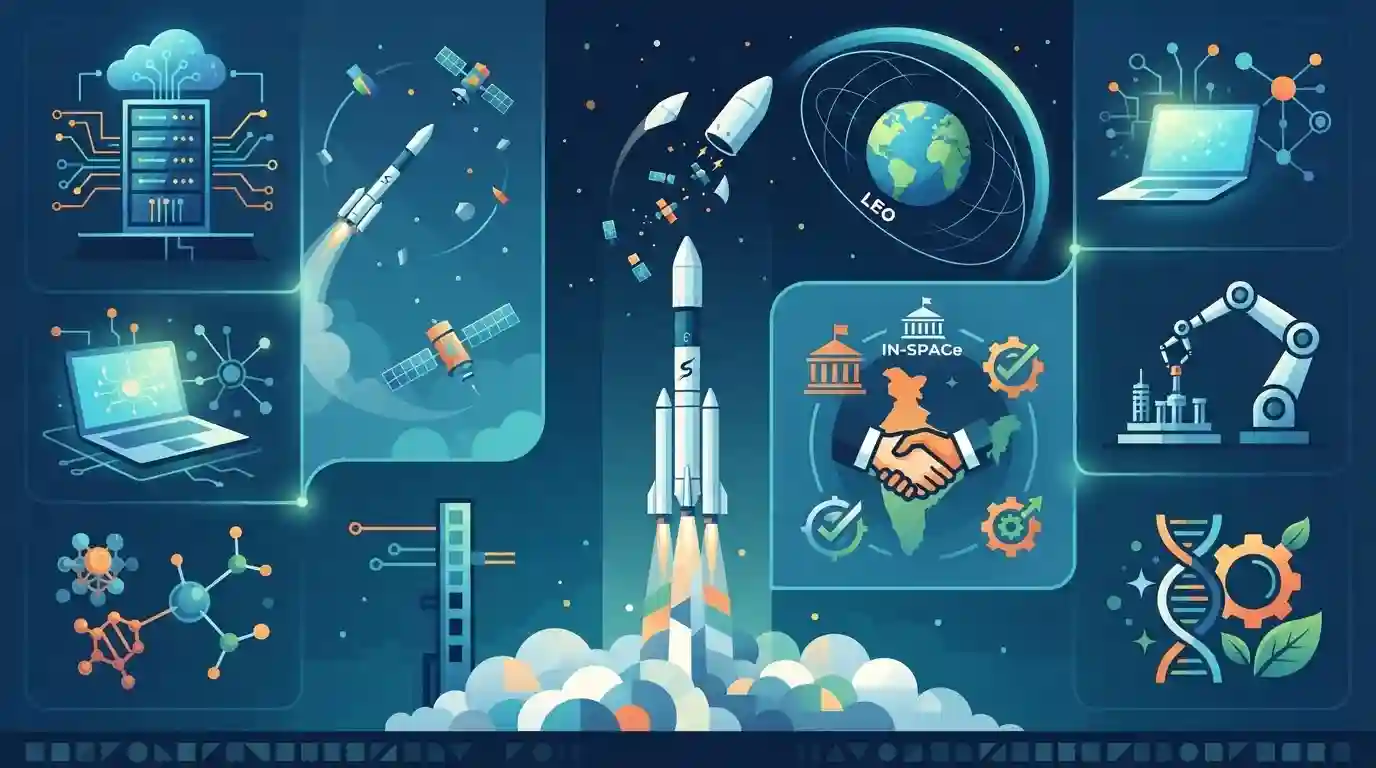
Skyroot Aerospace's Vikram-1 successfully completed its maiden orbital mission, marking a historic achievement as India's first privately built multi-stage rocket to reach orbit. The mission deployed technology demonstration payloads into Low Earth Orbit (LEO), validating the launch vehicle's mix of solid and liquid propulsion stages. This success highlights the rapid maturation of India's commercial space ecosystem, driven by space sector reforms and regulatory facilitation by IN-SPACe, making India one of the few nations with private orbital launch capabilities.
મુખ્ય મુદ્દા
- Vikram-1 is India's first privately developed multi-stage orbital launch vehicle, transitioning the country's private space sector from sub-orbital test flights to full orbital missions.
- The rocket features a four-stage architecture: three solid-fuel stages for lift-off and a liquid-fueled Orbital Adjustment Module for precise payload deployment into Low Earth Orbit (LEO).
- The mission successfully placed technology demonstration satellites into orbit, underscoring the commercial viability of private Indian space startups.
- This milestone validates the effectiveness of the Indian Space Policy 2023 and the regulatory support provided by IN-SPACe in fostering private sector participation.
મહત્વપૂર્ણ શબ્દો
Indian Space Policy 2023

A comprehensive policy framework that formalizes private sector participation across the entire space value chain, enabling commercial satellite launches, ground station operations, and private end-to-end space activities in India.
UPSC context
GS Paper III (Science & Tech). Tests understanding of regulatory reforms, space sector privatization, and domestic space ecosystem governance.
IN-SPACe (Indian National Space Promotion and Authorisation Centre)
A single-window, independent nodal agency under the Department of Space functioning as an autonomous regulator to promote, authorize, and supervise private sector space activities.
UPSC context
GS Paper III (Science & Tech). Tests knowledge of regulatory bodies, public-private partnerships, and ease of doing business in tech.
Skyroot Aerospace
A Hyderabad-based private aerospace company that developed the Vikram-1 rocket, making India the third nation to possess independent private orbital launch capabilities.
UPSC context
GS Paper III (Indigenization of Technology). Tests awareness of private-sector technological innovations, indigenization of aerospace, and launch services.
ISRO (Indian Space Research Organisation)
India's premier national space agency under the Department of Space, responsible for executing research, developing satellite launch technology, and promoting aerospace indigenization.
UPSC context
GS Paper III (Science & Tech). Tests achievements of Indians in science, technology transfer, and national space exploration milestones.
પ્રિલિમ્સ ટ્રેપ
Vikram-1 is a completely solid-fueled rocket, and IN-SPACe acts as the commercial arm of ISRO for marketing its space assets.
Vikram-1 uses three solid stages and a liquid-fueled upper stage. Additionally, NSIL is ISRO's commercial arm; IN-SPACe is an independent, single-window regulator for private entities.
સંલગ્ન સ્થિર ખ્યાલો
Difference between Solid, Liquid, and Cryogenic propulsion stages in Indian rocketry
- Solid Fuel: Provides high thrust at liftoff, has simple storage, but cannot be throttled or restarted once ignited (e.g., HTPB).
- Liquid Fuel: Offers high efficiency, precise thrust control, and restart capability; crucial for final payload placement in orbit.
- Cryogenic Fuel: Uses super-cooled liquid oxygen and hydrogen, delivering the highest efficiency (specific impulse) for heavy payload upper stages.
Institutional division of labor: IN-SPACe vs NSIL
- IN-SPACe: An autonomous, single-window nodal agency under Dept of Space regulating and authorizing private sector (NGE) space activities.
- NSIL: A commercial Central Public Sector Enterprise (CPSE) tasked with commercializing ISRO-developed technologies and launch services.
આંતર-વિષય પેટર્ન
Private space tech + IPR regimes
As startups build proprietary systems like 3D-printed engines, India's IP regime must evolve to protect commercial patents while managing dual-use defense technology controls.
LEO commercialization + Space debris
Rapid private LEO deployments will accelerate space congestion, requiring private operators to integrate with ISRO's Project NETRA and global space debris mitigation standards.

Distinction between IN-SPACe and NSIL, combined with private launch vehicle propulsion architecture, is a high-probability 2026 Prelims topic.
સંલગ્ન PYQ · 3
સંલગ્ન PYQ · 3
- 2026PrelimsGS1
Consider the following statements with regard to involvement of private entities in India's space programme : 1. The Indian National Space Promotion and Authorisation Centre (IN-SPACe) is an autonomous agency formed to facilitate participation of private entities. 2. Agnikul Cosmos launched the world's first flight using 3D-printed rocket engine. 3. Skyroot Aerospace has developed liquid fuel for GSLV. Which of the statements given above is/are correct ?
- 2018PrelimsGS1
With reference to India's satellite launch vehicles, consider the following statements: 1. PSLVs launch the satellites useful for Earth resources monitoring whereas GSLVs are designed mainly to launch communication satellites. 2. Satellites launched by PSLV appear to remain permanently fixed in the same position in the sky, as viewed from a particular location on Earth. 3. GSLV Mk III is a four-staged launch vehicle with the first and third stages using solid rocket motors; and the second and fourth stages using liquid rocket engines. Which of the statements given above is/are correct?
- 2016MainsGS3
Discuss India's achievements in the field of Space Science and Technology. How the application of this technology has helped India in its socio-economic development?
