Line of Control Ceasefire Violations and Military Readiness
Source:The Hindu ↗
Why It Matters
This development underscores the fragility of the 2022 LoC ceasefire agreement and exemplifies India's evolving strategic posture—combining diplomatic pressure with credible military deterrence—against cross-border terrorism. Understanding the operational capabilities of defense assets (like BrahMos, Rafale, and S-400) is crucial for Prelims and GS3 Science & Technology, while the geopolitical and border management aspects are key for GS2 and GS3 Internal Security.
Summary
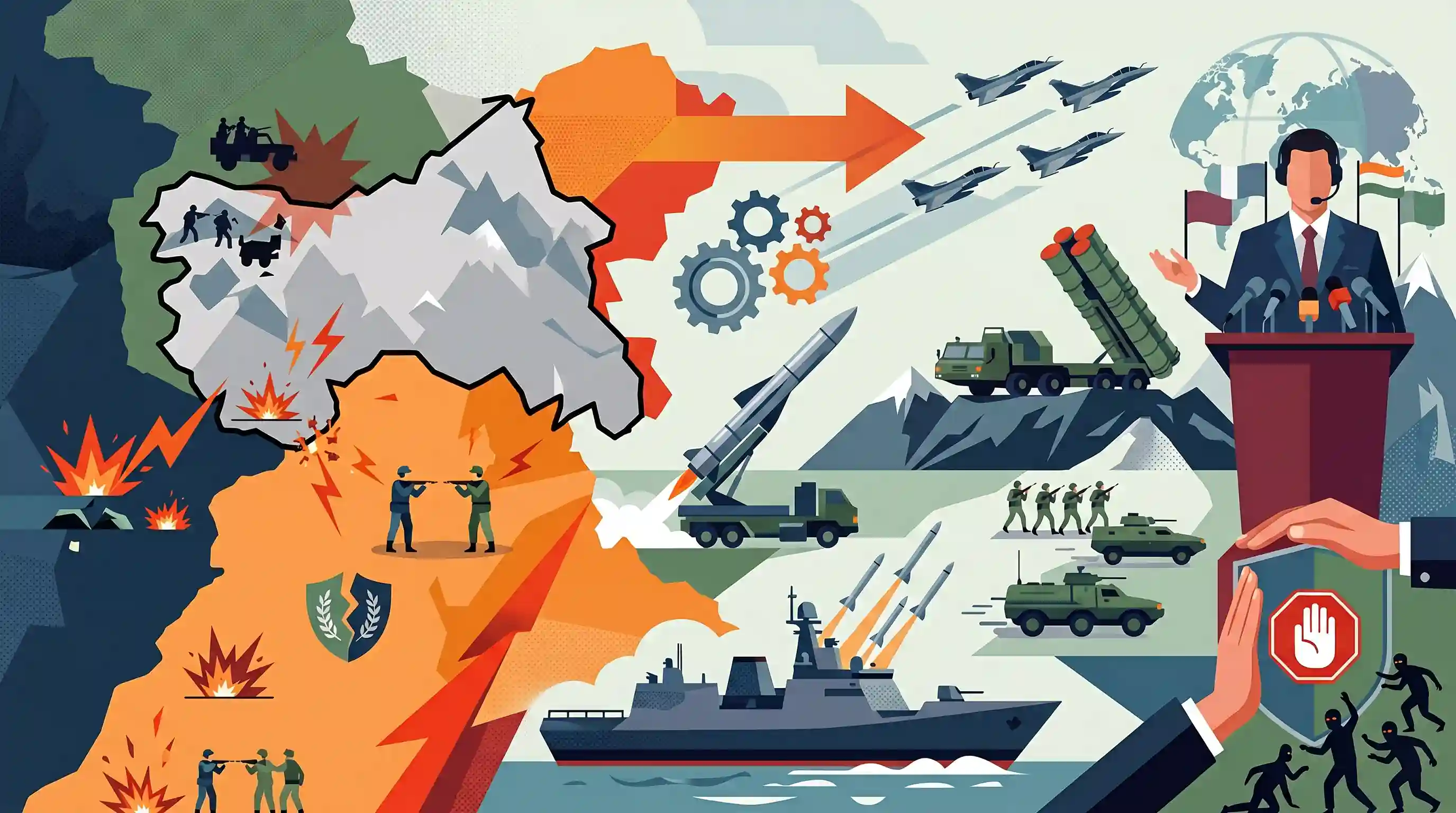
Following a deadly terror attack in Pahalgam, skirmishes and ceasefire violations have erupted between India and Pakistan along the Line of Control (LoC) in the Kashmir Valley. Although the 2022 ceasefire understanding technically holds, bilateral tensions are soaring. In response, Indian armed forces are weighing options for kinetic military action while simultaneously holding major military exercises to signal combat readiness. Key defense assets including BrahMos missiles, MRSAM systems fired from INS Surat, Rafale jets, and the S-400 Triumf have been prominently featured. Concurrently, Indian diplomats are reinforcing a 'zero-tolerance' stance on cross-border terrorism on the global stage.
Key Points
- Ceasefire violations have erupted along the LoC, specifically opposite the Tutmari Gali and Rampur sectors, following the terror attack in Pahalgam.
- While the 2022 ceasefire understanding remains in place nominally, Indian forces are considering kinetic military actions in response to continued cross-border terrorism.
- The Indian Navy successfully test-fired BrahMos supersonic cruise missiles and MRSAM anti-air systems from the INS Surat in a show of combat readiness.
- The Indian Air Force has readied strategic assets, including Rafale jets armed with Meteor and Scalp missiles, and S-400 Triumf air defence systems.
- Rising regional friction is marked by corresponding naval war games by the Pakistan Navy in the Arabian Sea, countered by India's deployment of INS Vikrant.
- Diplomatically, India's External Affairs Minister reiterated a zero-tolerance policy toward terrorism in international engagements, including talks with his UK counterpart.
Important Terms
BrahMos supersonic cruise missile

The world's fastest supersonic cruise missile, jointly developed by India (DRDO) and Russia (NPOM). It operates on a 'fire-and-forget' principle with a range of 290–450+ km.
UPSC context
GS-III: Defense Technology. Key example of international collaboration, technology indigenization, and precision-strike capability in modern warfare.
S-400 Triumf air defence system
A Russian-made mobile, long-range surface-to-air missile (SAM) system capable of intercepting aircraft, drones, and missiles at ranges up to 400 km. Known as 'Sudarshan Chakra' in India.
UPSC context
GS-III: Security Challenges & Modernization. Vital for layered air defense and strategic deterrence against two-front threats.
2022 LoC Ceasefire Agreement
A landmark 2021 reaffirmation (often cited as the 2021 understanding) between Indian and Pakistani DGMOs to strictly observe the 2003 ceasefire along the Line of Control.
UPSC context
GS-III: Border Management. Critical for understanding Indo-Pak bilateral relations, border stability, and conflict de-escalation mechanisms.
MRSAM (Medium Range Surface-to-Air Missile)
An advanced air defense system co-developed by India's DRDO and Israel Aerospace Industries (IAI). It provides a 70 km intercept range against various aerial threats.
UPSC context
GS-III: Indigenization of Technology. Highlights successful tri-service induction and the depth of India-Israel defense ties.
INS Surat
The fourth and final Visakhapatnam-class (Project 15B) stealth guided-missile destroyer. It is notably the Indian Navy's first AI-enabled warship, featuring 75% indigenous content.
UPSC context
GS-III: Security/Aatmanirbhar Bharat. Demonstrates naval modernization, domestic shipbuilding speed, and the integration of AI in defense.
Pinaka multi-barrel rocket launcher
An indigenous multi-barrel rocket launcher (MBRL) system developed by DRDO. It can fire a salvo of 12 rockets in 44 seconds for area saturation.
UPSC context
GS-III: Indigenization. A key replacement for Russian legacy systems and a major success in Indian defense exports.
Prelims Trap
"BrahMos is a hypersonic ballistic missile capable of striking targets at intercontinental ranges."
BrahMos is a supersonic (Mach 2.8-3.0) cruise missile, not a hypersonic ballistic missile. It is designed for regional precision strikes, not intercontinental ranges.
Static Concepts Connected
How do cruise missiles differ from ballistic missiles?
- Flight Path: Ballistic missiles follow an unguided, parabolic trajectory after the initial boost phase. Cruise missiles are self-propelled and guided throughout their flight.
- Atmosphere: Ballistic missiles leave and re-enter Earth's atmosphere, whereas cruise missiles fly mostly at lower altitudes entirely within the atmosphere.
- Precision & Range: Cruise missiles are typically used for high-precision, shorter-range tactical strikes. Ballistic missiles often carry strategic/nuclear payloads over intercontinental ranges.
What is Project 15B of the Indian Navy?
- Classification: It is a class of stealth guided-missile destroyers (Visakhapatnam-class) designed by the Warship Design Bureau.
- Fleet: The project comprises four ships: INS Visakhapatnam, INS Mormugao, INS Imphal, and INS Surat.
- Capabilities: Built at Mazagon Dock Shipbuilders with high indigenous content, they are equipped with BrahMos supersonic cruise missiles and MRSAM systems.
Cross-Topic Patterns
S-400 procurement and CAATSA waivers
India’s deployment of the Russian S-400 amidst Western pressure showcases strategic autonomy, frequently tested in Mains IR regarding the India-US-Russia balancing act.
Border terrain & infiltration dynamics
Skirmishes in the Tutmari Gali and Rampur sectors highlight how complex Himalayan topography and passes dictate Internal Security border management grids.

Expect a Prelims 'match-the-following' question pairing defense assets (Project 15B, S-400, BrahMos) with their core capabilities in 2026.
Linked PYQs · 5
Linked PYQs · 5
- 2020MainsGS3
Analyze internal security threats and transborder crimes along Myanmar, Bangladesh and Pakistan borders including Line of Control (LoC). Also discuss the role played by various security forces in this regard.
- 2024MainsGS3
India has a long and troubled border with China and Pakistan fraught with contentious issues. Examine the conflicting issues and security challenges along the border. Also give out the development being undertaken in these areas under the Border Area Development Programme (BADP) and Border Infrastructure and Management (BIM) Scheme.
- 2024PrelimsGS1
Consider the following aircraft : 1. Rafael 2. MiG-29 3. Tejas MK-1 How many of the above are considered fifth generation fighter aircraft?
- 2015MainsGS2
Terrorist activities and mutual distrust have clouded India-Pakistan relations. To what extent the use of soft power like sports and cultural exchanges could help generate goodwill between the two countries? Discuss with suitable examples.
- 2016MainsGS2
Increasing cross-border terrorist attacks in India and growing interference in the internal affairs of several member-states by Pakistan are not conducive for the future of SAARC (South Asian Association for Regional Cooperation)." Explain with suitable examples.
