SJVN One Gigawatt Solar Power Project in Pachapadra
Source:renewable-watch ↗
Why It Matters
With Rajasthan leading the country in solar energy capacity, mega-projects like the 1 GW Pachapadra project are critical. It highlights the inter-state allocation of power, alignment with domestic content requirements (DCR) promoting 'Make in India' in solar cell/module manufacturing, and SJVN's evolving role in transitioning to renewable energy. This is a high-yield topic for Rajasthan economic and environmental geography in RAS Prelims.
Summary
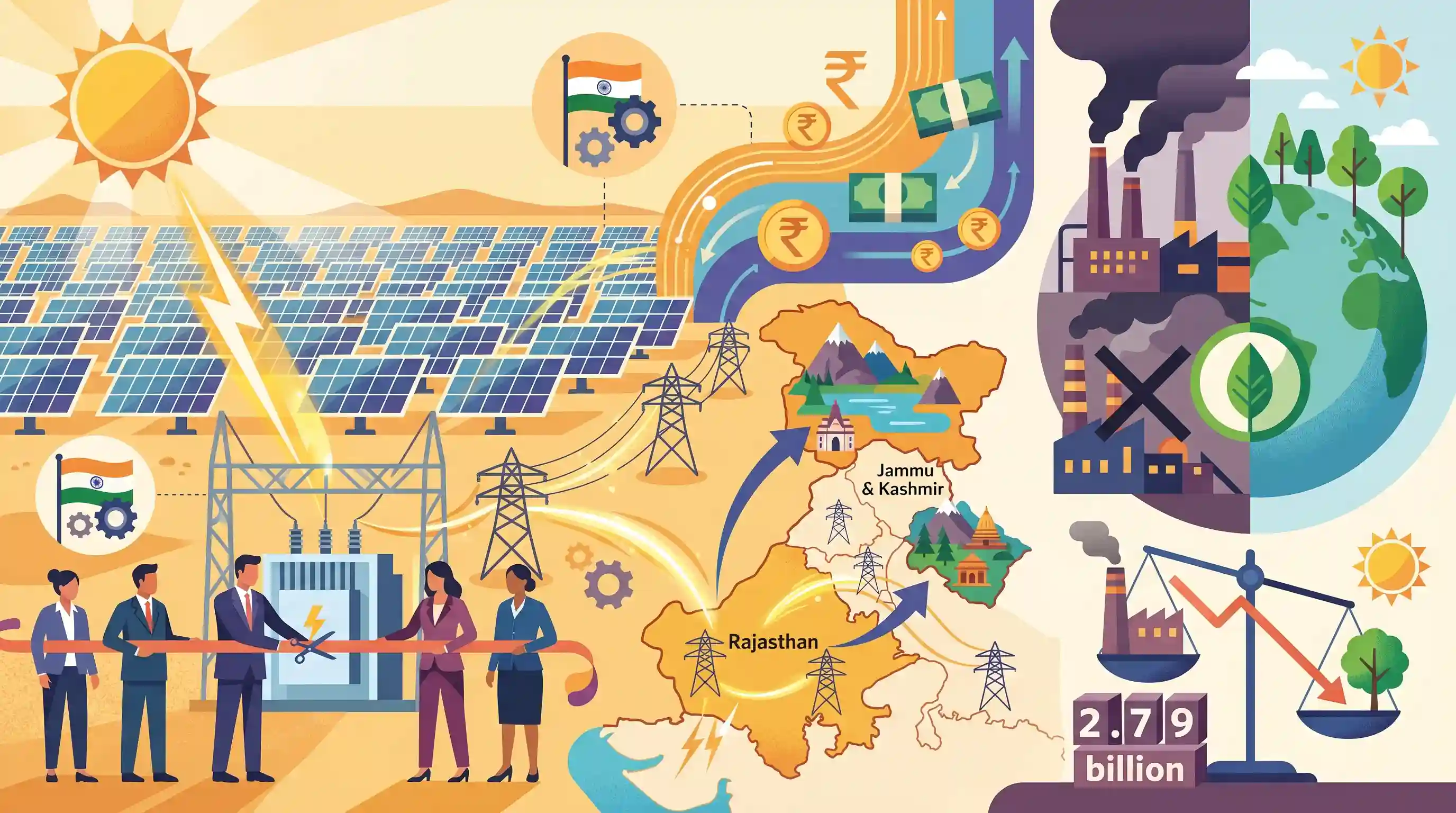
SJVN Green Energy Limited has inaugurated a major 1,000 MW (1 GW) solar project in Pachapadra, Rajasthan, with an investment of Rs 54.92 billion. The project aims to supply clean energy to Rajasthan, Uttarakhand, and Jammu & Kashmir, utilizing domestic content compliant components and expected to cut lifetime carbon emissions by 2.79 billion kg.
Key Points
- SJVN Green Energy Limited has inaugurated a 1 GW (1,000 MW) solar power project in Pachapadra, Rajasthan.
- The project has been developed with an investment of approximately Rs 54.92 billion (~Rs 5,492 crore).
- The power generated from this project will be shared among three states/UTs: Rajasthan (500 MW), Jammu & Kashmir (300 MW), and Uttarakhand (200 MW).
- In its first year, it is expected to generate 2,454.84 million units (MUs) of electricity, and around 56,482.14 MUs over its 25-year life cycle, reducing carbon emissions by 2.79 billion kg.
- The project promotes domestic manufacturing by utilizing about 2.42 million Domestic Content Requirement (DCR) solar modules and nearly 1,750 million solar cells.
- SJVN also signed a 25-year Power Purchase Agreement (PPA) with BluPine Energy to supply 150 MW of assured peak power at a tariff of Rs 6.74 per unit under its FDRE-4 tender.
Important Terms
Domestic Content Requirement (DCR)

A policy mandate requiring solar developers to use locally manufactured components, like solar cells and modules, to qualify for government benefits, promoting indigenous industrial capacity and self-reliance.
UPSC context
GS Paper III (Energy/Economy); tests understanding of trade protectionism, domestic manufacturing, and self-reliance policies.
SJVN Limited
A Navratna Central Public Sector Enterprise under the Ministry of Power, jointly promoted by the Government of India and Government of Himachal Pradesh, engaged in power generation.
UPSC context
GS Paper III (Infrastructure: Energy); tests knowledge of key public sector undertakings driving India's power capacity and transition.
SJVN Green Energy Limited
A wholly-owned renewable energy subsidiary of SJVN Limited, established to formulate, construct, operate, and manage large-scale solar, wind, and hybrid clean energy power plants.
UPSC context
GS Paper III (Infrastructure/Environment); tests PSU-led institutional frameworks implementing national renewable energy and decarbonization goals.
SJVN FDRE-4 tender
A competitive bidding tender launched by SJVN to secure Firm and Dispatchable Renewable Energy, leveraging solar, wind, and storage systems to supply stable peak power.
UPSC context
GS Paper III (Infrastructure/Energy); tests innovative procurement models for peak-hour power demand and grid stability.
BluPine Energy
An Indian renewable energy developer, backed by global investor Actis, focused on utility-scale solar, wind, and storage-integrated projects to provide reliable clean power.
UPSC context
GS Paper III (Infrastructure: Energy); tests private sector and foreign investment contributions to India's climate commitments.
Prelims Trap
Domestic Content Requirements (DCR) are universally mandated for all grid-connected solar power projects in India.
DCR cannot be applied to commercial or private solar projects under WTO rules. It is strictly confined to government-subsidized schemes or government-use procurement.
Static Concepts Connected
What is Firm and Dispatchable Renewable Energy (FDRE)?
- Definition: A hybrid power procurement model combining renewable energy sources with Energy Storage Systems (ESS) like Pumped Hydro or Batteries.
- Grid Stability: Addresses the inherent intermittency of wind and solar by guaranteeing stable, non-intermittent power with high availability during peak hours.
- Policy Driver: Promoted by the Ministry of New and Renewable Energy (MNRE) to transition from simple RE generation to round-the-clock power supply.
Why was India's solar Domestic Content Requirement (DCR) challenged at the WTO?
- National Treatment: The WTO ruled that India’s DCR violated GATT Article III:4 by treating imported solar cells less favorably than domestic ones.
- TRIMs Violation: It was found inconsistent with the Agreement on Trade-Related Investment Measures (TRIMs) regarding domestic-sourcing mandates.
- Government Exception: Under Article III:8(a), DCR is only valid for government procurement for its own use, not for commercial resale.
Cross-Topic Patterns
Solar trade barriers vs Climate targets
Illustrates the friction between domestic green manufacturing policies (like DCR) and international trade rules (WTO) that prioritize non-discriminatory market access over climate subsidies.
Renewable integration + Grid storage
Highlights how the shift to FDRE power purchase agreements forces the integration of Pumped Hydro Storage (PHS) and battery storage into national infrastructure planning.

FDRE models and WTO compliance of domestic sourcing policies (DCR) are highly likely targets for multi-statement prelims questions.
Linked PYQs · 4
Linked PYQs · 4
- 2023RPSC_PRELIMSGS1
Which agency has been given the responsibility of implementing the PM-KUSUM scheme (Component A) in Rajasthan, which involves the establishment of solar power plants with a capacity of 0.5 MW to 2 MW?
- 2024RPSC_PRELIMSGS1
Which of the following statements about Rajasthan Multi Bijli Yojana is/are correct? A. Provide plants on one side to provide 100 solar plants. B. Subsidy for setting up rooftop solar panels. C. Provision of loan at book interest.
- 2012RPSC_PRELIMSGS1
Where will the first solar park (solar park) be set up in Rajasthan?
- 2025RPSC_PRELIMSGS1
Which of the following statements are correct with respect to the PM Surya Ghar Free Electricity Scheme? (i) Under this scheme, solar plants will be installed on one crore houses to provide free electricity up to 300 units per month. (ii) Provision of 30% subsidy for installing rooftop solar plants (iii) 100% online system for registration, application, approval and grant (iv) Provision of lending to each applicant at a bank interest rate of 4%
