Sixteenth Finance Commission Tables Report in Parliament
Source:The Hindu ↗
Why It Matters
The Finance Commission's recommendations are the bedrock of India's fiscal federalism, determining state revenues for a five-year period. The 16th FC's shift in horizontal parameters—especially rewarding state GDP contributions—has major geopolitical and economic implications for the balance between demographic realities and economic performance among states.
Summary
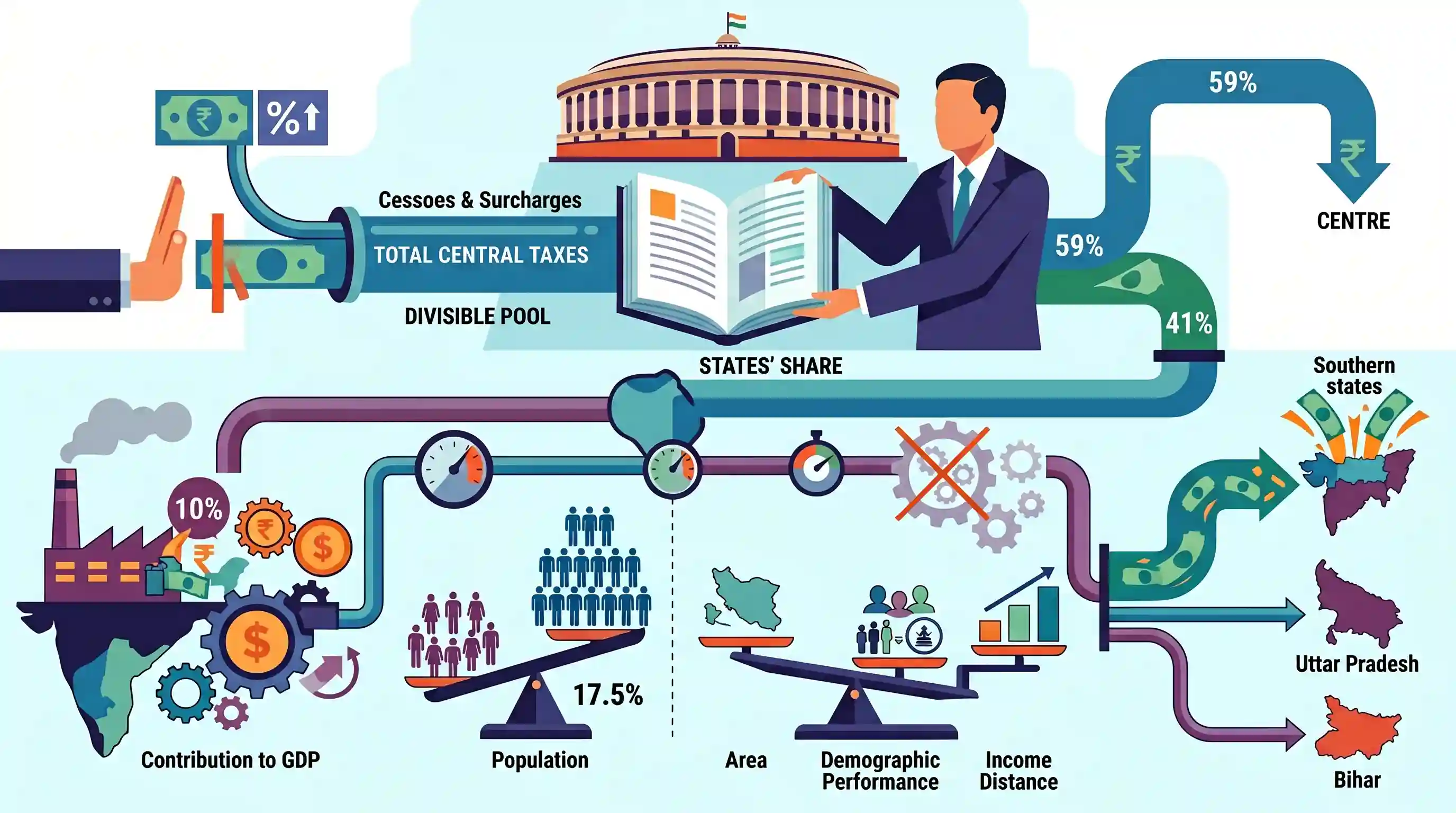
The 16th Finance Commission, chaired by Arvind Panagariya, has tabled its report in Parliament, maintaining the states' vertical share of central taxes at 41%. It introduced significant changes to the horizontal devolution formula by adding 'contribution to GDP' (10%) and dropping 'tax and fiscal efforts'. It also increased the weight for population to 17.5% while reducing weights for area, demographic performance, and income distance. This restructuring results in increased tax allocations for Southern states and decreased shares for highly populous states like Uttar Pradesh and Bihar. Furthermore, the Commission addressed states' concerns regarding a shrinking divisible pool by advising the Centre to limit the use of cesses and surcharges as permanent revenue measures.
Key Points
- The 16th Finance Commission retained the states' vertical share in the divisible tax pool at 41%.
- The horizontal devolution formula replaced 'tax and fiscal efforts' with a new 'contribution to GDP' criterion assigned a 10% weight.
- Formula weightages were adjusted: Population increased (17.5%), while demographic performance (10%), area (10%), and income distance (42.5%) saw reductions.
- Southern states (e.g., Tamil Nadu, Karnataka) see their tax shares increase, whereas populous states like Uttar Pradesh and Bihar face reductions.
- The Commission urged the Centre to restrict the use of cesses and surcharges—which are not shared with states—addressing a key concern in fiscal federalism.
Important Terms
Sixteenth Finance Commission

A constitutional body chaired by Arvind Panagariya that recommends the distribution of central tax revenues between the Union and States for the 2026-2031 period.
UPSC context
GS Paper II & III: Essential for topics on Constitutional Bodies and Centre-State financial relations.
Divisible Pool
The portion of gross central tax revenue, net of collection costs and excluding cesses and surcharges, that is constitutionally mandated to be shared with the states.
UPSC context
GS Paper III: Indian Economy; tests understanding of revenue sharing mechanisms and fiscal transparency.
Vertical Devolution
The percentage of the central divisible pool of taxes transferred to all states collectively; the 16th Finance Commission maintained this at 41%.
UPSC context
GS Paper II: Centre-State relations; critical for understanding fiscal balance and state autonomy.
Horizontal Devolution
The formula-based distribution of the states' shared tax revenue among individual states, using criteria like population, income distance, and economic contribution.
UPSC context
GS Paper II: Polity/Governance; tests knowledge of equity versus efficiency in inter-state resource allocation.
Cesses and Surcharges
Additional taxes levied by the Centre for specific purposes (e.g., health, education) that remain entirely with the Union and are not shared with states.
UPSC context
GS Paper III: Taxation; focuses on issues of shrinking divisible pools and fiscal friction.
Fiscal Federalism
The financial relationship and division of revenue-raising and spending responsibilities between different layers of government (Centre, States, and Local Bodies).
UPSC context
GS Paper II: Indian Constitution/Federalism; a core concept for mains answers on cooperative federalism.
Article 280
The constitutional provision that mandates the President of India to constitute a Finance Commission every five years to recommend tax distribution and grants-in-aid.
UPSC context
GS Paper II: Constitutional Provisions; frequently tested in Prelims regarding the powers of the President and FC.
Prelims Trap
The 16th Finance Commission increased vertical devolution or mandated sharing of cesses.
Vertical devolution remains 41% (same as 15th FC). Furthermore, Article 270 explicitly excludes cesses and surcharges from the divisible pool; the FC can only advise limiting them, not mandate inclusion.
Static Concepts Connected
What constitutes the Divisible Pool of Taxes under Article 270?
- Inclusions: All taxes and duties referred to in the Union List, except those explicitly excluded by the Constitution.
- Exclusions: Surcharges (Article 271), cesses levied for specific purposes, and taxes collected by the Centre but assigned to States.
- Net Proceeds: Calculated after deducting the cost of collection. The Comptroller and Auditor General (CAG) certifies this amount, and their certificate is final.
What is the difference between Vertical and Horizontal Devolution?
- Vertical Devolution: The distribution of net tax proceeds between the Union government and the State governments collectively (currently 41%).
- Horizontal Devolution: The allocation of the States' collective share among individual States based on a specific weighted formula (e.g., population, income distance).
Cross-Topic Patterns
Delimitation fears & Fiscal rewarding
Southern states fear losing Lok Sabha seats due to successful population control. The 16th FC offset this slightly by introducing 'contribution to GDP', easing long-standing demographic-penalty anxieties.
Cess proliferation vs. Divisible pool
The Centre's increasing reliance on cesses/surcharges shrinks the effective divisible pool for states. This ties directly to mains debates on cooperative federalism and state revenue autonomy.

Expect a Prelims question comparing 15th and 16th FC horizontal devolution criteria, specifically the new 'contribution to GDP'.
Linked PYQs · 5
Linked PYQs · 5
- 2025MainsGS2
Examine the evolving pattern of Centre-State financial relations in the context of planned development in India. How far have the recent reforms impacted the fiscal federalism in India?
- 2024MainsGS2
What changes has the Union Government recently introduced in the domain of Centre-State relations ? Suggest measures to be adopted to build the trust between the Centre and the States and for strengthening federalism.
- 2018MainsGS2
How is the Finance Commission of India constituted? What do you know about the terms of reference of the recently constituted Finance Commission? Discuss.
- 2023PrelimsGS1
Consider the following: 1. Demographic performance 2. Forest and ecology 3. Governance reforms 4. Stable government 5. Tax and fiscal efforts For the horizontal tax devolution, the Fifteenth Finance Commission used how many of the above as criteria other than population area and income distance?
- 2025PrelimsGS1
Which of the following statements with regard to recommendations of the 15th Finance Commission of India are correct? I. It has recommended grants of ₹ 4,800 crores from the year 2022-23 to the year 2025-26 for incentivizing States to enhance educational outcomes. II. 45% of the net proceeds of Union taxes are to be shared with States. III. ₹ 45,000 crores are to be kept as performance-based incentive for all States for carrying out agricultural reforms. IV. It reintroduced tax effort criteria to reward fiscal performance. Select the correct answer using the code given below.
