Implementation Bottlenecks in National Education Policy Stream Choices
Source:The Hindu ↗
Why It Matters
Highlights the critical gap between the policy intent of NEP 2020 and its on-ground implementation. It exposes systemic bottlenecks in India's education sector, particularly the misalignment between secondary school reforms and higher education entrance requirements, which is highly relevant for GS-2 questions on governance, education, and human resources.
Summary
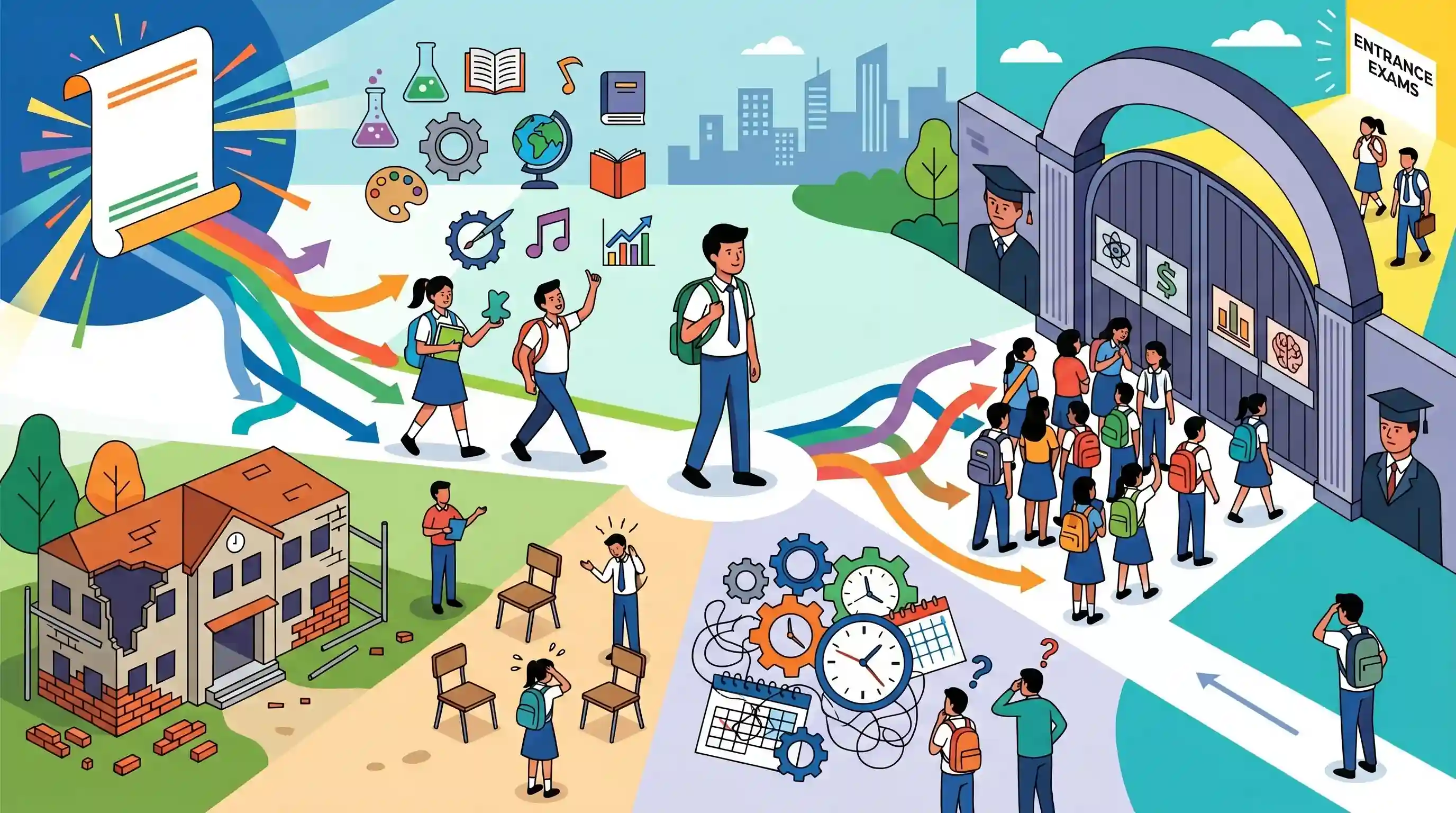
Six years after the National Education Policy (NEP) 2020 introduced the vision of flexible, multidisciplinary subject choices for school students, the goal remains largely unrealized. Despite the policy's intent to dismantle the rigid boundaries between Science, Commerce, and Humanities, implementation is stalled by inadequate school infrastructure, teacher shortages, and logistical hurdles in scheduling. Crucially, the persistence of traditional subject requirements in higher education admission processes and major entrance exams like JEE and NEET continues to disincentivize students from opting for mixed-stream subjects, revealing a significant gap between policy design and systemic execution.
Key Points
- NEP 2020 envisioned a multidisciplinary education system, aiming to eliminate the rigid separations between Science, Commerce, and Humanities streams in schools.
- Six years post-implementation, schools face severe infrastructural and logistical challenges, including a shortage of diverse subject teachers and complex timetable management, hindering flexible subject offerings.
- Higher education entrance exams (like JEE, NEET, and CUET) and university admission criteria still predominantly require traditional subject combinations, misaligning with NEP’s multidisciplinary goals.
- Due to career anxieties, parents and students continue to favor conventional academic streams, perpetuating the systemic inertia against cross-disciplinary learning.
Important Terms
National Education Policy (NEP) 2020

Comprehensive 2020 framework overhauling India's education system to emphasize flexibility, multidisciplinary learning, and universal access from foundational to higher education levels.
UPSC context
GS II (Education/Government Policies). Tests policy analysis, human capital development, and structural reforms in the social sector.
Multidisciplinary Education
An educational approach dismantling rigid silos between Science, Commerce, and Humanities, allowing students to integrate diverse fields to foster holistic development and creative thinking.
UPSC context
GS II (Social Sector-Education). Key for questions on pedagogical innovation and global educational standards.
National Curriculum Framework for School Education (NCF-SE) 2023
The operational document translating NEP 2020 goals into school practices, defining subject groups, textbooks, and the shift from streams to choice-based courses.
UPSC context
GS II (Governance). Crucial for understanding the implementation tools and structural changes (5+3+3+4) in school education.
University Grants Commission (UGC)
A statutory body coordinating and maintaining standards in higher education; responsible for aligning university admissions and degree structures with NEP 2020's flexible vision.
UPSC context
GS II (Regulatory Bodies). Tests the regulatory challenges in bridging school education with higher education requirements.
National Credit Framework (NCrF)
A unified meta-framework developed to integrate credits from school, higher, and vocational education, facilitating seamless mobility and flexibility across different learning pathways.
UPSC context
GS II (HRD/Education). Relevant for discussions on credit transfer, lifelong learning, and the National Skills Qualification Framework.
Central Board of Secondary Education (CBSE)
India's national-level board for public and private schools, acting as a primary implementing agency for NEP reforms like competency-based assessments and flexible subject choices.
UPSC context
GS II (Social Sector). Relevant for implementation-level challenges in the national school certification system.
Prelims Trap
NEP 2020 aims to achieve a 100% Gross Enrolment Ratio (GER) in higher education by 2030.
The 100% GER target by 2030 applies strictly to school education (pre-school to secondary). The target for higher education GER is 50% by 2035.
Static Concepts Connected
What are the foundational structural changes introduced in school education by NEP 2020?
- 5+3+3+4 Framework: Replaces the 10+2 structure with a new pedagogical design covering ages 3-18 across Foundational, Preparatory, Middle, and Secondary stages.
- No Hard Silos: Aims to eliminate hard separations between arts and sciences, vocational and academic streams, and curricular and extra-curricular activities.
- Vocational Integration: Mandates integration of vocational education from Class 6, including internships, targeting 50% learner exposure by 2025.
How is education distributed between the Union and States in the Constitution?
- Concurrent List: Transferred from the State List to the Concurrent List (Entry 25) via the 42nd Constitutional Amendment Act, 1976.
- Fundamental Right: Article 21A (86th Amendment, 2002) mandates free and compulsory education for all children aged 6 to 14 years.
- Article 45 (DPSP): The State shall endeavor to provide early childhood care and education for all children until they complete 6 years of age.
Cross-Topic Patterns
Policy Vision vs. Assessment Reality
NEP's multidisciplinary goals clash with centralized exams (JEE/NEET) demanding rigid stream knowledge, highlighting how higher-education assessment metrics dictate school-level curriculum implementation.
Fiscal Federalism & Teacher Shortages
Over 10 lakh teacher vacancies reflect state-level fiscal constraints and weak devolution of funds/functions to local bodies (PRIs) meant to manage school infrastructure.

Expect a GS2 Mains question evaluating structural hurdles like legacy entrance exams and state fiscal constraints in actualizing NEP 2020.
Linked PYQs · 2
Linked PYQs · 2
- 2020MainsGS2
National Education Policy 2020 is in conformity with the Sustainable Development Goal-4 (2030). It intends to restructure and reorient education system in India. Critically examine the statement.
- 2023MainsGS2
Skill development programmes have succeeded in increasing human resources supply to various sectors. In the context of the statement analyse the linkages between education, skill and employment.
