Alternate Dispute Resolution and Arbitration Council Delay
Source:The Hindu ↗
Why It Matters
Understanding the mechanisms and bottlenecks in Alternate Dispute Resolution (ADR) is crucial for GS Paper 2 (Dispute Redressal Mechanisms). Furthermore, the evolution and efficacy of arbitration laws directly impact the ease of doing business and the climate for foreign investment in India, intersecting with GS Paper 3 economy topics.
Summary
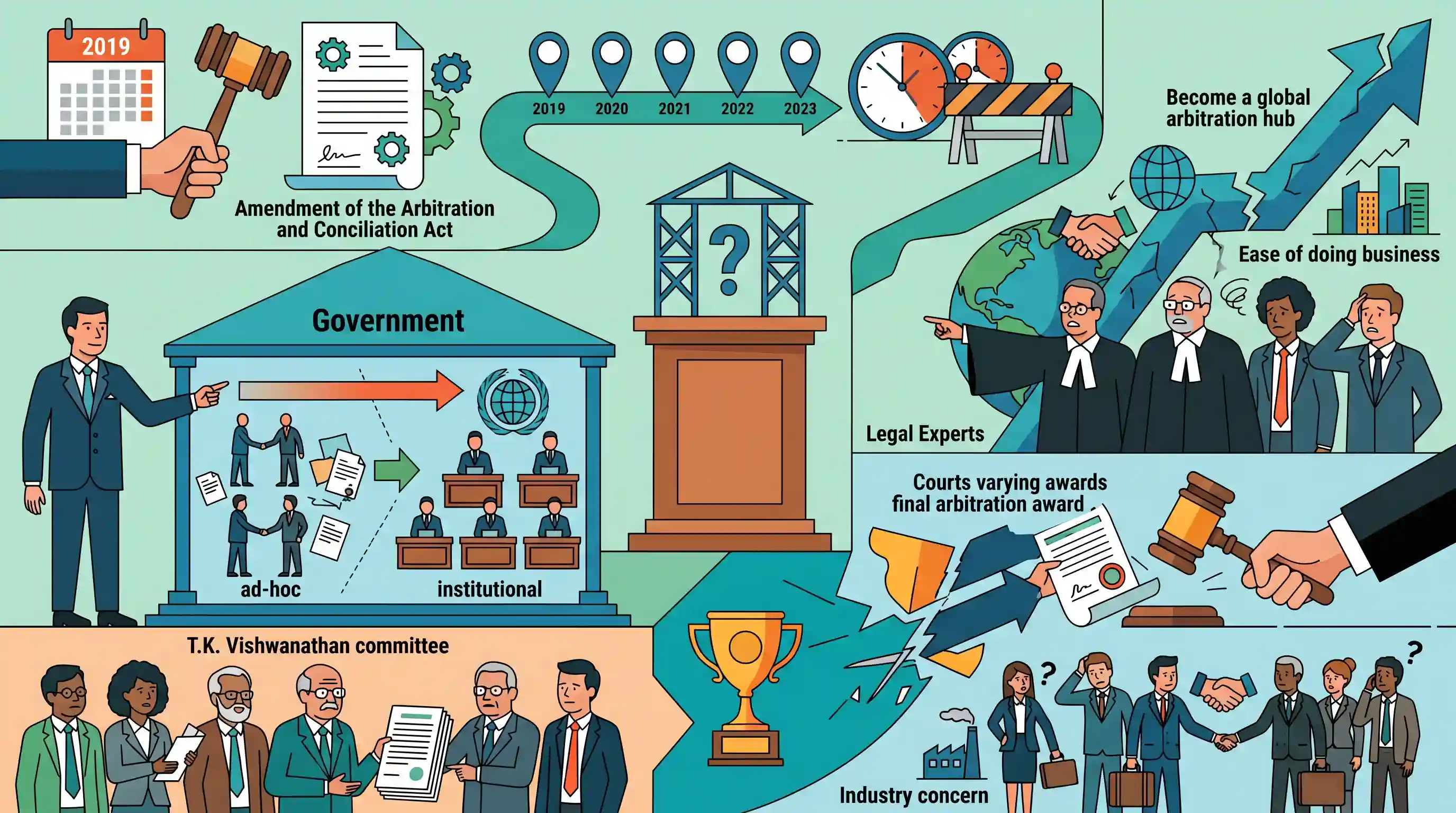
Six years after the Arbitration and Conciliation Act was amended in 2019, the Union Government has yet to constitute the Arbitration Council of India. While the Law Ministry attributes the delay to the slow transition by corporates from ad-hoc to institutional arbitration, legal experts argue that the absence of a regulatory council has hindered India's ambition to become a global arbitration hub. Furthermore, the T.K. Vishwanathan committee's recommendation to allow courts to vary arbitration awards has sparked industry concerns.
Key Points
- The Arbitration Council of India, mandated by the 2019 amendment to the Arbitration and Conciliation Act, has still not been established after six years.
- The delay is seen as a major roadblock in making India a hub for international commercial arbitration.
- Law Ministry officials claim that the corporate shift from ad-hoc towards institutional arbitration was a prerequisite for the council's formation, and expect to set it up this year.
- The T.K. Vishwanathan expert committee proposed reforms allowing courts to set aside or vary arbitration awards, drawing criticism from industry groups who view it as a setback.
- A draft Bill floated by the Law Ministry in late 2025 to tweak the arbitration law currently remains stalled.
Important Terms
Arbitration Council of India (ACI)

An independent statutory body proposed under the 2019 Amendment Act to regulate and promote institutional arbitration by grading institutions and accrediting arbitrators.
UPSC context
GS Paper II (Governance); essential for understanding reforms in judicial administration and Ease of Doing Business.
Arbitration and Conciliation (Amendment) Act, 2019
Legislation aimed at making India a global arbitration hub by introducing the ACI, promoting institutional arbitration, and reducing judicial intervention in commercial disputes.
UPSC context
GS Paper II (Polity/Statutory Bodies); tests knowledge of legal frameworks for alternative dispute resolution.
Institutional Arbitration
Arbitration conducted under the rules and administrative oversight of an established organization (like MCIA or SIAC), providing professional management and procedural certainty.
UPSC context
GS Paper III (Economy); relevant to improving the investment climate and contract enforcement in India.
Ad-hoc Arbitration
A flexible form of arbitration where parties themselves manage the procedure without an administrative institution, often leading to more frequent court intervention in India.
UPSC context
GS Paper II (Judicial Reforms); tests understanding of challenges in India's current dispute resolution landscape.
T.K. Vishwanathan Committee
An expert panel formed to suggest reforms to the Arbitration Act, known for recommending that courts be allowed to vary arbitral awards in exceptional cases.
UPSC context
GS Paper II (Judicial Reforms); important for tracing recent policy shifts and expert recommendations in ADR.
Alternative Dispute Resolution (ADR)
A range of legal techniques (like arbitration, mediation, and conciliation) used to resolve disputes outside the traditional court system to reduce judicial pendency.
UPSC context
GS Paper II (Polity); a core topic for judicial efficiency and the 'justice for all' constitutional mandate.
Arbitral Award
A final and binding decision rendered by an arbitral tribunal on a dispute, equivalent to a court decree for enforcement purposes.
UPSC context
GS Paper II (Judiciary); tests awareness of the legal finality vs. judicial review of alternative settlements.
Prelims Trap
Under the Arbitration Act, civil courts have broad powers to modify or vary arbitral awards on merits.
Under Section 34, Indian courts currently can generally only set aside awards, not modify them. The T.K. Vishwanathan committee has merely recommended allowing courts to vary awards.
Static Concepts Connected
What is the Arbitration Council of India (ACI) and its mandate?
- Statutory Origin: Mandated by the 2019 Amendment to the 1996 Arbitration Act to grade arbitral institutions, accredit arbitrators, and promote alternative dispute resolution (ADR) in India.
- Composition: To be led by a retired Supreme Court Judge or High Court Chief Justice, appointed by the Central Government in consultation with the CJI.
Ad-hoc vs. Institutional Arbitration: What is the core difference?
- Ad-hoc Arbitration: Parties mutually decide the rules, procedures, and appoint arbitrators independently without relying on a formal administering institution. It is dominant in India but often slower.
- Institutional Arbitration: Disputes are administered by specialized bodies (e.g., SIAC, MCIA) using pre-established procedural rules, fixed fee structures, and professional panels.
Cross-Topic Patterns
Arbitration & Ease of Doing Business
Regulatory delays in ACI directly impact commercial contract enforcement. Improving institutional arbitration is critical for reducing judicial pendency and boosting India's foreign investment climate.
T.K. Vishwanathan & Commercial Laws
Beyond arbitration, the T.K. Vishwanathan committee is central to India's economic legislation history, having also chaired the Bankruptcy Law Reforms Committee that conceptualized the IBC.

Expect a 2026 Prelims multi-statement question contrasting Ad-hoc vs Institutional arbitration and the statutory mandate/composition of ACI.
Linked PYQs · 2
Linked PYQs · 2
- 2015MainsGS2
What are the major changes brought in the Arbitration and Conciliation Act, 1996 through the recent Ordinance promulgated by the President? How far will it improve India's dispute resolution mechanism? Discuss.
- 2024MainsGS2
Explain and distinguish between Lok Adalats and Arbitration Tribunals. Whether they entertain civil as well as criminal cases ?
