Six states sign Kishau water agreement amid expert safety concerns
Source:downtoearth-org ↗
Why It Matters
Crucial for HPAS aspirants tracking inter-state water agreements, major river systems of Himachal Pradesh (like the Tons and Yamuna basins), and developmental versus environmental debates in the Himalayas.
Summary
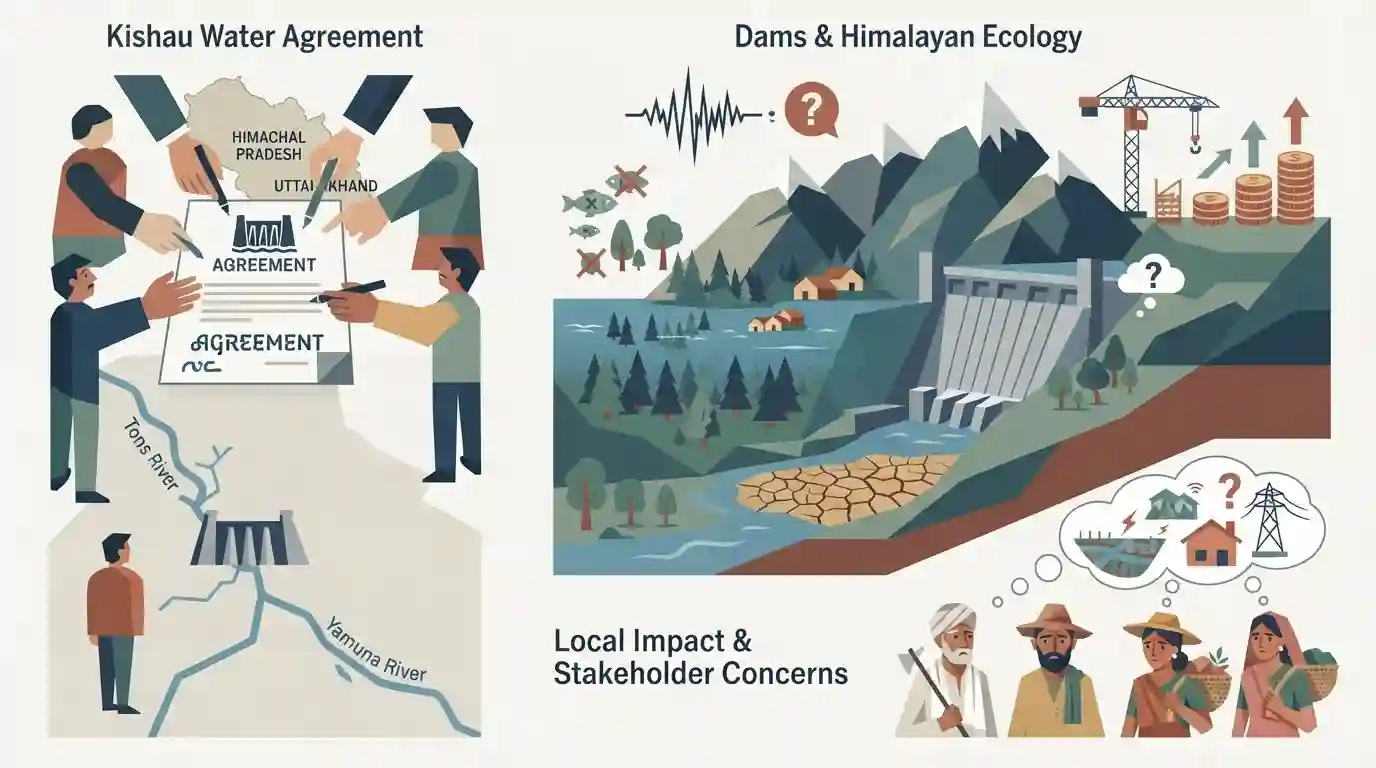
Six states have signed the Kishau Water Agreement to advance the Kishau Dam project on the Tons River (a tributary of the Yamuna). However, environmental experts and local stakeholders have questioned its seismic risks, high costs, ecological footprint, and actual utility in the context of Himalayan ecology.
Key Points
- Six states signed the Kishau Water Agreement concerning a mega dam project on the Tons river, a major tributary of the Yamuna.
- Experts and environmentalists have raised severe concerns regarding the project's high seismic risks, massive ecological disruptions, and questionable utility given changing climate and river flow patterns.
- The project impacts regions spanning Himachal Pradesh and Uttarakhand, involving inter-state water sharing and submergence issues.
Important Terms
Kishau Water Agreement

An inter-state pact signed by six riparian states to advance the construction of the Kishau Multipurpose Project on the Tons River to supply water, irrigation, and power.
UPSC context
HPAS Paper II (Geography & Polity) / Inter-state water sharing, federal cooperation, and hydro-infrastructure disputes involving Himachal Pradesh.
Kishau Dam Project
A major national hydroelectric and irrigation project involving a 232.6m concrete gravity dam on the Tons River along the Himachal Pradesh-Uttarakhand border.
UPSC context
HPAS Paper II (Geography of HP & Disaster Management) / Tests understanding of Himalayan river valley development, seismic vulnerability, and ecological displacement.
Upper Yamuna River Board
A regulatory body established in 1995 following an MoU between basin states to allocate and manage the surface water resources of the Upper Yamuna River Basin.
UPSC context
HPAS Paper II (Polity & Governance) / Tests institutional mechanisms for inter-state water dispute resolution and river basin governance.
Prelims Trap
Tons River is a major tributary of the Ganga.
Aspirants often assume the Tons River is a direct tributary of the Ganga or Sutlej, whereas it is the largest tributary of the Yamuna.
Static Concepts Connected
What are the key geographical and ecological features of the Tons River?
- Origin & Path: Largest tributary of the Yamuna, originating from the Rupin and Supin river systems in Uttarakhand/Himachal border.
- Seismic Profile: High gradient river flowing through fragile Himalayan terrain, prone to landslides and seismic vulnerability (Zone IV/V).
Cross-Topic Patterns
Himalayan Dams vs. EIA Norms
Mega dams in fragile Himalayan ecosystems test the delicate balance between renewable energy mandates and ecological security governed by EIA protocols.
Inter-State Water Disputes and Riparian Rights
Inter-state water sharing pacts require complex coordination among riparian states, frequently invoking the Inter-State Water Disputes Act.

Kishau Dam + Tons River + seismic/EIA concerns are prime candidates for Mains GS-3 (Environment/Disasters) and HPAS Geography.
Linked PYQs · 2
Linked PYQs · 2
- 2017HPAS_PRELIMSGS1
Where does river Yamuna, after flowing through Uttarakhand, enter in Sirmaur district of Himachal Pradesh ?
- 2023HPAS_PRELIMSGS1
Shinku-La tunnel pertains to which of the following ?
