Six States Sign Kishau Multipurpose Dam Water Agreement
Source:downtoearth-org ↗
Why It Matters
The Kishau Dam agreement involves multiple northern states, including Rajasthan, addressing regional water security and hydropower generation. Understanding interstate river water agreements and the associated environmental critiques is crucial for RPSC aspirants studying geography, governance, and environmental policy.
Summary
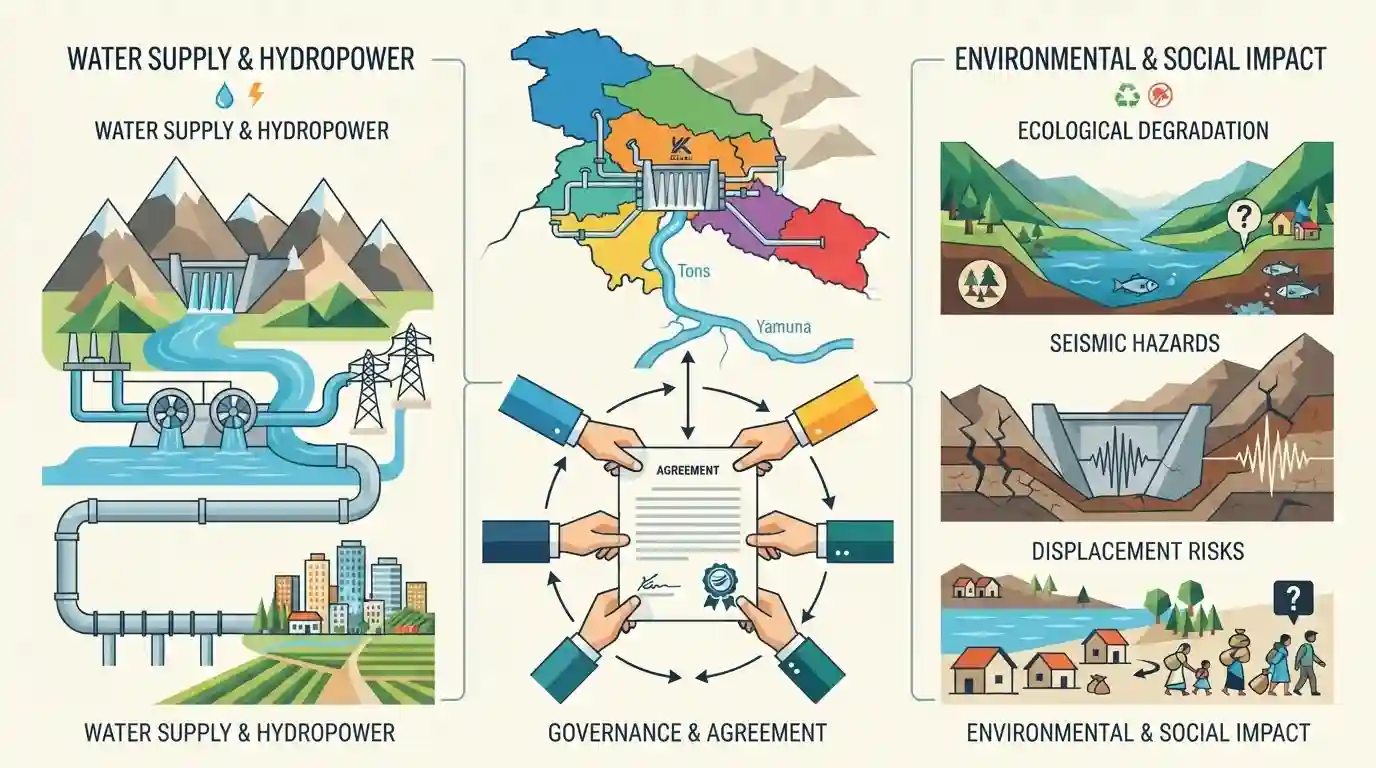
Six states have signed the Kishau water agreement for a major multipurpose dam project on the Tons river, a key tributary of the Yamuna. While aimed at enhancing water supply and hydropower generation across northern states including Rajasthan, the project has drawn criticism from experts over environmental degradation, seismic hazards in the Himalayas, and displacement risks.
Key Points
- Six states (Himachal Pradesh, Uttarakhand, Haryana, Uttar Pradesh, Rajasthan, and Delhi) have signed the Kishau water agreement for a multipurpose project on the Tons river, a major tributary of the Yamuna.
- The project involves the construction of a 236-meter-high roller-compacted concrete dam primarily for power generation (660 MW) and water supply.
- Environmental experts and local communities have raised concerns regarding ecological risks, displacement of populations, seismic vulnerability of the Himalayan region, and the overall economic utility of large dam projects.
Important Terms
Kishau Water Agreement

A multilateral pact among six northern states (Uttar Pradesh, Uttarakhand, Himachal Pradesh, Rajasthan, Delhi, and Haryana) to construct a multipurpose dam on the Tons river for enhanced water supply and hydropower generation.
UPSC context
Relevant for RPSC Paper II (Geography & Polity) / Interstate Water Disputes, cooperative federalism, and infrastructure planning in Rajasthan.
Upper Yamuna River Board
A statutory regulatory body established in 1995 to implement the Upper Yamuna water-sharing MOU among basin states, regulating water allocation and monitoring river flows.
UPSC context
Important for RPSC Paper II (Polity & Governance / Water Governance) regarding interstate river water management boards.
Central Water Commission
A premier technical organization under the Ministry of Jal Shakti responsible for initiating, coordinating, and furthering schemes for control, conservation, and utilization of water resources.
UPSC context
Essential for RPSC questions on national water infrastructure bodies, flood forecasting, and techno-economic appraisals.
Prelims Trap
Kishau dam project on the Yamuna river
Aspirants often assume the Kishau dam is built directly on the Yamuna river, whereas it is constructed on the Tons river, a key tributary of the Yamuna.
Static Concepts Connected
What are the key institutional mechanisms for resolving interstate water disputes in India?
- Constitutional Basis: Article 262 empowers Parliament to adjudicate inter-state river water disputes by law.
- Statutory Framework: The Inter-State River Water Disputes (ISRWD) Act, 1956 provides for setting up ad-hoc tribunals.
- Recent Reforms: The 2002 amendment streamlined tribunal procedures by introducing a maximum time limit for adjudication.
What are the major tributaries of the Yamuna River system in northern India?
- Tons River: Tons is the largest tributary of the Yamuna, contributing more water than the Yamuna itself at their confluence.
- Peninsular Tributaries: Chambal, Betwa, and Ken are major peninsular tributaries originating from central India.
- Other Tributaries: Hindon, Giri, and Sind are other notable tributaries joining the Yamuna system.
Cross-Topic Patterns
Interstate Water Pacts and Basin Management
Interstate water agreements in northern India frequently intersect with the Upper Yamuna River Board's allocations, creating complex supply-demand balancing acts for desert states like Rajasthan during peak summer.
Himalayan Infrastructure and Environmental Governance
Large Himalayan dam projects combine severe ecological sensitivity with multi-state river water sharing, testing both the EIA framework and cooperative federalism mechanisms.

Kishau dam on Tons river (Yamuna tributary) involving Rajasthan + seismic/EIA concerns makes a prime 2-statement RPSC prelims target.
Linked PYQs · 2
Linked PYQs · 2
- 2024RPSC_PRELIMSGS1
Which of the following is correct regarding Rajasthan Bharatpur – Rajasthan Berger? A. Luni Basin and Southwest Rajasthan Border are part of Rajasthan Berger. B. Ghagghar Plain covers mainly the North Rajasthan. C. Rajasthan Plain does have salty lakes and inland drainage. D. Bhilwara district is a part of all the above things of Rajasthan. Select the correct answer using the codes given below:
- 2023RPSC_PRELIMSGS1
The Mahi Bajaj Sagar project is a joint venture of:
