Six states sign Kishau water pact amid expert concerns over dam risks
Source:downtoearth-org ↗
Why It Matters
The article deals with inter-state river water agreements and multipurpose dam projects, which are critical for both national geography/environment syllabus and regional water resource management relevant to HPAS.
Summary
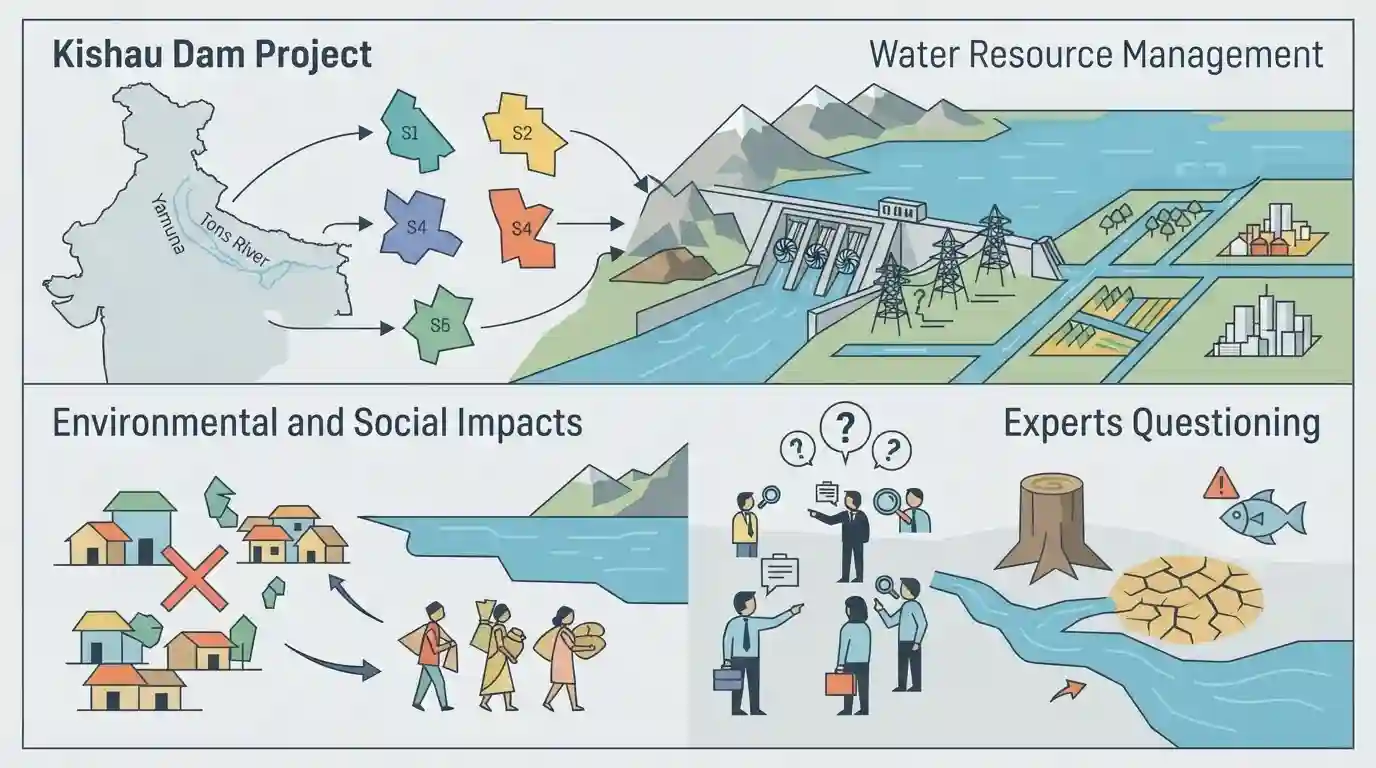
Six states have signed the Kishau water agreement concerning the Kishau Dam project on the Tons river, a tributary of the Yamuna. However, environmental and social experts have questioned the risks, high displacement costs, and overall utility associated with the large dam project.
Key Points
- Six states signed an agreement regarding the Kishau water project located on the Tons river, a major tributary of the Yamuna.
- Experts and environmentalists have raised concerns regarding the ecological risks, displacement, and overall utility of large dams in the region.
- Interstate river water agreements require careful balancing of developmental benefits and ecological sustainability.
Important Terms
Kishau Water Agreement

A historic multi-state pact signed by six Yamuna basin states to end a decades-long deadlock over the Kishau Multipurpose Project, focusing on water sharing, irrigation, and hydropower generation.
UPSC context
Important for HPAS/IAS GS Paper II & III under Inter-State Water Disputes and Cooperative Federalism.
Kishau Dam Project
A major multipurpose project featuring a 232.6-meter concrete gravity dam on the Tons River (a Yamuna tributary), designed to enhance water storage, irrigation, and power supply.
UPSC context
Relevant for HPAS/IAS Geography of India and Environmental Impact Assessment (EIA), testing knowledge of river basin management and dam risks.
Prelims Trap
Kishau Dam agreement involves only Himachal Pradesh and Uttarakhand as riparian states.
Aspirants often assume only Himachal Pradesh and Uttarakhand are party to the Kishau Dam agreement since it is on their border, forgetting that Delhi, Rajasthan, UP, and Haryana are also signatories within the Upper Yamuna Basin framework.
Static Concepts Connected
What are the constitutional provisions and statutory mechanisms for managing inter-state river water disputes in India?
- Constitutional Basis: Article 262 of the Constitution empowers Parliament to adjudicate disputes relating to waters of inter-state rivers and river valleys.
- Statutory Framework: Inter State Water Disputes Act (ISWD Act), 1956 provides for the constitution of ad hoc tribunals for resolving specific water sharing disputes.
- Recent Reforms: Inter-State River Water Disputes (Amendment) Act, 2019 provides for a single Dispute Resolution Committee and a permanent tribunal with multiple benches.
Cross-Topic Patterns
Interstate Water Agreements + Himalayan Ecology Risks
Large dam projects in fragile Himalayan ecologies test the intersection of Article 262 (Inter-State Water Disputes) and disaster management preparedness.
Upper-Lower Riparian Bargaining in Himalayan Rivers
Financing arrangements where upper riparian states surrender water for downstream power funding mirror debates in Chenab and Sutlej basin treaties.

Kishau Dam (Tons-Yamuna) + inter-state water sharing framework + seismic/ecological risks in HP geography likely in Mains GS-1/3.
Linked PYQs · 1
Linked PYQs · 1
- 2018HPAS_PRELIMSGS1
The impacts caused by construction of dams and reservoirs include all, except :
