ISRO Strategy Reset and Upcoming Satellite Launch Missions
Source:The Hindu ↗
Why It Matters
This article encapsulates major shifts in India's space strategy, showing a transition from state-led launches to a commercially competitive, privately driven space ecosystem. This aligns directly with Mains GS3 topics on scientific achievements, indigenization of technology, and disaster mitigation (via geospatial monitoring of glacial lakes), as well as GS2 international cooperation.
Summary
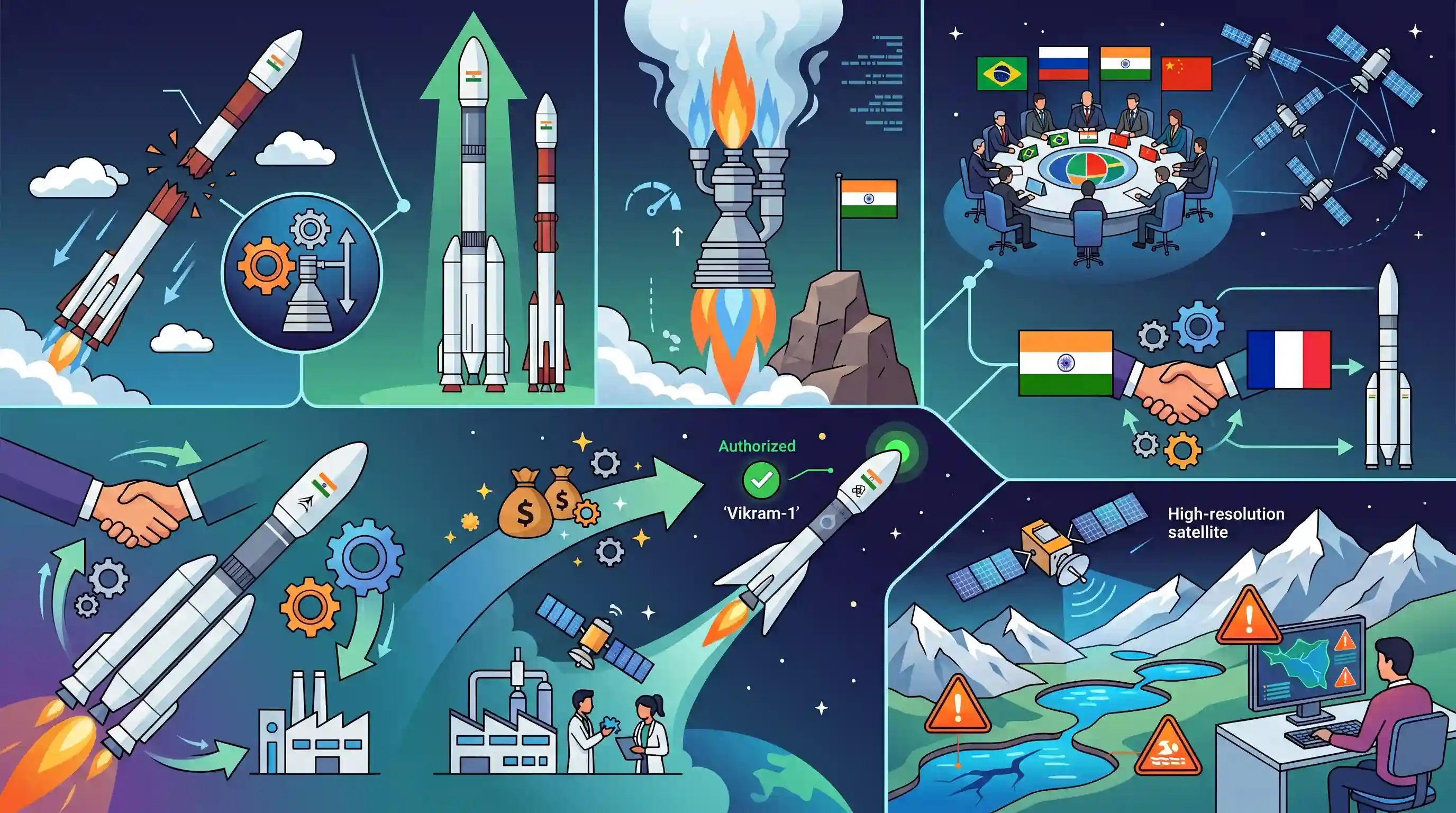
The first half of 2026 saw a relatively slow period for ISRO, marked by the failure of the PSLV-C62 mission. However, a national expert committee has successfully resolved the underlying third-stage anomaly. Moving forward, the space agency is ramping up for GSLV and PSLV missions. On the technology front, ISRO achieved a major milestone by successfully hot-testing its semi-cryogenic engine test article at 175-tonne thrust at Mahendragiri. Concurrently, space sector reforms are gaining significant momentum: IN-SPACe is transferring technology for the heavy-lift LVM3 rocket to private industry, funding startups via the Technology Adoption Fund (TAF), and authorizing Skyroot Aerospace's maiden orbital-class rocket test flight (Vikram-1). On the international stage, India hosted the BRICS Heads of Space Agencies 2026 meeting to strengthen satellite constellation cooperation, and renewed bilateral ties with France's CNES. Furthermore, the rising capability of the private geospatial sector was demonstrated through a high-resolution satellite-based risk assessment of climate-sensitive glacial lakes in Arunachal Pradesh.
Key Points
- ISRO has successfully identified and resolved the third-stage anomaly in its Polar Satellite Launch Vehicle (PSLV), which caused consecutive mission failures for PSLV-C61 (EOS-09) and PSLV-C62 (EOS-N1).
- The space agency completed a successful hot test of its indigenous Semi-Cryogenic Engine Power Head Test Article (PHTA) at 175 tonnes of thrust at IPRC Mahendragiri, paving the way for a 200-tonne thrust engine.
- Skyroot Aerospace is preparing for the maiden test flight (Mission Aagaman) of Vikram-1, India's first privately developed orbital-class rocket.
- IN-SPACe has issued an Expression of Interest (EoI) to transfer ISRO's Launch Vehicle Mark-III (LVM3) technology to the private sector for commercial manufacture and launch operations.
- Three Indian space startups (Astrobase Space Technologies, SatSure Analytics India, and TM2SPACE Technologies) have been selected for funding under IN-SPACe's Technology Adoption Fund (TAF) Scheme.
- The BRICS Heads of Space Agencies (HOSA) 2026 meeting in Bengaluru advanced discussions on the BRICS Space Council and amended the Remote Sensing Satellite Constellation Agreement to include new BRICS members.
- A geospatial study by private firm Suhora Technologies monitored five high-risk glacial lakes in Arunachal Pradesh's Mago Chu Basin using high-resolution satellites, showcasing the growing utility of private space-data analytics in disaster management.
Important Terms
IN-SPACe (Indian National Space Promotion and Authorisation Centre)

An autonomous, single-window nodal agency under the Department of Space, established to promote, regulate, and facilitate private sector participation in the Indian space ecosystem.
UPSC context
GS Paper III (Science & Technology); tests understanding of regulatory bodies and private sector inclusion in space exploration.
Technology Adoption Fund (TAF) Scheme
A ₹500 crore fund launched by IN-SPACe to provide milestone-linked financial assistance to Indian space startups, supporting the commercialisation of indigenous deep-tech and space innovations.
UPSC context
GS Paper III (Indian Economy / Space Technology); tests knowledge of state-backed financial mechanisms driving indigenous deep-tech startups.
LVM3 Transfer of Technology (ToT) Initiative
IN-SPACe's program to transfer technology of ISRO’s heaviest operational rocket, LVM3, to the Indian private sector, enabling end-to-end manufacturing, operation, and commercial launch services.
UPSC context
GS Paper III (Science & Technology); tests awareness of structural transitions in India's space program from state monopoly to commercialized models.
BRICS Remote Sensing Satellite Constellation Agreement
A multilateral pact among BRICS nations establishing a virtual satellite constellation and data-sharing mechanism to cooperate on global climate change, natural disasters, and environmental monitoring.
UPSC context
GS Paper II (Bilateral & Multilateral Agreements); tests knowledge of international space collaborations and multilateral technology frameworks.
Skyroot Aerospace
An Indian private aerospace company that pioneered private spaceflight in India with Vikram-S and is preparing to launch Vikram-1, India's first privately developed orbital-class rocket.
UPSC context
GS Paper III (Space Technology); tests awareness of commercial space milestones and private-sector capabilities in India.
Prelims Trap
ISRO's semi-cryogenic engine uses liquid hydrogen as fuel and liquid oxygen as oxidizer, making it safer than traditional cryogenic engines.
Semi-cryogenic engines replace liquid hydrogen (LH2) with refined kerosene (isrosene) as fuel; only the oxidizer (liquid oxygen) is kept at cryogenic temperatures.
Static Concepts Connected
What is the stage configuration and fuel type of India's Polar Satellite Launch Vehicle (PSLV)?
- Four-stage design: It is a four-stage launch vehicle utilizing alternating solid and liquid propulsion systems.
- Solid stages: First (PS1) and third (PS3) stages use hydroxyl-terminated polybutadiene (HTPB) solid propellant.
- Liquid stages: Second (PS2) uses the Vikas engine, and fourth (PS4) uses MMH and MON-3 liquid propellants.
How do cryogenic engines differ from semi-cryogenic engines in propulsion technology?
- Cryogenic fuel: Uses ultra-cold liquid hydrogen (LH2) as fuel and liquid oxygen (LOX) as oxidizer.
- Semi-cryogenic fuel: Replaces liquid hydrogen with refined kerosene (isrosene) as fuel, while retaining liquid oxygen (LOX).
- Storage advantage: Refined kerosene is stable at room temperature, simplifying storage, transport, and engine design compared to liquid hydrogen.
Cross-Topic Patterns
Space technology and GLOF mitigation
High-resolution private satellite data assists disaster management authorities in monitoring vulnerable glacial lakes, transforming space technology into an active climate-adaptation and risk-mitigation tool.
Technology transfer and space commercialization
IN-SPACe transferring heavy-lift LVM3 technology to private consortia marks a structural shift from ISRO as a launch operator to a research-and-development focused national agency.

Focus on space sector reforms (IN-SPACe, TAF) and cryogenic vs semi-cryogenic propellants in 2026 multi-statement technology questions.
Linked PYQs · 3
Linked PYQs · 3
- 2018PrelimsGS1
With reference to India's satellite launch vehicles, consider the following statements: 1. PSLVs launch the satellites useful for Earth resources monitoring whereas GSLVs are designed mainly to launch communication satellites. 2. Satellites launched by PSLV appear to remain permanently fixed in the same position in the sky, as viewed from a particular location on Earth. 3. GSLV Mk III is a four-staged launch vehicle with the first and third stages using solid rocket motors; and the second and fourth stages using liquid rocket engines. Which of the statements given above is/are correct?
- 2016MainsGS3
Discuss India's achievements in the field of Space Science and Technology. How the application of this technology has helped India in its socio-economic development?
- 2017MainsGS3
India has achieved remarkable successes in unmanned space missions including the Chandrayaan and Mars Orbitter Mission, but has not ventured into manned space missions. What are the main obstacles to launching a manned space mission, both in terms of technology and logistics? Examine critically.
