Seventy Five Years Of Refugee Convention
Source:The Hindu ↗
આ શા માટે મહત્વનું છે
Understanding the 1951 Refugee Convention and the principle of non-refoulement is crucial for UPSC aspirants. India, though not a signatory to the convention, hosts significant refugee populations (e.g., Tibetans, Sri Lankan Tamils, Rohingya) and frequently balances human rights obligations with national security concerns regarding illegal transborder migration. This interplay is a recurrent theme in both GS2 (International Relations) and GS3 (Internal Security).
સારાંશ
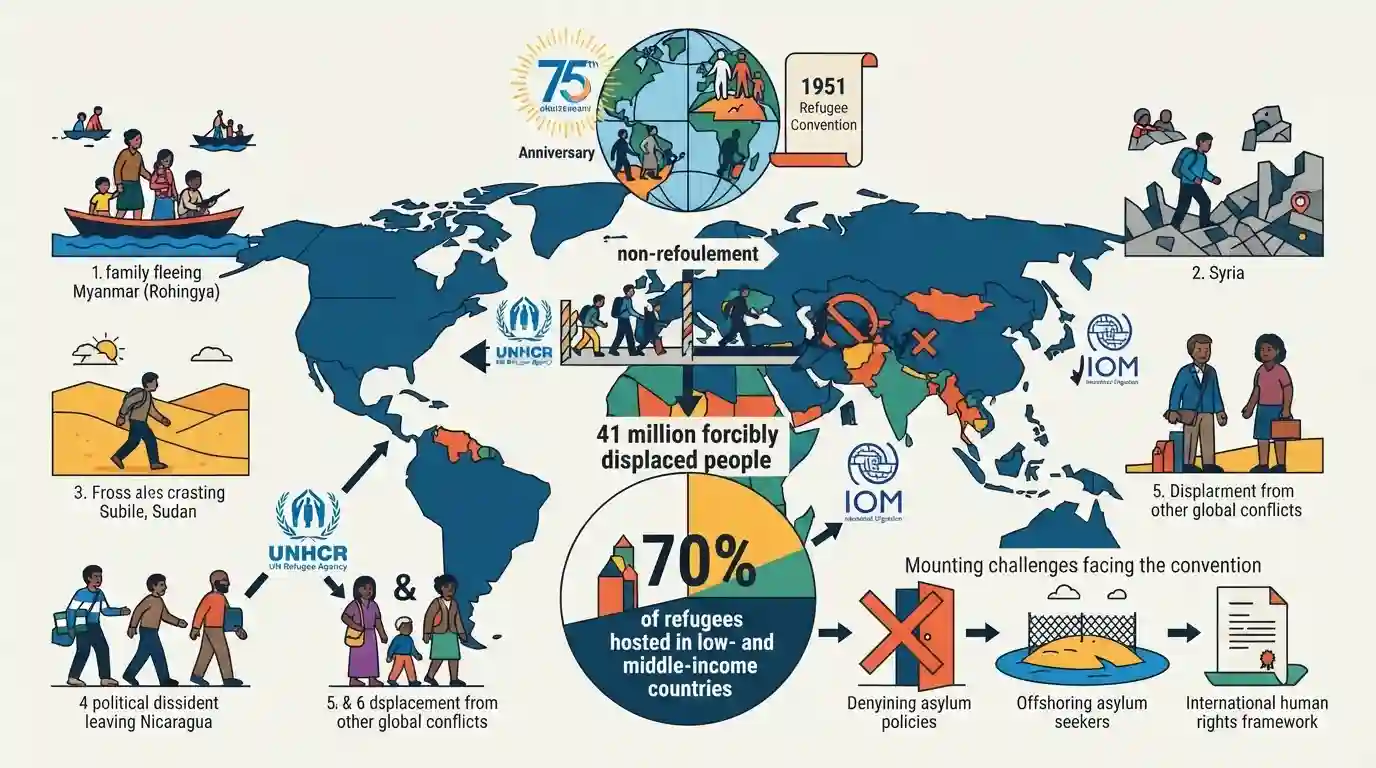
The UN-backed 1951 Refugee Convention, a landmark treaty established post-World War II to protect those fleeing war and persecution, marked its 75th anniversary. The convention's fundamental principle is 'non-refoulement,' ensuring refugees are not forcibly returned to dangerous territories. Today, amid over 130 armed conflicts globally, more than 41 million people are forcibly displaced, with low- and middle-income countries bearing the brunt of the crisis by hosting 70% of refugees. The article highlights the personal stories of six refugees from diverse conflicts—including the Rohingya crisis in Myanmar, the Syrian civil war, and displacement in Sudan and Nicaragua—illustrating both the life-saving impact of the treaty and the critical work of organizations like UNHCR and IOM. However, the convention faces mounting challenges as several nations adopt restrictive asylum policies, such as denying entry or offshoring asylum seekers, straining international human rights frameworks.
મુખ્ય મુદ્દા
- The UN-backed 1951 Refugee Convention, which protects individuals fleeing war and persecution, marked its 75th anniversary.
- The cornerstone of the convention is the principle of 'non-refoulement', which prohibits returning refugees to places where they face serious harm or threats to their lives.
- Currently, over 41 million refugees are forcibly displaced worldwide, with nearly 70% being hosted by low- and middle-income countries.
- Global commitment to the treaty is under strain, as some nations are increasingly denying entry to asylum seekers or implementing offshore processing policies.
- The personal accounts of refugees from Myanmar (Rohingya), Nicaragua, Palestine, South Sudan, and Syria underscore the vital humanitarian and resettlement roles played by agencies like UNHCR and IOM.
મહત્વપૂર્ણ શબ્દો
1951 Refugee Convention

A landmark multilateral United Nations treaty that defines "refugee," outlines their legal rights, and establishes the core principle of non-refoulement, prohibiting forced repatriation to dangerous territories.
UPSC context
GS Paper II: International Relations. Tests understanding of global refugee frameworks, non-refoulement, and India's non-signatory position.
United Nations High Commissioner for Refugees (UNHCR)
A specialized United Nations agency established in 1950 mandated to safeguard the rights and well-being of refugees, internally displaced persons, and stateless individuals globally.
UPSC context
GS Paper II: Important International Institutions. Tests comprehension of multilateral humanitarian bodies, global refugee governance, and Indian context.
International Organization for Migration (IOM)
A United Nations-related intergovernmental body founded in 1951 that promotes humane, safe, and orderly migration by advising governments and providing humanitarian support to migrants.
UPSC context
GS Paper II: International Relations. Tests knowledge of global migration policies, the distinction between migrants and refugees, and associated conventions.
International Committee of the Red Cross (ICRC)
An independent, neutral humanitarian organization founded in 1863 to protect and assist victims of armed conflicts and promote adherence to international humanitarian law.
UPSC context
GS Paper II: Important International Organizations. Tests knowledge of international humanitarian law, Geneva Conventions, and protection of war victims.
United Nations (UN)
An international organization founded in 1945 to maintain global peace and security, foster friendly relations among nations, and promote human rights and international cooperation.
UPSC context
GS Paper II: Important International Institutions. Tests understanding of global governance structure, UN Charter principles, and multilateral diplomacy.
પ્રિલિમ્સ ટ્રેપ
The principle of non-refoulement only binds states that are signatories to the 1951 Refugee Convention or its 1967 Protocol.
Non-refoulement is recognized as Customary International Law (CIL). It binds all nations, including non-signatories like India, and is judicially linked to Article 21 of the Indian Constitution.
સંલગ્ન સ્થિર ખ્યાલો
How does India legally govern refugees without a dedicated national refugee law?
- Foreigners Act 1946: Classifies refugees as generic 'foreigners', granting the executive absolute power to deport, detain, or restrict movement.
- Constitutional Safeguards: Supreme Court rulings extend Article 14 and Article 21 protections to all persons, protecting refugees from arbitrary deportation.
- Ad-hoc Treatment: Employs strategic ambiguity, providing direct relief to some groups (Tibetans) while requiring others (Rohingya) to register with UNHCR.
What distinguishes the 1951 Refugee Convention from its 1967 Protocol?
- Scope Removal: The 1951 Convention had geographical (Europe-only) and temporal (post-WWII) limits; the 1967 Protocol removed both limitations entirely.
- Non-Refoulement Foundation: Established non-refoulement as a fundamental treaty right, which has since evolved into Customary International Law.
આંતર-વિષય પેટર્ન
Refugee rights vs National Security
Examines how India balances humanitarian non-refoulement obligations with domestic security concerns under the Foreigners Act, especially concerning Rohingya and border state demographics.
Externalization of borders and sovereignty
Wealthy nations outsourcing asylum processing to third countries challenges the post-WWII human rights regime and shifts hosting burdens disproportionately to the Global South.

Expected 2026 Prelims question testing the 1951 Convention/1967 Protocol scope vs. India's treatment of refugees under Article 21.
સંલગ્ન PYQ · 2
સંલગ્ન PYQ · 2
- 2014MainsGS3
How does illegal transborder migration pose a threat to India's security? Discuss the strategies to curb this, bringing out the factors which give impetus to such migration.
- 2019MainsGS3
Cross-border movement of insurgents is only one of the several security challenges facing the policing of the border in North-East India. Examine the various challenges currently emanating across the India-Myanmar border. Also, discuss the steps to counter the challenges.
