NEET-UG OMR Sheet Discrepancies and NTA Accountability
Source:The Hindu ↗
ఇది ఎందుకు ముఖ్యం
Recurring irregularities in national-level competitive examinations like NEET-UG directly relate to GS Paper 2 topics on governance, transparency, and accountability of statutory bodies (NTA). It also provides context for evaluating recent legislative measures like the Public Examination (Prevention of Unfair Means) Act, 2024.
సారాంశం
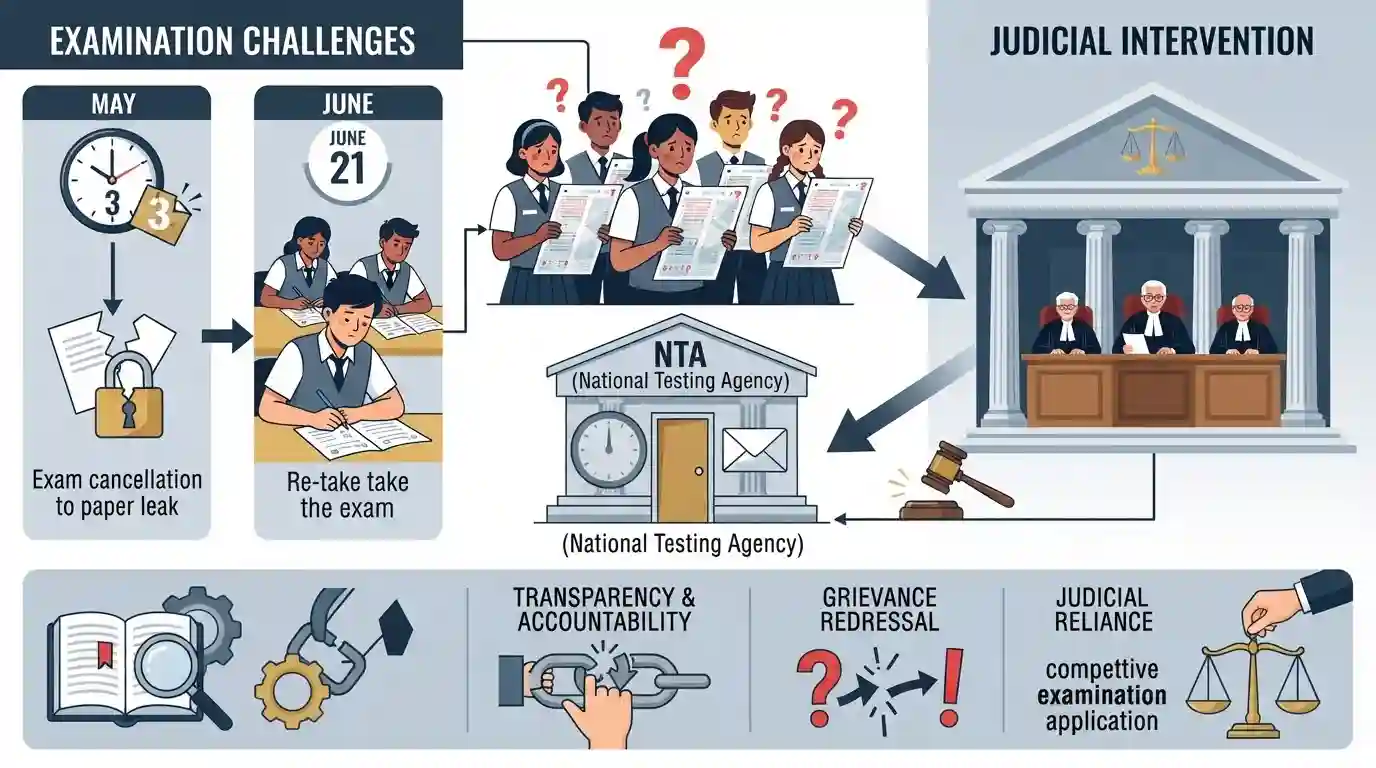
Six NEET-UG candidates have petitioned the Supreme Court over alleged discrepancies in their OMR sheets, claiming the versions uploaded by the National Testing Agency (NTA) do not match their original answers. The candidates approached the apex court after failing to receive a response from the NTA. This incident follows the earlier cancellation of the May 3 exam due to a paper leak, which necessitated a re-test on June 21. The recurring issues with the NEET-UG examination highlight significant governance and transparency challenges within the NTA, underscoring the lack of an effective grievance redressal mechanism and the growing reliance on judicial intervention for competitive examination disputes.
ముఖ్య అంశాలు
- Six NEET-UG candidates have approached the Supreme Court alleging that the OMR sheets uploaded by the National Testing Agency (NTA) differ from their original responses.
- The candidates filed the plea after the NTA reportedly failed to respond to their grievances regarding the discrepancies.
- The exam, originally held on May 3, was previously cancelled due to a paper leak and had to be reconducted on June 21 by the NTA.
- The issue highlights systemic governance challenges in conducting large-scale public examinations, raising concerns over transparency and accountability.
- The situation underscores the necessity for robust internal grievance redressal mechanisms within public examination bodies to prevent frequent judicial interventions.
ముఖ్యమైన పదాలు
National Testing Agency (NTA)

An autonomous, self-sustained organization under the Ministry of Education, registered under the Societies Registration Act, 1860, established to conduct standardized and transparent national-level entrance examinations for higher educational institutions.
UPSC context
GS Paper II: Statutory, Regulatory, and Quasi-judicial Bodies. Tests knowledge of public institutional governance, reform, and accountability.
Supreme Court of India
The apex judicial authority and final court of appeal under Articles 124–147 of the Constitution, acting as the ultimate interpreter of the Constitution and guardian of fundamental rights.
UPSC context
GS Paper II: Structure, Organization, and Functioning of the Judiciary. Tests understanding of judicial review and separation of powers.
NEET-UG (National Eligibility cum Entrance Test - Undergraduate)
India’s unified, nationwide entrance examination conducted by the NTA for admissions to undergraduate medical programs (MBBS, BDS, and AYUSH) in all central, state, and private colleges.
UPSC context
GS Paper II: Social Sector/Services relating to Education. Tests dynamics of centralized public entrance systems and federal-state dynamics.
ప్రిలిమ్స్ ఉచ్చు
The National Testing Agency (NTA) is a statutory body established under an Act of Parliament to conduct nationwide entrance exams.
NTA is an autonomous society registered under the Societies Registration Act, 1860, operating under the Ministry of Education. It is not a statutory body.
అనుసంధానమైన స్థిర భావనలు
What is the legal status and governance of the National Testing Agency (NTA)?
- Legal Status: Registered as an autonomous society under the Societies Registration Act, 1860, operating under the Department of Higher Education, Ministry of Education.
- Financial Model: Operates on a self-sustained basis, funded primarily through examination fees rather than ongoing annual budgetary allocations.
- Governance Structure: Headed by a Director General appointed by the Central Government, supported by a Governing Body of domain experts.
What are the core provisions of the Public Examinations (Prevention of Unfair Means) Act, 2024?
- Target Audience: Explicitly shields genuine candidates from prosecution under this specific law, focusing instead on organized syndicates, service providers, and complicit authorities.
- Organized Crime: Defines collusion or manipulation by service providers or exam authorities to disrupt exam integrity as a severe offense.
- Legal Nature: All offences under the Act are cognizable, non-bailable, and non-compoundable, carrying prison terms up to 10 years and steep fines.
అంతర-అంశ నమూనాలు
Judiciary as regulatory backstop
The lack of robust internal grievance redressal in executive bodies forces the Supreme Court to act as an administrative regulator, testing the separation of powers.
Administrative reform and trust
The Radhakrishnan Committee's recommendations on NTA reform highlight broader GS2 themes of governance transparency, institutional capacity building, and digital public infrastructure security.

The operational status of NTA and statutory teeth of the 2024 Public Examinations Act are ripe for a multi-statement Prelims 2026 question.
అనుసంధాన PYQలు · 3
అనుసంధాన PYQలు · 3
- 2024MainsGS2
What are the aims and objects of recently passed and enforced, The Public Examination (Prevention of Unfair Means) Act, 2024? Whether University/State Education Board examinations, too, are covered under the Act ?
- 2024MainsGS2
Explain the reasons for the growth of public interest litigation in India. As a result of it, has the Indian Supreme Court emerged as the world's most powerful judiciary ?
- 2024MainsGS4
“The 'Code of Conduct' and 'Code of Ethics' are the sources of guidance in public administration. There is code of conduct already in operation, whereas code of ethics is not yet put in place. Suggest a suitable model for code of ethics to maintain integrity, probity and transparency in governance.”
