Anti Defection Law and MP Defection in Maharashtra
Source:The Hindu ↗
Why It Matters
The defection of the MPs brings into focus the provisions of the Tenth Schedule (anti-defection law), specifically Para 4 relating to splits and mergers, highlighting the ongoing political and legal complexities surrounding party splits in India.
Summary
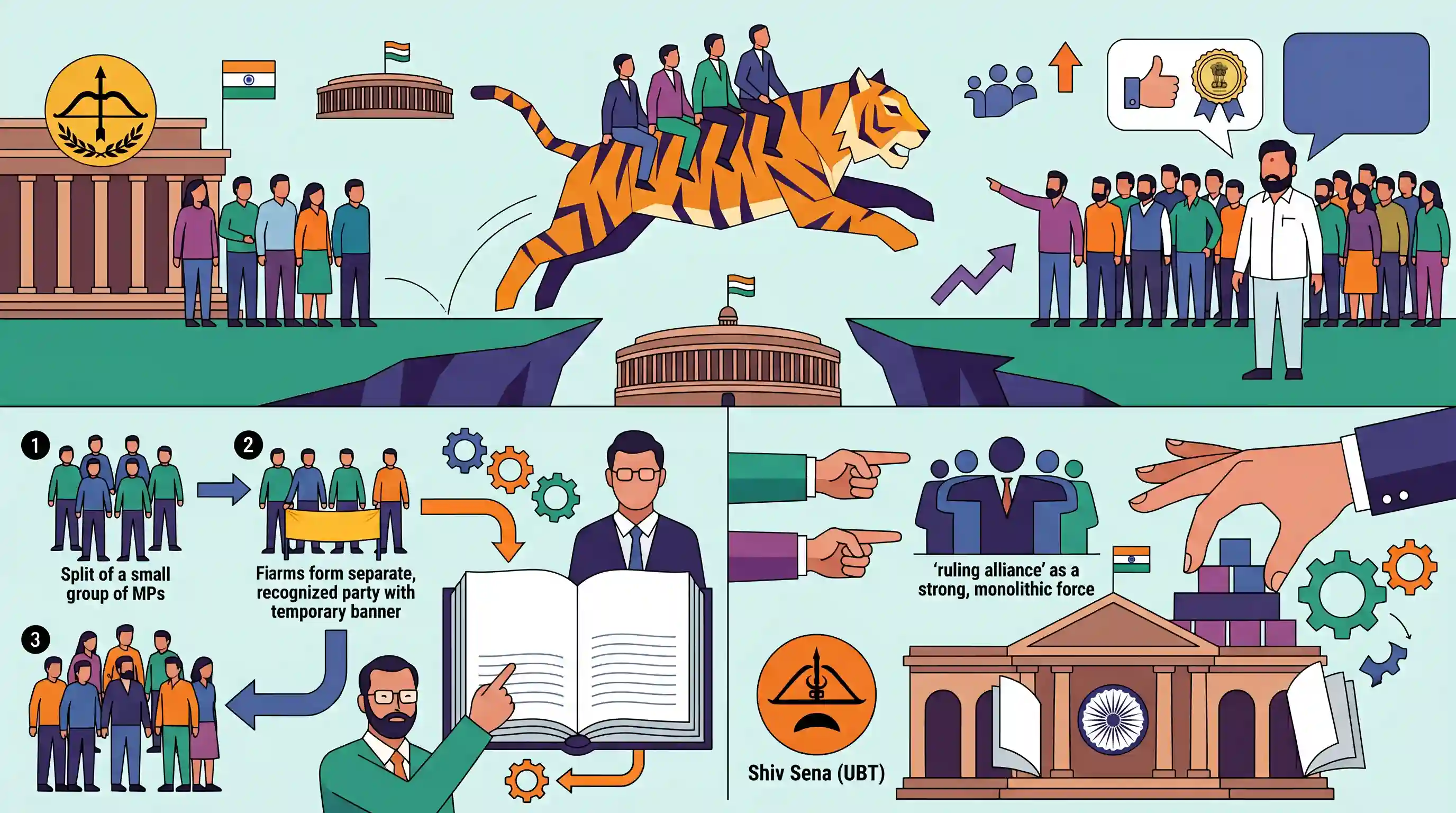
Six Members of Parliament belonging to the Shiv Sena (UBT) faction have defected to the Shiv Sena under the leadership of Maharashtra Deputy Chief Minister Eknath Shinde. Termed 'Operation Tiger,' the defection increases the Shiv Sena's Lok Sabha tally from seven to 13. Shinde asserted that the move was conducted within the legal and constitutional framework. A constitutional expert noted that under Para 4 of the Tenth Schedule, the defection process involves the MPs claiming a split, forming a separate recognised party, and then merging with another party. Meanwhile, the Shiv Sena (UBT) condemned the move, accusing the ruling alliance of attempting to secure a majority to alter the Constitution.
Key Points
- Six Lok Sabha MPs from the Shiv Sena (UBT) formally joined the Shiv Sena led by Maharashtra Deputy Chief Minister Eknath Shinde.
- The induction increases the Shinde-led Shiv Sena's strength in the Lok Sabha from seven to 13.
- Shiv Sena leaders claimed the defection was executed legally by first forming a separate group of the six MPs, and subsequently merging it with the Shiv Sena under Para 4 of the Tenth Schedule of the Constitution.
- Shiv Sena (UBT) leader Aaditya Thackeray criticized the move, alleging it was part of a broader strategy by the BJP and its allies to amass a majority and alter the Constitution.
Important Terms
Tenth Schedule

A constitutional framework added via the 52nd Amendment (1985) to disqualify legislators for switching parties, aimed at ensuring political stability and curbing opportunistic 'Aaya Ram Gaya Ram' floor-crossing.
UPSC context
GS Paper 2: Indian Constitution/Polity. Essential for questions on parliamentary discipline, political ethics, and the role of the Speaker in disqualification cases.
Para 4 of the Tenth Schedule
A specific provision within the Tenth Schedule that exempts legislators from disqualification if two-thirds of the legislature party agree to merge with another political party.
UPSC context
GS Paper 2. High-yield for Prelims/Mains regarding the 'merger loophole' and challenges to the spirit of the Anti-Defection Law.
91st Constitutional Amendment Act, 2003
The legislation that abolished the 'one-third split' exception in the Tenth Schedule, making a two-thirds 'merger' the only legal way to switch parties without disqualification.
UPSC context
GS Paper 2. Frequent Prelims fact; tests knowledge of evolutionary changes in anti-defection laws and Council of Ministers size caps.
Speaker of the Lok Sabha
The adjudicating authority under the Tenth Schedule who decides on disqualification petitions. This role acts as a quasi-judicial tribunal, subject to judicial review.
UPSC context
GS Paper 2. Relevant for discussions on the impartiality of presiding officers and the need for independent tribunals in defection cases.
Kihoto Hollohan Case (1992)
A landmark 1992 Supreme Court judgment which upheld the validity of the Tenth Schedule but established that the Speaker's decision is subject to judicial review.
UPSC context
GS Paper 2. Critical case law for Mains answers regarding the judiciary's role in maintaining legislative accountability and curbing partisan adjudication.
Shiv Sena (UBT)
The faction of the Shiv Sena led by Uddhav Thackeray, formed after the 2022 split and subsequent 2023 Election Commission decision awarding the original name/symbol to the Shinde faction.
UPSC context
GS Paper 2. Case study for inter-party splits, the role of the Election Commission (Symbols Order, 1968), and legal tests for original political parties.
Prelims Trap
A split in a party protects members from disqualification if 1/3rd of the legislature party agrees.
The 91st Amendment Act (2003) deleted the 'split' provision (Para 3). Now, only a 'merger' involving at least 2/3rds of the legislature party (Para 4) provides immunity from disqualification.
Static Concepts Connected
What are the exceptions to disqualification under the Tenth Schedule?
- Two-thirds Merger: Immunity is granted if the original political party merges with another, provided at least two-thirds of the legislature party agrees to the merger.
- Presiding Officer Exemption: A member elected as Speaker/Chairman can voluntarily give up their party membership without disqualification, ensuring neutrality of the presiding officer's chair.
What was the SC ruling in Subhash Desai (2023) regarding party factions?
- Original Party Prevails: The power to appoint a Whip and Leader of the House belongs to the 'original political party', not merely the elected 'legislature party'.
- Speaker's Adjudication Role: The Speaker must determine the real party based on its constitution and organizational structure, rather than just relying on the majority within the legislature.
Cross-Topic Patterns
Tenth Schedule + Judicial Review limits
Links the Speaker's tribunal power with the Kihoto Hollohan judgment, emphasizing that courts cannot intervene prior to the Speaker making a final decision on disqualification.
Defection vs ECI Symbols Order
Connects the Tenth Schedule's definition of "political party" with the Election Commission's power to recognize factions and allot symbols under the Election Symbols (Reservation and Allotment) Order, 1968.

Expect a tricky prelims statement contrasting "legislature party" vs "original political party" under Para 4 of the Tenth Schedule in 2026.
Linked PYQs · 3
Linked PYQs · 3
- 2022MainsGS2
Discuss the procedures to decide the disputes arising out of the election of a Member of the Parliament or State Legislature under The Representation of the People Act, 1951. What are the grounds on which the election of any returned candidate may be declared void ? What remedy is available to the aggrieved party against the decision ? Refer to the case laws.
- 2023MainsGS2
Discuss the role of Presiding Officers of state legislatures in maintaining order and impartiality in conducting legislative work and in facilitating best democratic practices.
- 2017MainsGS2
The Indian Constitution has provisions for holding joint session of the two Houses of the Parliament. Enumerate the occasions when this would normally happen and also the occasions when it cannot, with reason thereof.
