सुरक्षा बलों ने माओवादियों को मार गिराया, वामपंथी उग्रवाद खत्म करने का लक्ष्य
स्रोत:द हिंदू ↗
क्यों मायने रखता है
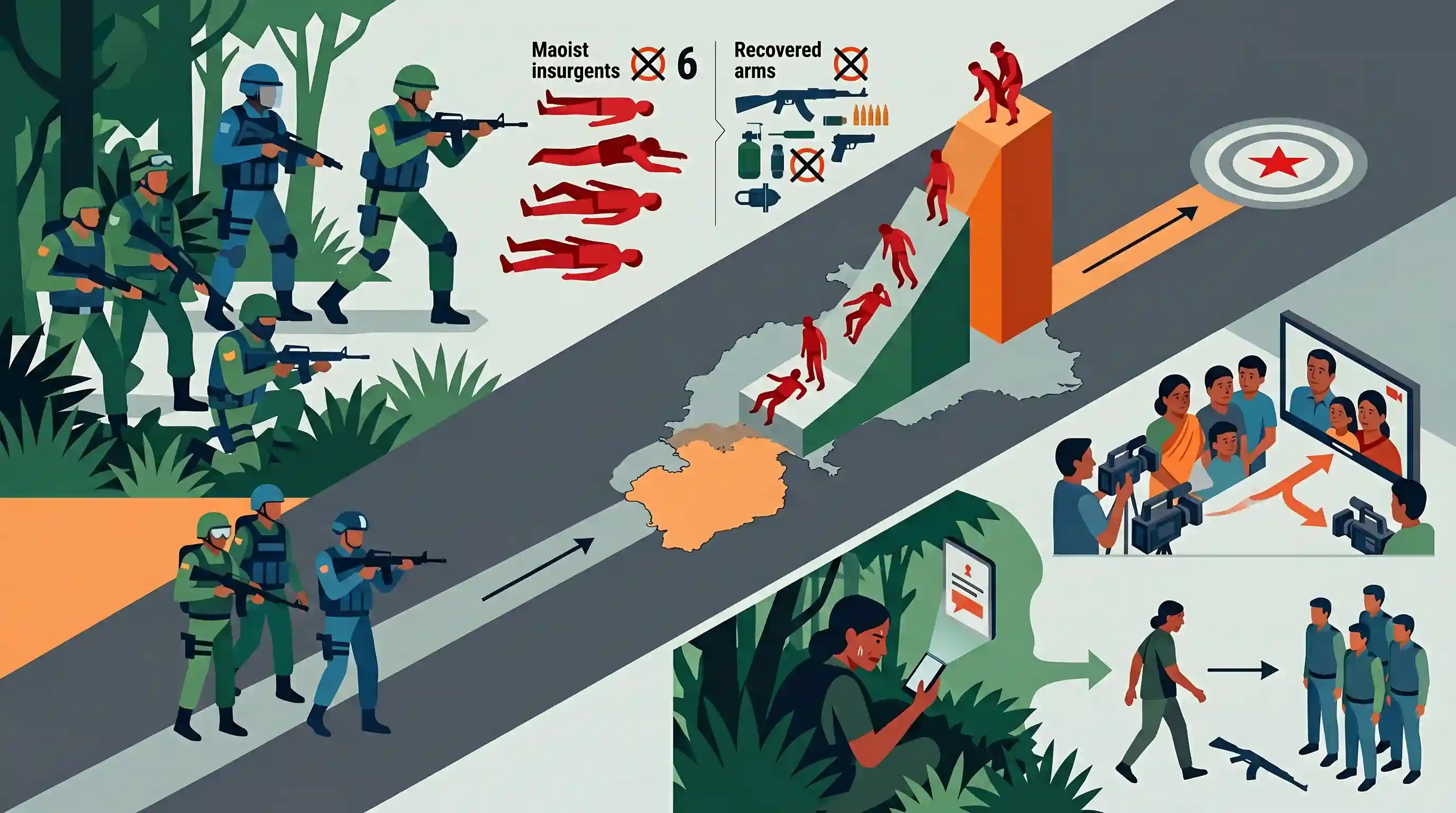
Highlights the current state of India's ongoing battle against Left Wing Extremism (LWE), demonstrating a two-pronged approach of intense kinetic operations by specialized state forces and psychological efforts aimed at encouraging surrenders to meet the 2026 elimination deadline.
सारांश
In a major joint operation by the District Reserve Guard and Special Task Force in Chhattisgarh’s Bijapur district, six Maoists were killed and a significant cache of arms was recovered. Chief Minister Vishnu Deo Sai hailed the operation as a critical step toward the government's target of eliminating Left Wing Extremism by March 31, 2026. Intensified counter-insurgency efforts have led to 259 Maoist fatalities in the state so far in 2025, largely concentrated in the Bastar region. The government is also deploying soft-power tactics, utilizing emotional video appeals from family members to encourage top-ranking insurgents to surrender.
मुख्य बिंदु
- Six Maoists were killed by a joint team of the District Reserve Guard and the Special Task Force in Chhattisgarh's Bijapur district, yielding a cache of automatic weapons and explosives.
- The operation aligns with the state and central government's stated goal of completely eliminating Left Wing Extremism (LWE) from Chhattisgarh by March 31, 2026.
- Kinetic operations are being supplemented by psychological warfare, with the state releasing video appeals from the mothers of top Maoist commanders urging them to surrender.
- So far in 2025, 259 Maoists have been killed in Chhattisgarh, with the Bastar region accounting for the vast majority of these encounters.
महत्वपूर्ण शब्द
District Reserve Guard (DRG)

A specialized Chhattisgarh Police unit established in 2008, primarily recruiting local tribals and surrendered Maoists (known as "Sons of the Soil") to leverage their local intelligence and terrain knowledge.
UPSC context
GS Paper III: Internal Security. Tests knowledge of local-state-led counter-insurgency models and their impact on intelligence-driven operations.
Special Task Force (STF)
A specialized unit within State Police forces (like Chhattisgarh) trained for high-risk operations, counter-terrorism, and anti-Maoist missions, often conducting joint operations with central forces.
UPSC context
GS Paper III: Security Forces. Relevant for understanding state-level specialized agencies in the internal security architecture.
Left Wing Extremism (LWE)
An insurgency involving groups (Maoists/Naxalites) who seek to overthrow the state through armed revolution, primarily active in the "Red Corridor" regions of central and eastern India.
UPSC context
GS Paper III: Linkages between development and spread of extremism. A core theme in internal security syllabus.
SAMADHAN सिद्धांत
The Ministry of Home Affairs' 2017 multi-pronged strategy for tackling LWE, involving Smart leadership, Aggressive strategy, Motivation, Actionable intelligence, Dashboard-based KPIs, Harnessing technology, Action plans, and No access to financing.
UPSC context
GS Paper III: Security Strategies. Tests understanding of the government’s holistic policy approach toward ending Naxalism.
बस्तर क्षेत्र
A region in southern Chhattisgarh comprising districts like Bijapur and Sukma, serving as the historical and tactical stronghold for Maoist insurgents due to its dense forests and difficult terrain.
UPSC context
GS Paper I & III: Geography and Internal Security. Focuses on the geographical factors that facilitate insurgency and the socioeconomic challenges of tribal areas.
Surrender and Rehabilitation Policy
A Chhattisgarh state government policy offering financial aid, housing, and vocational training to Maoists who renounce violence and surrender, aiming for social reintegration.
UPSC context
GS Paper III: Security. Evaluates the "soft-power" and developmental measures used by the state to degrade insurgent ranks.
प्रारंभिक ट्रैप
"The District Reserve Guard (DRG) is a specialized battalion under the Central Armed Police Forces (CAPF)."
The DRG is a state-raised police unit of Chhattisgarh, uniquely composed of local tribal youth and surrendered Maoists, not a CAPF.
संबंधित अवधारणाएँ
What is the GoI's multi-pronged strategy to eliminate Left Wing Extremism?
- Security Measures: Implementation of the SAMADHAN doctrine, deployment of CAPFs, and funding state police modernization via the Security Related Expenditure (SRE) scheme.
- Development Push: Infrastructure push via the Road Requirement Plan (RRP-I), Mobile Tower Projects, and socio-economic saturation under the Aspirational Districts Programme.
- Rehabilitation: Standardized Surrender-cum-Rehabilitation policies offering vocational training, financial stipends, and legal leniency for surrendering cadres.
What makes the District Reserve Guard (DRG) highly effective in anti-Naxal operations?
- Local Composition: It comprises local tribal youth and surrendered Naxals who possess an intimate, intuitive knowledge of the difficult Bastar terrain.
- Intelligence Advantage: Their local roots and linguistic familiarity provide a vastly superior human intelligence network compared to outside central forces.
अंतर-विषय पैटर्न
Aspirational Districts & LWE
The spatial contraction of LWE correlates strongly with the Aspirational Districts Programme, which focuses on saturating infrastructure, health, and education in historically heavily-impacted areas.
Forest Rights Act vs Extremism
Ensuring tribal land rights through effective implementation of FRA 2006 removes a key ideological and socio-economic grievance often exploited by Maoist recruiters in the Bastar region.

The March 2026 LWE elimination deadline makes the SAMADHAN doctrine and "Red Zones to Growth Corridors" a highly probable GS-3 Mains topic.
संबद्ध PYQ · 4
संबद्ध PYQ · 4
- 2022MainsGS3
Naxalism is a social, economic and developmental issue manifesting as a violent internal security threat. In this context, discuss the emerging issues and suggest a multilayered strategy to tackle the menace of Naxalism.
- 2020MainsGS3
What are the determinants of left-wing extremism in Eastern part of India? What strategy should Government of India, civil administration and security forces adopt to counter the threat in the affected areas?
- 2018MainsGS3
Left Wing Extremism (LWE) is showing a downward trend, but still affects many parts of the country. Briefly explain the Government of India's approach to counter the challenges posed by LWE.
- 2015MainsGS3
The persisting drives of the Government for development of large industries in backward areas have resulted in isolating the tribal population and the farmers who face multiple displacements. With Malkangiri and Naxalbari foci, discuss the corrective strategies needed to win the Left Wing Extremism (LWE) doctrine affected citizens back into the mainstream of social and economic growth.
