Chhattisgarh Steel Plant Roof Collapse and Industrial Safety Lapses
Source:The Hindu ↗
Why It Matters
Industrial accidents and structural failures frequently cause loss of life among the working class. For UPSC aspirants, this event illustrates the practical importance of enforcing the Occupational Safety, Health and Working Conditions Code, rigorous structural auditing of industrial infrastructure, and disaster mitigation strategies at the facility level.
Summary
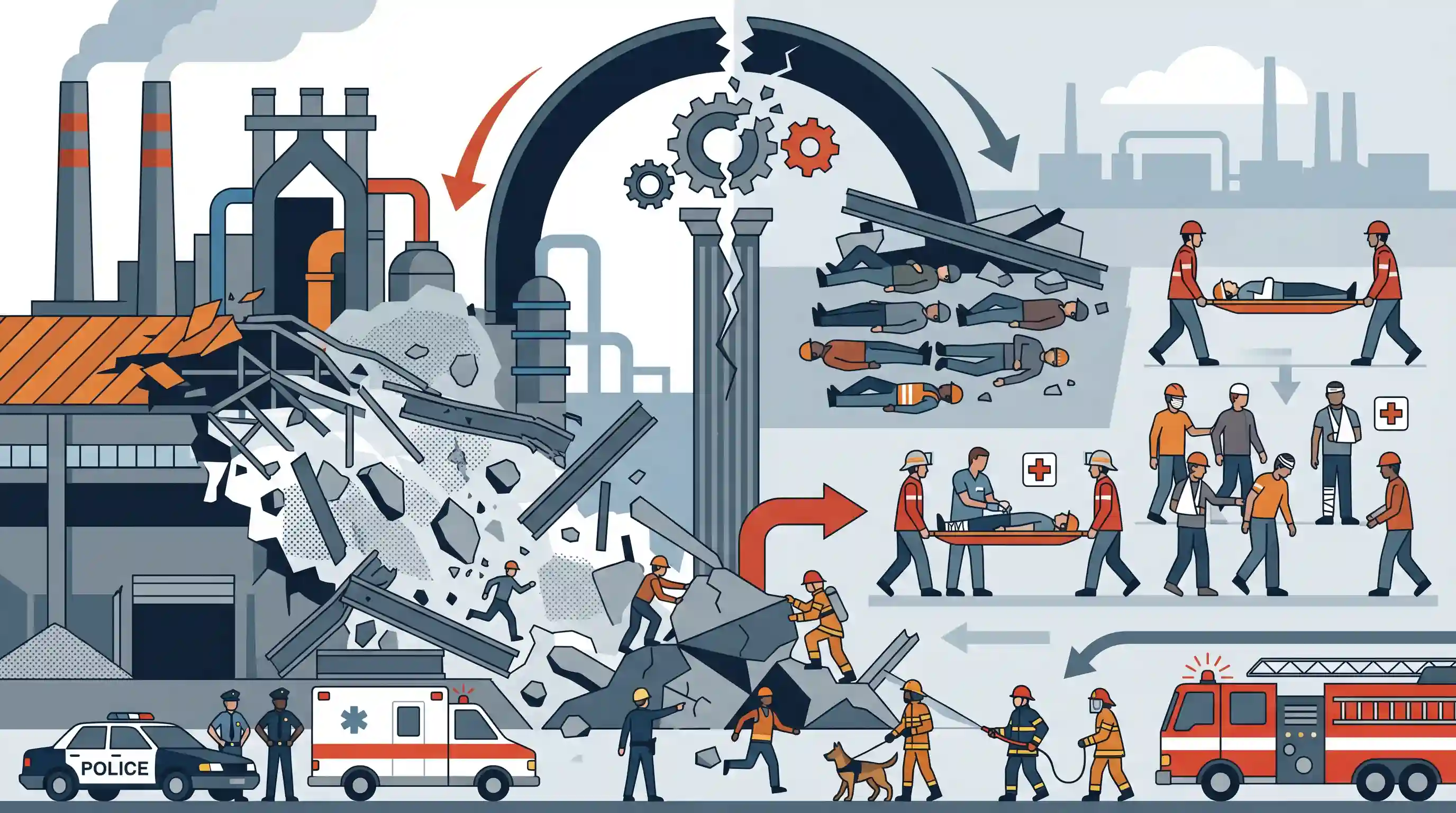
Six workers were killed and six others were injured following the collapse of a newly constructed roof at a private steel plant (Godavari Ispat Ltd) in the Siltara industrial area of Raipur, Chhattisgarh. Police and rescue teams were quickly deployed to manage the aftermath. The fatal incident highlights critical concerns regarding occupational safety, adherence to structural and construction standards, and the vulnerability of industrial workers to workplace hazards.
Key Points
- A newly constructed roof collapsed at the Godavari Ispat Ltd steel plant in Raipur, Chhattisgarh, resulting in six workers' deaths and leaving six others injured.
- The incident underscores potential lapses in structural engineering, construction quality, and adherence to safety norms in industrial facilities.
- Highlights the persistent vulnerabilities of factory and construction workers to occupational hazards and industrial accidents.
Important Terms
Occupational Safety, Health and Working Conditions Code, 2020

A 2020 legislation consolidating 13 central labor laws to regulate workplace safety, health, and working conditions. It mandates appointment letters, annual health check-ups, and social security for workers.
UPSC context
GS Paper 2 (Governance) & GS Paper 3 (Employment/Industry). Vital for topics on labor reforms and worker welfare.
Factories Act, 1948
A landmark post-independence act regulating working conditions, safety, health, and welfare in factories. It defines 'factory' based on worker strength and use of power, ensuring humane work environments.
UPSC context
GS Paper 2 (Labor Laws). Foundational for understanding the evolution of industrial safety and regulatory compliance in India.
Siltara Industrial Area
A major industrial hub in Raipur, Chhattisgarh, hosting numerous manufacturing units, particularly steel fabrication, sponge iron plants, and engineering industries. It is a significant economic contributor to the region.
UPSC context
GS Paper 1 (Geography) & GS Paper 3 (Economic Development). Relevant for industrial geography and regional development studies.
Industrial Safety
The management of all operations and events within an industry to protect employees and assets by minimizing risks, hazards, and accidents through standard operating procedures (SOPs).
UPSC context
GS Paper 3 (Disaster Management). Tests knowledge of risk mitigation and safety protocols in hazardous environments.
National Disaster Management Authority (NDMA)
India's apex body for disaster management, established under the DM Act 2005. It issues mandatory guidelines for industrial safety and chemical accident prevention to promote a culture of preparedness.
UPSC context
GS Paper 3 (Disaster Management). Essential for understanding institutional frameworks for managing large-scale industrial tragedies.
Godawari Power and Ispat Limited (GPIL)
A leading integrated steel manufacturer based in Raipur, Chhattisgarh, primarily engaged in iron ore mining, sponge iron production, and power generation. The site of the 2025 roof collapse tragedy.
UPSC context
Current Affairs/Case Study. Useful for examples of industrial accidents and accountability in the private sector.
Prelims Trap
"The OSHWC Code 2020 applies universally to all industrial and unorganized sector establishments."
False. The OSHWC Code specifically applies to establishments with 10 or more workers (or 20+ in certain cases), excluding many micro and informal units.
Static Concepts Connected
How do DPSP Articles 42 and 43 address industrial workers' rights?
- Article 42: Directs the State to make provisions for securing just and humane conditions of work and for maternity relief.
- Article 43: Directs the State to secure a living wage, a decent standard of life, and full enjoyment of leisure and social/cultural opportunities for workers.
What are the primary features of the OSHWC Code, 2020?
- Consolidation: It subsumed 13 legacy central labor laws, including the Factories Act, 1948, to streamline safety compliances across sectors.
- Applicability Threshold: Generally applies to establishments employing 10 or more workers, leaving many micro-enterprises outside its stringent safety mandate.
- Safety Boards: Mandates the constitution of a National Occupational Safety and Health Advisory Board to recommend standards.
Cross-Topic Patterns
Labour Codes vs Regulatory Capacity
The push for ease of doing business via employer self-certification under new Labour Codes risks exacerbating safety hazards, given India's severe shortage of factory inspectors.
NDMA Industrial Disaster Guidelines
Structural collapses link to NDMA frameworks, which require vulnerable industries to institutionalize on-site emergency disaster management plans and conduct strict risk assessments.

Expect a GS-3 Mains question analyzing the trade-off between promoting 'Ease of Doing Business' via new Labour Codes and industrial safety.
Linked PYQs · 3
Linked PYQs · 3
- 2019MainsGS3
Vulnerability is an essential element for defining disaster impacts and its threat to people. How and in what ways can vulnerability to disasters be characterized? Discuss different types of vulnerability with reference to disasters.
- 2023MainsGS3
Dam failures are always catastrophic, especially on the downstream side, resulting in a colossal loss of life and property. Analyze the various causes of dam failures. Give two examples of large dam failures.
- 2019MainsGS2
Performance of welfare schemes that are implemented for vulnerable sections is not so effective due to absence of their awareness and active involvement at all stages of policy process. Discuss.
