ISRO Misses March Launch Targets Amid Logistical Bottlenecks
Source:The Hindu ↗
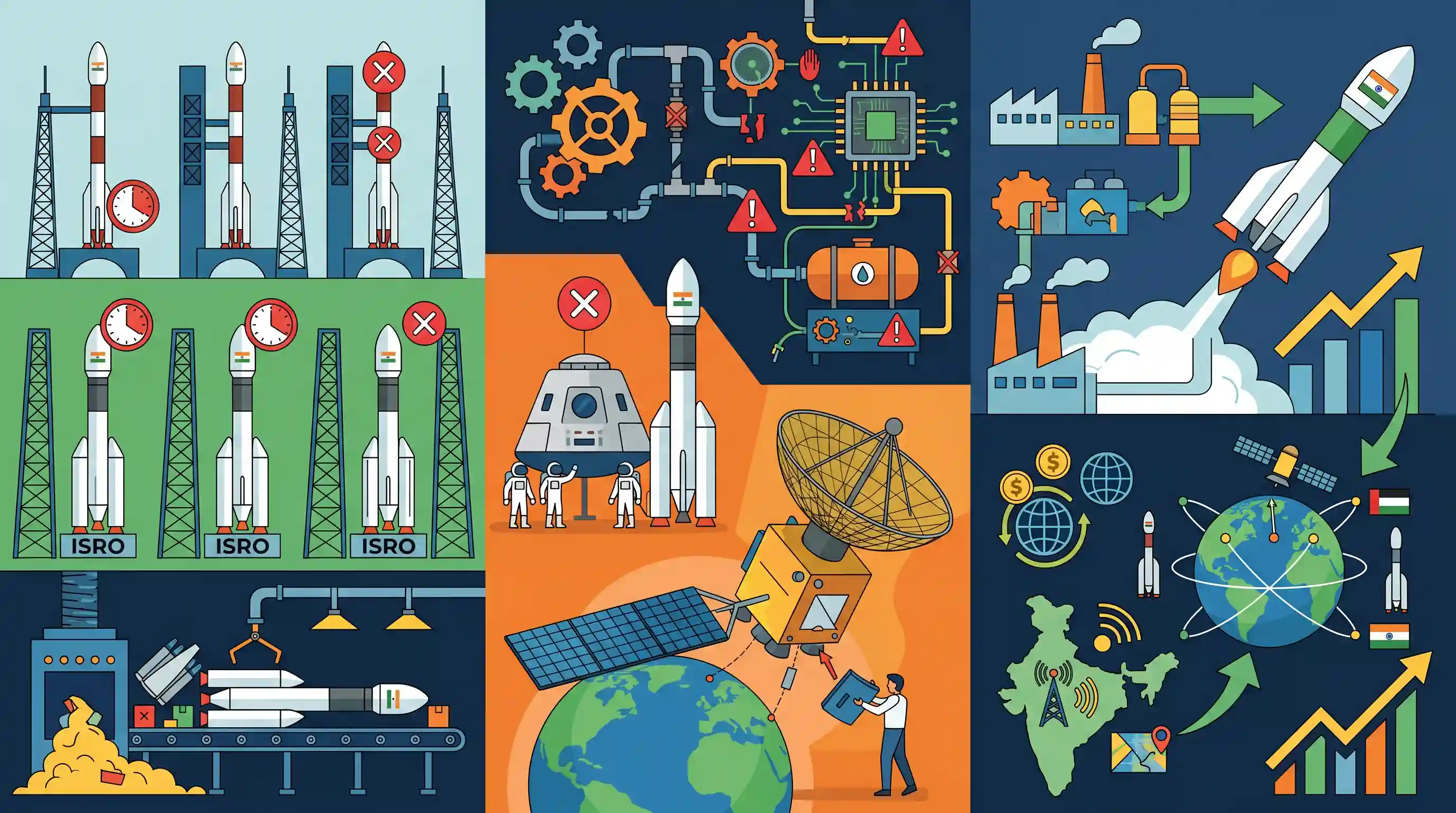
Why It Matters
Delays in space missions impact India's strategic capabilities, socio-economic satellite services (like weather and communication), and its growing ambitions in the global commercial space market. Understanding these logistical and technical challenges is crucial for evaluating ISRO's operational scaling.
Summary
The article highlights that six planned ISRO missions missed their March launch deadlines, contributing to a backlog in India's space schedule. Key missions facing potential delays include the NASA-ISRO Synthetic Aperture Radar (NISAR) and developmental flights for the Gaganyaan human spaceflight programme. These unfulfilled launches underscore the technical, logistical, and supply-chain challenges ISRO encounters as it scales up its mission frequency. Addressing these bottlenecks is essential for India to sustain its momentum in space exploration, meet domestic strategic needs, and enhance its footprint in the competitive global commercial space market.
Key Points
- Six planned ISRO space missions have missed their March deadline, leading to a backlog in India's space launch schedule.
- High-profile missions, including the joint NASA-ISRO Synthetic Aperture Radar (NISAR) and crucial test flights for the Gaganyaan human spaceflight programme, are affected by the delays.
- The unfulfilled launch targets highlight underlying technical, logistical, and supply-chain challenges faced by ISRO as it attempts to increase its annual launch frequency.
- Timely execution of missions is critical for India to meet its strategic satellite deployment needs and maintain competitiveness in the global commercial space market.
Important Terms
Gaganyaan Mission

India's maiden human spaceflight program aimed at sending a crew of three to a 400 km orbit for three days and returning them safely to Earth.
UPSC context
GS Paper III (Science & Technology); focuses on indigenous technological capabilities, human-rated launch vehicles, and life-support systems.
NISAR (NASA-ISRO Synthetic Aperture Radar)
A joint NASA-ISRO Earth-observation satellite featuring dual-frequency Synthetic Aperture Radar (L and S bands) to track global environmental changes, disasters, and land subsidence.
UPSC context
GS Paper III (Science & Tech/International Relations); tests high-resolution remote sensing technology and bilateral strategic cooperation.
NewSpace India Limited (NSIL)
A Central Public Sector Enterprise and ISRO's commercial arm, mandated to transfer space technologies to Indian industry and manage commercial launch services.
UPSC context
GS Paper III (Economy/Science); relates to the commercialization of space and increasing private sector participation in India’s space economy.
NavIC (Navigation with Indian Constellation)
India’s indigenous regional navigation system (IRNSS) designed to provide accurate positioning and timing services over India and a 1,500 km region around it.
UPSC context
GS Paper III (Science & Tech/Security); tests India's strategic autonomy and self-reliance in satellite-based navigation.
Vyommitra
A female-looking humanoid robot developed by ISRO to monitor life-support systems and simulate human functions during the uncrewed test flights of the Gaganyaan mission.
UPSC context
GS Paper III (Science & Technology); tests advancements in space robotics and safety protocols for crewed missions.
Small Satellite Launch Vehicle (SSLV)
A three-stage all-solid launch vehicle designed for cost-effective, high-frequency launches of small satellites (up to 500 kg) into Low Earth Orbit.
UPSC context
GS Paper III (Science & Tech); essential for India's play in the global commercial small-satellite market.
Prelims Trap
"NSIL serves as the single-window nodal agency for regulating private sector space activities in India."
IN-SPACe is the regulatory and authorization body for private space activities. NSIL is the commercial arm focused on technology transfer and launch services.
Static Concepts Connected
How do IN-SPACe and NSIL differ in India's space framework?
- IN-SPACe mandate: Acts as the single-window independent agency to promote, authorize, and regulate private space activities in India.
- NSIL mandate: Functions as the commercial arm of DoS, responsible for technology transfer, launch vehicle production, and commercial satellite services.
- ISRO mandate: Focuses primarily on advanced R&D, new space technologies, planetary exploration, and human spaceflight missions.
What are the core technical specifications of the Gaganyaan mission?
- Target orbit: Aims to place a crew of three members into a Low Earth Orbit (LEO) of roughly 400 km for three days.
- Launch vehicle: Will utilize a human-rated version of India's heaviest rocket, the LVM3 (formerly GSLV Mk III), designated as HLVM3.
- Module components: Equipped with an Orbital Module comprising a Crew Module (for astronauts) and a Service Module (for propulsion and power).
Cross-Topic Patterns
Space supply chains + Electronics PLI
ISRO's mission delays, driven by reliance on imported high-end sensors, directly link India's space commercialization ambitions to its domestic semiconductor PLI and critical mineral supply chain strategies.
NISAR + Disaster Management
The NISAR mission's dual-frequency radar will precisely track land deformation, tying space technology directly into GS-3 disaster management for monitoring glacial lake outburst floods (GLOFs) and urban subsidence.

Expect a multi-statement Prelims question testing NISAR’s payload split (L-band vs S-band) and Gaganyaan's target orbit (LEO, 400km).
Linked PYQs · 4
Linked PYQs · 4
- 2016MainsGS3
Discuss India's achievements in the field of Space Science and Technology. How the application of this technology has helped India in its socio-economic development?
- 2017MainsGS3
India has achieved remarkable successes in unmanned space missions including the Chandrayaan and Mars Orbitter Mission, but has not ventured into manned space missions. What are the main obstacles to launching a manned space mission, both in terms of technology and logistics? Examine critically.
- 2023MainsGS3
What is the main task of India's third moon mission which could not be achieved in its earlier mission? List the countries that have achieved this task. Introduce the subsystems in the spacecraft launched and explain the role of the Virtual Launch Control Centre' at the Vikram Sarabhai Space Centre which contributed to the successful launch from Sriharikota.
- 2018PrelimsGS1
With reference to India's satellite launch vehicles, consider the following statements: 1. PSLVs launch the satellites useful for Earth resources monitoring whereas GSLVs are designed mainly to launch communication satellites. 2. Satellites launched by PSLV appear to remain permanently fixed in the same position in the sky, as viewed from a particular location on Earth. 3. GSLV Mk III is a four-staged launch vehicle with the first and third stages using solid rocket motors; and the second and fourth stages using liquid rocket engines. Which of the statements given above is/are correct?
