Madras High Court Directs CBI Probe in Sivaganga Custodial Death
Source:The Hindu ↗
Why It Matters
The case provides a concrete example of judicial intervention to ensure fair investigation in cases of custodial death involving state police. It is highly relevant for GS-2 topics involving the CBI's jurisdiction, human rights violations, police reforms, and the practical application of the Witness Protection Scheme.
Summary
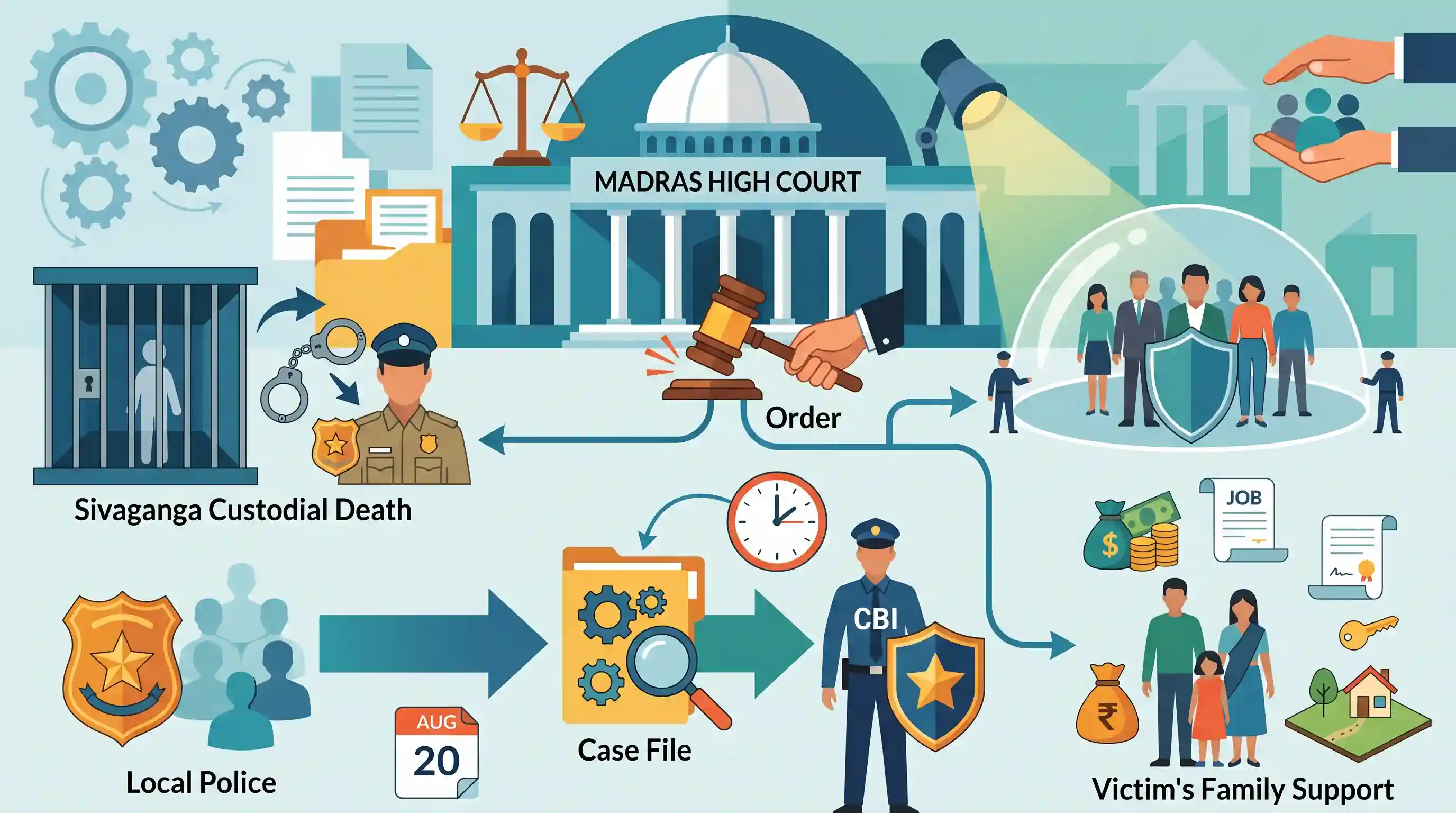
The Madras High Court has directed the Central Bureau of Investigation (CBI) to take over the investigation into the custodial death of B. Ajith Kumar in Sivaganga, Tamil Nadu. The court mandated that the CBI appoint an investigating officer and complete the probe by August 20, transferring the case away from the state police to ensure fairness. To safeguard against witness intimidation, the court invoked the Witness Protection Scheme, ordering the state to provide necessary security. In response to the human rights violation, the Tamil Nadu government issued interim compensation and offered employment and land to the victim's family. The ruling underscores the critical role of judicial oversight in addressing police brutality and enforcing accountability.
Key Points
- The Madras High Court transferred the probe into the custodial death of B. Ajith Kumar from the state police to the CBI to ensure an impartial investigation.
- The court directed the state to provide security to witnesses under the Witness Protection Scheme, emphasizing the need to shield them from potential police coercion.
- The state government provided interim compensation, a government job to the victim's brother, and land to his mother, demonstrating restorative measures following human rights violations.
- The case highlights systemic concerns regarding custodial violence, the necessity for robust police accountability, and active judicial intervention.
Important Terms
Witness Protection Scheme, 2018

A legal framework approved by the Supreme Court to safeguard witnesses from intimidation, providing measures like identity concealment, relocation, and threat assessment categorized into three levels (A, B, and C).
UPSC context
GS Paper II (Polity/Criminal Justice System); vital for discussing 'fair trial' and judicial safeguards against witness hostility.
Central Bureau of Investigation (CBI)
India's premier investigative agency, established under the Delhi Special Police Establishment (DSPE) Act, 1946, specializing in high-profile corruption, economic crimes, and special cases of national importance.
UPSC context
GS Paper II (Statutory/Quasi-judicial Bodies); tests knowledge of federal structure, jurisdiction, and the need for state consent.
Custodial Death
The death of a person while under the custody of police or judicial authorities, categorized as a severe violation of Fundamental Rights under Articles 21 and 22.
UPSC context
GS Paper II (Human Rights/Judiciary); central to debates on police reforms, custodial torture, and state accountability.
Article 226 of the Constitution
Constitutional provision empowering High Courts to issue writs for the enforcement of Fundamental Rights and for 'any other purpose,' offering broader jurisdiction than Article 32.
UPSC context
GS Paper II (Judiciary); tests understanding of High Court powers and the protection of legal vs. fundamental rights.
D.K. Basu Guidelines
A landmark 1997 Supreme Court judgment that established 11 mandatory guidelines for police during arrest and detention to prevent custodial violence and ensure transparency.
UPSC context
GS Paper II (Human Rights); the standard reference for judicial oversight of police brutality and custodial safety in India.
Prelims Trap
The CBI requires the consent of the State Government to investigate a crime even if directed by a High Court.
While the DSPE Act requires state consent for CBI operations, the Supreme Court has ruled that SCs and HCs can order CBI probes without state consent.
Static Concepts Connected
Under what conditions can the CBI investigate cases in a state without its consent?
- Constitutional Court orders: The Supreme Court (Article 32) or a High Court (Article 226) can direct a CBI probe to protect fundamental rights without state consent.
- Central subjects: The CBI does not require state consent for offenses related to central government departments, PSUs, or central employees.
- Union Territories: Under the DSPE Act, the CBI has original jurisdiction to investigate crimes within Union Territories.
Which landmark Supreme Court cases govern police conduct and custodial deaths?
- D.K. Basu (1997): Laid down 11 specific procedural guidelines for arrest and detention, including medical examinations and arrest memos, to prevent custodial torture.
- Nilabati Behera (1993): Established the State's strict liability to pay monetary compensation for custodial deaths as a public law remedy for Article 21 violations.
Cross-Topic Patterns
Witness Protection as Article 21 right
The Witness Protection Scheme 2018 connects directly to judicial independence and the Right to Life, a recurring theme in UPSC's rights-based jurisprudence questions.
Custodial Violence & NHRC limitations
While courts enforce accountability and grant compensation, the NHRC's recommendations on police brutality remain largely advisory, exposing a gap in statutory human rights enforcement.

Expect a multi-statement Prelims question merging the Witness Protection Scheme 2018, CBI jurisdiction without state consent, and Art 21.
Linked PYQs · 4
Linked PYQs · 4
- 2021MainsGS2
The jurisdiction of the Central Bureau of Investigation (CBI) regarding lodging an FIR and conducting probe within a particular State is being questioned by various States. However, the power of the States to withhold consent to the CBI is not absolute. Explain with special reference to the federal character of India.
- 2021MainsGS2
Though the Human Rights Commissions have contributed immensely to the protection of human rights in India, yet they have failed to assert themselves against the mighty and powerful. Analyzing their structural and practical limitations, suggest remedial measures.
- 2024MainsGS2
Explain the reasons for the growth of public interest litigation in India. As a result of it, has the Indian Supreme Court emerged as the world's most powerful judiciary ?
- 2019MainsGS4
"Non-performance of duty by a public servant is a form of corruption". Do you agree with this view? Justify your answer.
