GST Administration Reforms and Ease of Doing Business Measures
Source:Indian Express ↗
Why It Matters
Tax administration reforms are critical for economic growth. Prolonged tax investigations and complex registration processes hinder business operations. Understanding these administrative shifts is important for analyzing India's indirect tax regime (GST) and its impact on the business ecosystem.
Summary
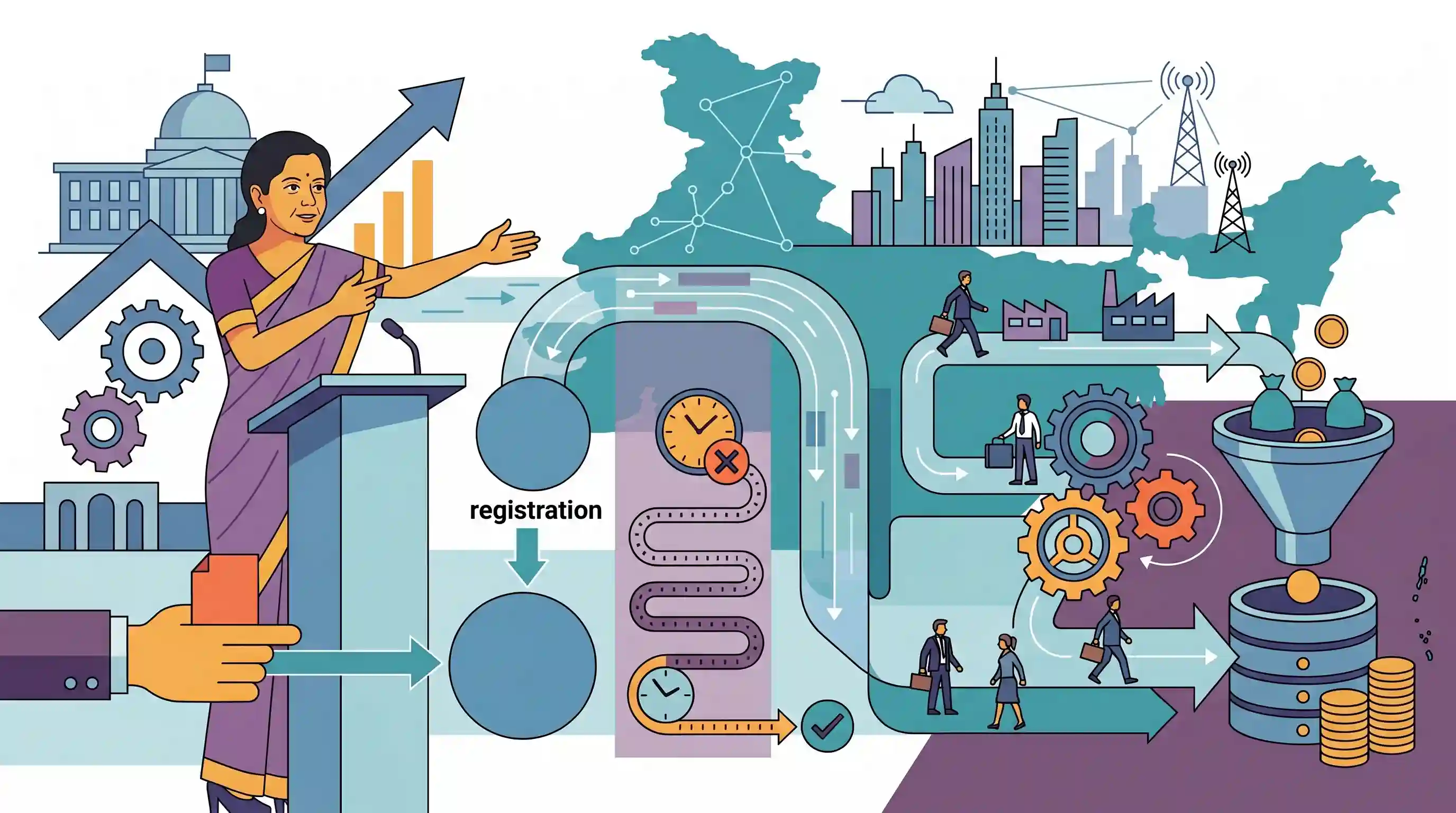
Finance Minister Nirmala Sitharaman has called for significant improvements in GST administration, emphasizing the need for an easier GST registration process and the swift conclusion of ongoing tax investigations. By instructing tax authorities to avoid keeping investigations open indefinitely, the government aims to reduce uncertainty and compliance burdens for businesses. These directives are part of a broader push to improve the 'ease of doing business' in India, fostering a more taxpayer-friendly environment while maintaining effective revenue collection and tax compliance mechanisms.
Key Points
- Finance Minister Nirmala Sitharaman emphasized the need for a simplified and user-friendly GST registration process to enhance the ease of doing business.
- She directed tax authorities to ensure the speedy closure of ongoing GST evasion investigations, preventing indefinite delays and uncertainty for businesses.
- The focus is on balancing effective tax administration and revenue collection with reducing the regulatory and compliance burden on honest taxpayers.
- These directives aim to create a more taxpayer-friendly ecosystem, improving trust between the government and the business community.
Important Terms
Goods and Services Tax (GST)

A comprehensive, destination-based indirect tax levied on the supply of goods and services, subsuming most previous central and state indirect taxes.
UPSC context
GS-III/Economy; tests understanding of major indirect tax reforms and the 'One Nation, One Tax' concept.
GST Council
A constitutional body under Article 279A, chaired by the Union Finance Minister, that makes recommendations on GST rates, exemptions, and compliance rules.
UPSC context
GS-II/Polity & GS-III/Economy; crucial for understanding fiscal federalism and cooperative decision-making between Centre and States.
Central Board of Indirect Taxes and Customs (CBIC)
The statutory body under the Ministry of Finance responsible for administering indirect taxes, including GST, Customs, and Central Excise.
UPSC context
GS-III/Economy; relevant for studying the administrative machinery of revenue collection and trade facilitation.
Ease of Doing Business (EoDB)
The degree to which a country's regulatory environment facilitates the starting, operation, and growth of private businesses through streamlined procedures.
UPSC context
GS-III/Economy; tests knowledge of regulatory reforms aimed at attracting investment and improving the business climate.
Tax Compliance
The degree to which taxpayers fulfill their obligations to register, file returns, and pay taxes on time as per legal requirements.
UPSC context
GS-III/Economy; tests understanding of revenue management, transparency, and government efforts to broaden the tax base.
Prelims Trap
The GST Council's recommendations on tax administration are constitutionally binding on the Union and States.
The Supreme Court ruled in Mohit Minerals (2022) that GST Council recommendations have only 'persuasive value' and are not strictly binding, preserving fiscal federalism.
Static Concepts Connected
What is the composition and voting structure of the GST Council?
- Chairperson: The Union Finance Minister acts as the Chairperson of the GST Council.
- Voting weight: The Centre holds 1/3rd of the voting weight, while all States combined hold 2/3rd of the voting weight.
- Decision majority: All decisions require a 3/4th (75%) majority of the weighted votes of the members present and voting.
What are recent administrative initiatives to establish a taxpayer-friendly ecosystem in India?
- Faceless Assessment: Eliminates physical interface between tax authorities and taxpayers to curb rent-seeking and harassment.
- Taxpayers' Charter: Introduced under the Income Tax Act to grant statutory rights to taxpayers, ensuring fair, courteous, and reasonable treatment.
- Dispute Resolution: Schemes like Vivad se Vishwas are designed to swiftly clear prolonged tax litigations and reduce compliance burdens.
Cross-Topic Patterns
Formalization via GST and MSME survival
Complex GST registration deters MSMEs from joining e-commerce platforms like ONDC. Easing registration accelerates the formalization of the informal economy, boosting credit access via Udyam.
Regulatory cholesterol and sovereign ratings
Indefinite tax investigations create an environment of 'tax terrorism', increasing policy uncertainty. This directly hampers FDI inflows and impacts India's broader sovereign credit rating evaluations.

Expect a 2026 Prelims statement testing the non-binding nature of GST Council recommendations alongside CBIC's statutory enforcement powers.
Linked PYQs · 4
Linked PYQs · 4
- 2019MainsGS3
Enumerate the indirect taxes which have been subsumed in the Goods and Services Tax (GST) in India. Also, comment on the revenue implications of the GST introduced in India since July 2017.
- 2013MainsGS3
Discuss the rationale for introducing Goods and Services Tax (GST) in India. Bring out critically the reasons for the delay in roll out for its regime.
- 2017PrelimsGS1
What is/are the most likely advantages of implementing 'Goods and Services Tax (GST)'? 1. It will replace multiple taxes collected by multiple authorities and will thus create a single market in India. 2. It will drastically reduce the 'Current Account Deficit' of India and will enable it to increase its foreign exchange reserves. 3. It will enormously increase the growth and size of economy of India and will enable it to overtake China in the near future. Select the correct answer using the code given below:
- 2023MainsGS2
e-governance, as a critical tool of governance, has ushered in effectiveness, transparency and accountability in governments. What inadequacies hamper the enhancement of these features ?
