PM E-DRIVE scheme brings 129 EV charging stations to Bihar districts
Source:times-of-india ↗
Why It Matters
Understanding the transition to electric mobility and the implementation of key national schemes (PM E-DRIVE, formerly FAME) at the state level is crucial. Questions on government subsidies, green initiatives, and infrastructure projects frequently appear in Prelims under economy and environment heads.
Summary
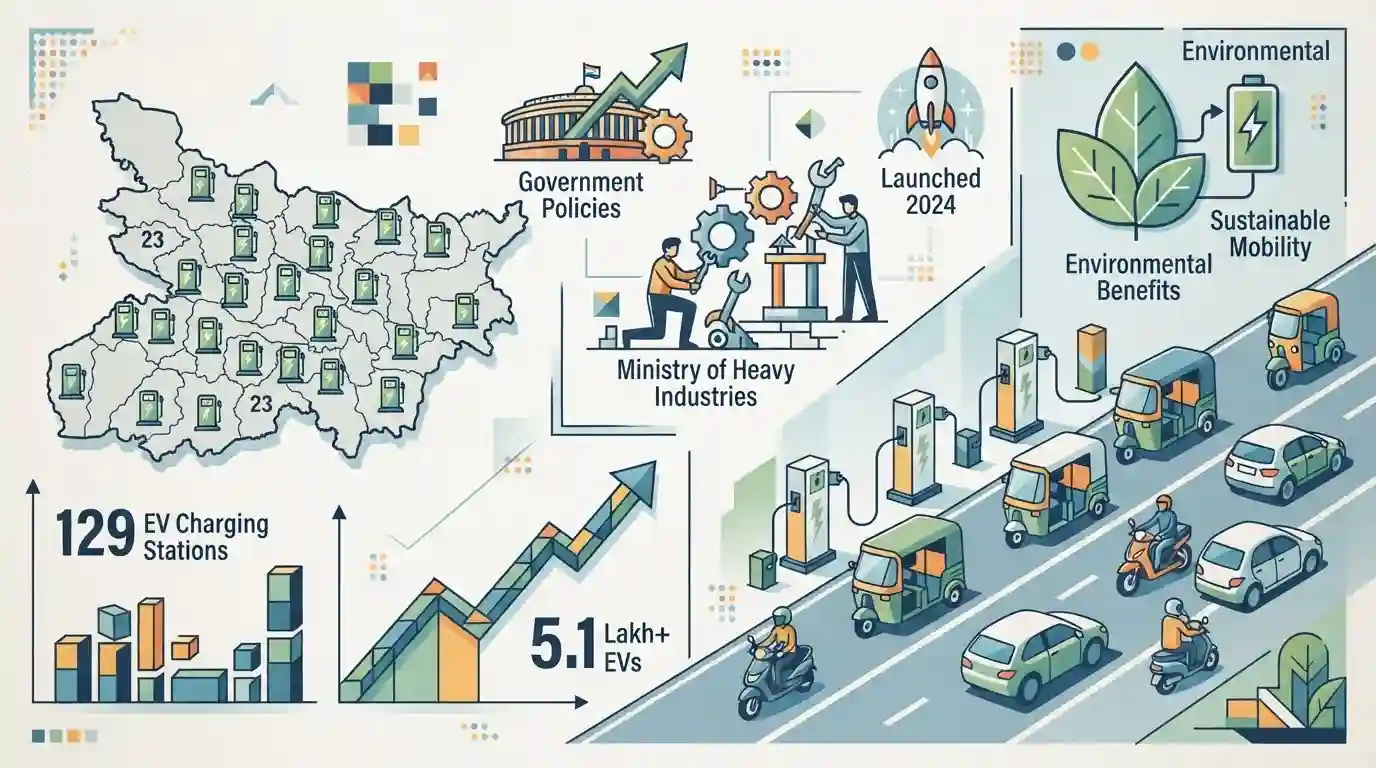
Surveys are underway in Bihar to set up 129 EV charging stations across 23 districts as part of the PM E-DRIVE scheme. Executed by BHEL and the Ministry of Heavy Industries, the project aims to support Bihar's rapidly growing electric vehicle base, which now exceeds 5.1 lakh EVs, primarily e-rickshaws. The PM E-DRIVE scheme was launched in 2024 with a Rs 10,900 crore outlay to accelerate national EV adoption and infrastructure development.
Key Points
- Site surveys have begun for installing 129 EV charging stations across 23 districts in Bihar.
- The initiative is being executed under the PM E-DRIVE scheme by BHEL and the Ministry of Heavy Industries in coordination with the UDHD and state power distribution companies.
- Bihar currently has over 5.1 lakh electric vehicles on its roads, dominated by e-rickshaws, electric motorcycles, and electric three-wheelers.
- The PM E-DRIVE scheme, launched in September 2024 with a Rs 10,900 crore outlay, replaces the FAME II scheme and allocates Rs 2,000 crore specifically for charging infrastructure nationwide.
Important Terms
PM E-DRIVE Scheme

A ₹10,900 crore central initiative (2024-2026) aimed at accelerating electric vehicle adoption and establishing a robust nationwide EV charging infrastructure network.
UPSC context
Crucial for BPSC GS Paper 2 (Economy & Environment) to illustrate government interventions for sustainable transport and infrastructure development.
FAME Scheme
The Faster Adoption and Manufacturing of (Hybrid &) Electric Vehicles scheme, India's previous flagship EV subsidy program that concluded and was replaced by PM E-DRIVE in 2024.
UPSC context
Vital for GS Paper 2 (Economy/Environment) to trace the evolution, continuity, and transition of India's electric mobility policies.
Bharat Heavy Electricals Limited (BHEL)
A major central public sector enterprise acting as a nodal project implementation agency for the PM E-DRIVE scheme to survey and develop public EV charging networks.
UPSC context
Relevant for GS Paper 2 (Economy), highlighting the role of Central PSUs in executing large-scale green infrastructure projects in Bihar.
Ministry of Heavy Industries
The central nodal ministry overseeing the automotive sector and green mobility transition, responsible for launching, funding, and administering the PM E-DRIVE scheme.
UPSC context
Tests governance knowledge in GS Paper 2, linking specific green infrastructure and subsidy policies to the correct administrative body.
Central Electricity Authority (CEA)
A statutory organization that advises the government on electricity policy and mandates the technical, grid-connectivity, and safety standards for all EV charging stations.
UPSC context
Important for GS Paper 2 (Science & Tech / Infrastructure), focusing on the regulatory safety framework required for new energy systems.
South Bihar Power Distribution Company Limited (SBPDCL)
A state government utility undertaking responsible for electricity distribution in southern Bihar, essential for providing dedicated grid connections to new EV charging infrastructure.
UPSC context
Highly relevant for GS Paper 2 (Economy/Bihar Specific), demonstrating the state-level institutional machinery required for executing national energy schemes.
Prelims Trap
"PM E-DRIVE scheme is implemented by the Ministry of Road Transport and Highways (MoRTH)."
Aspirants intuitively link vehicular schemes to MoRTH or renewable energy to MNRE, but PM E-DRIVE (and FAME) falls under the Ministry of Heavy Industries.
Static Concepts Connected
What are the key features of the PM E-DRIVE scheme?
- Nodal Ministry: Administered by the Ministry of Heavy Industries, it officially replaces the FAME II scheme and the temporary EMPS 2024.
- Financial Outlay: Rs 10,900 crore allocation over two years, with Rs 2,000 crore dedicated solely to public charging infrastructure.
- Targeted Vehicles: Subsidies heavily focus on electric 2-wheelers, 3-wheelers (e-rickshaws), ambulances, trucks, and public e-buses. Electric cars are notably excluded.
What are the core targets of the Bihar Electric Vehicle Policy 2023?
- Adoption Target: Aims for 15% of all new vehicle registrations in the state to be electric vehicles by the year 2028.
- Tax Incentives: Offers substantial motor vehicle tax exemptions (up to 75%) for the first 10,000 electric two-wheelers and four-wheelers registered in Bihar.
- Infrastructure Focus: Mandates developing robust public charging networks across municipalities, commercial spaces, and key state highways, subsidized by the state government.
Cross-Topic Patterns
EV Infra & Critical Minerals
Rising EV charging demand connects to India's strategic push for critical minerals (Lithium, Cobalt) and the KABIL joint venture to secure overseas battery supply chains.
E-rickshaws & Urban Pollution
Bihar's EV growth, heavily driven by e-rickshaws, provides a dual solution for last-mile urban connectivity and tackling severe AQI levels in cities like Patna and Gaya.

Expect a multi-statement question on PM E-DRIVE focusing on its nodal ministry (Heavy Industries) and Bihar's EV base (e-rickshaw driven).
Linked PYQs · 3
Linked PYQs · 3
- 2023BPSC_PRELIMSGS1
Consider the following statements about the Production-Linked Incentive (PLI) scheme: 1. The scheme offers a production-linked incentive to boost domestic manufacturing and attract large investments in mobile phone manufacturing and specified electronic components. 2. The scheme has two categories of applicants, namely, global companies and domestic companies. 3. The scheme shall extend an average incentive of around 8% on net incremental sales (over base year) of goods manufactured in India and covered under the target segment, to eligible companies, for a period of six years. 4. The target segment under PLI shall include (i) laptops, (ii) tablets, (iii) all-in-one PCs, (iv) servers and (v) Ultra-Small Form Factor (USFF).
- 2024-EBPSC_PRELIMSGS1
When did Bihar State introduce the Green Budget for the first time?
- 2025BPSC_PRELIMSGS1
The Atmanirbhar Bharat Scheme announced by the Government helps in: 1) Enhancing India’s manufacturing capabilities and exports across the industries 2) Incentivizing foreign investments for domestic production
