SIT and CBI Expand NEET Exam Fraud Probe to Medical Colleges in Bihar
Source:the-times-of-india ↗
Why It Matters
It links a major ongoing exam-malpractice controversy in Bihar to core state history (Jainism and modern Bihar founders), Bihar geography (Nalanda & Gaya), and federal administrative law governing CBI investigations and national-level examinations.
Summary
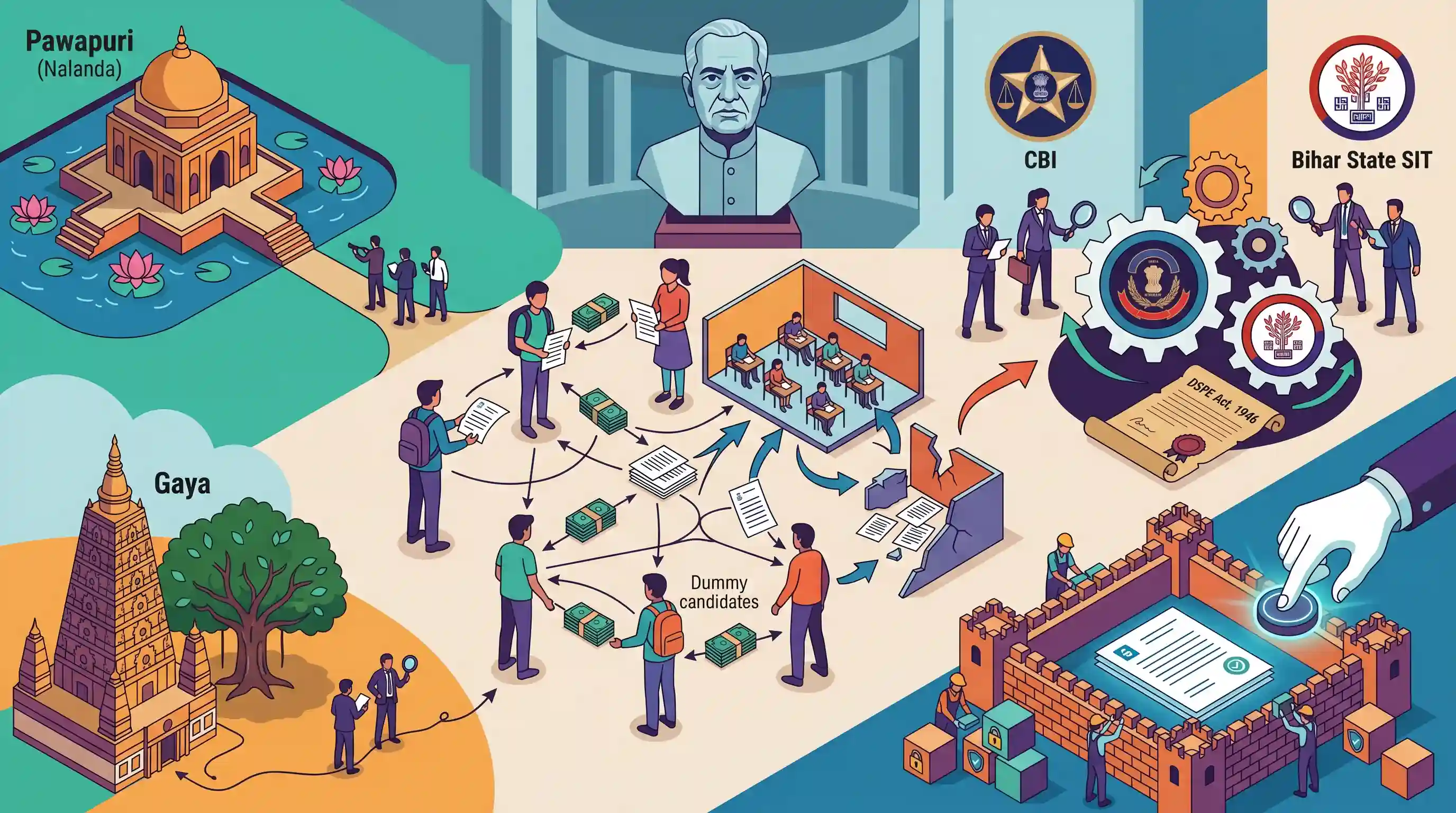
The article covers the intensifying probe by the Bihar Police SIT and the CBI into the NEET-UG examination leak. Investigators visited Bhagwan Mahavir Institute of Medical Sciences (BMIMS) in Nalanda and other medical institutions in Gaya and West Bengal, uncovering an organized network of medical students acting as solvers and dummy candidates. This current affair directly connects to Bihar's historical heritage (Pawapuri/Gaya), eminent state figures (Anugrah Narayan Sinha), and federal polity debates (CBI jurisdiction and central examination integrity laws).
Key Points
- An investigation by the Bihar Police Special Investigation Team (SIT) and the CBI revealed a NEET-UG paper leak and imposter 'solver' syndicate operating out of prominent medical colleges, including BMIMS Nalanda and ANMMCH Gaya.
- BMIMS Nalanda (formerly Vardhman Institute of Medical Sciences or VIMS, Pawapuri) is located in Pawapuri, which is highly significant in Jainism as the place of salvation (Moksha/Nirvana) of Lord Mahavir, the 24th Tirthankara.
- ANMMCH Gaya is named after Anugrah Narayan Sinha, one of Bihar's most prominent nationalist leaders (Bihar Vibhuti), the first Deputy Chief Minister and Finance Minister of Bihar, who worked closely during the Champaran Satyagraha (1917).
- Gaya remains a key religious center situated on the Falgu River, recently proposed for tourism development under the Vishnupad Yojana in the Union Budget.
- The involvement of the CBI alongside state police brings in crucial administrative and federal elements, governed by the Delhi Special Police Establishment (DSPE) Act of 1946. State consent issues fall under the broader federal framework, often contested under the Supreme Court's Original Jurisdiction (Article 131).
- To combat systemic leakages, India implemented the Public Examinations (Prevention of Unfair Means) Act, 2024, which prescribes stringent punishments (up to 10 years of imprisonment and ₹1 crore fine) for organized examination syndicates.
Important Terms
Delhi Special Police Establishment (DSPE) Act, 1946

A British-era legislation that provides the legal framework and investigative powers—such as arrest, search, and seizure—to the Central Bureau of Investigation (CBI) in India.
UPSC context
GS Paper II (Federalism & Statutory Bodies); tests state consent, federal police powers, and jurisdiction of central investigative agencies.
Public Examinations (Prevention of Unfair Means) Act, 2024
A central legislation enacted to criminalize and curb malpractices like paper leaks, impersonation, and tampering in national competitive and entrance exams, prescribing stringent punishments and heavy fines.
UPSC context
GS Paper II (Governance & Education); tests understanding of exam integrity, administrative reforms, and legal mechanisms to prevent organized academic crimes.
Central Bureau of Investigation (CBI)
India's premier non-constitutional and non-statutory central investigative agency, established in 1963 on the Santhanam Committee's recommendation, tasked with probing major corruption, economic offenses, and high-profile crimes.
UPSC context
GS Paper II (Statutory/Non-statutory Bodies); tests agency autonomy, role in cooperative federalism, and the requirement of state consent under the DSPE Act.
Special Investigation Team (SIT)
A specialized, temporary task force of senior law enforcement officers appointed by the Supreme Court, High Courts, or executive governments to conduct impartial and focused probes into complex or sensitive high-profile cases.
UPSC context
GS Paper II (Judiciary & Governance); tests judicial activism, extraordinary police power delegation, and ensuring fair trials in high-profile criminal investigations.
Bihar Conduct of Examinations Act, 1981
A state-specific legislation enacted in Bihar to deter cheating, paper leaks, and other unfair means during state-conducted examinations, establishing penalties such as imprisonment and fines for violators.
UPSC context
GS Paper II (State Legislations & Governance); tests federal-state legislative overlaps, sub-national governance, and regional legal measures to tackle academic malpractices.
Bhagwan Mahavir Institute of Medical Sciences (BMIMS)
A government medical college in Pawapuri, Nalanda. Its location holds deep historical significance as the site of Lord Mahavira's Nirvana and cremation, home to the revered Jain Jal Mandir.
UPSC context
GS Paper I (Art and Culture / Jainism); tests regional heritage, locations associated with the life of Tirthankaras, and ancient history of Bihar.
Prelims Trap
The CBI requires state consent under Section 6 of the DSPE Act in all situations, including court-ordered investigations.
The Supreme Court and High Courts have the constitutional power to direct the CBI to investigate any crime within a state without requiring the consent of that state government.
Static Concepts Connected
What is the constitutional and statutory framework governing CBI's jurisdiction in Indian States?
- Statutory Origin: CBI derives its investigating powers from the Delhi Special Police Establishment (DSPE) Act, 1946, which classifies it as a federal police force.
- State Consent: Under Section 6, the CBI needs either 'general' or 'case-specific' consent from the respective state government to investigate within its territorial jurisdiction.
- Judicial Exception: The Supreme Court and High Courts can bypass the consent requirement, ordering a CBI probe under their constitutional powers, which the state cannot block.
What is the historical and religious significance of Pawapuri and Lord Mahavir?
- Nirvana Site: Pawapuri is the holy site where Lord Mahavir, the 24th and final Tirthankara of Jainism, delivered his last sermon and attained Moksha.
- Jal Mandir: The Jal Mandir is a famous marble temple situated in the center of a lotus pond, marking the spot where Lord Mahavir's mortal remains were cremated.
Cross-Topic Patterns
Heritage Corridors + Budgetary Devolution
Union budget funding of spiritual heritage corridors (like Vishnupad in Gaya) highlights the intersection of central fiscal devolution, state tourism development, and ancient site preservation.
Exam Integrity + National Security Law
The Public Examinations Act 2024 shifts examination malpractice from a localized law-and-order concern to a national security issue handled by central investigative agencies.

The DSPE Act's state consent mechanism and Article 131 original jurisdiction are likely to be paired in a 2026 GS-2 federalism question.
Linked PYQs · 3
Linked PYQs · 3
- 2017BPSC_PRELIMSGS1
The salvation place of Mahavirji, the originator of Jain religion, is located at
- 2024-EBPSC_PRELIMSGS1
Which of the following centres in Bihar is proposed to develop under Vishnupad Yojana for promotion of tourism in Union Budget 2024?
- 2024-IBPSC_PRELIMSGS1
The power of the Supreme Court of India to decide disputes between the Centre and the State falls under its
