Supreme Court Rules on Voter List Deletions and Citizenship
Source:Indian Express ↗
Why It Matters
This ruling clarifies the distinction between electoral rights and citizenship status. It establishes the evidentiary value of electoral rolls and outlines the procedural fairness and administrative steps required for identifying and adjudicating the citizenship of suspected non-citizens.
Summary
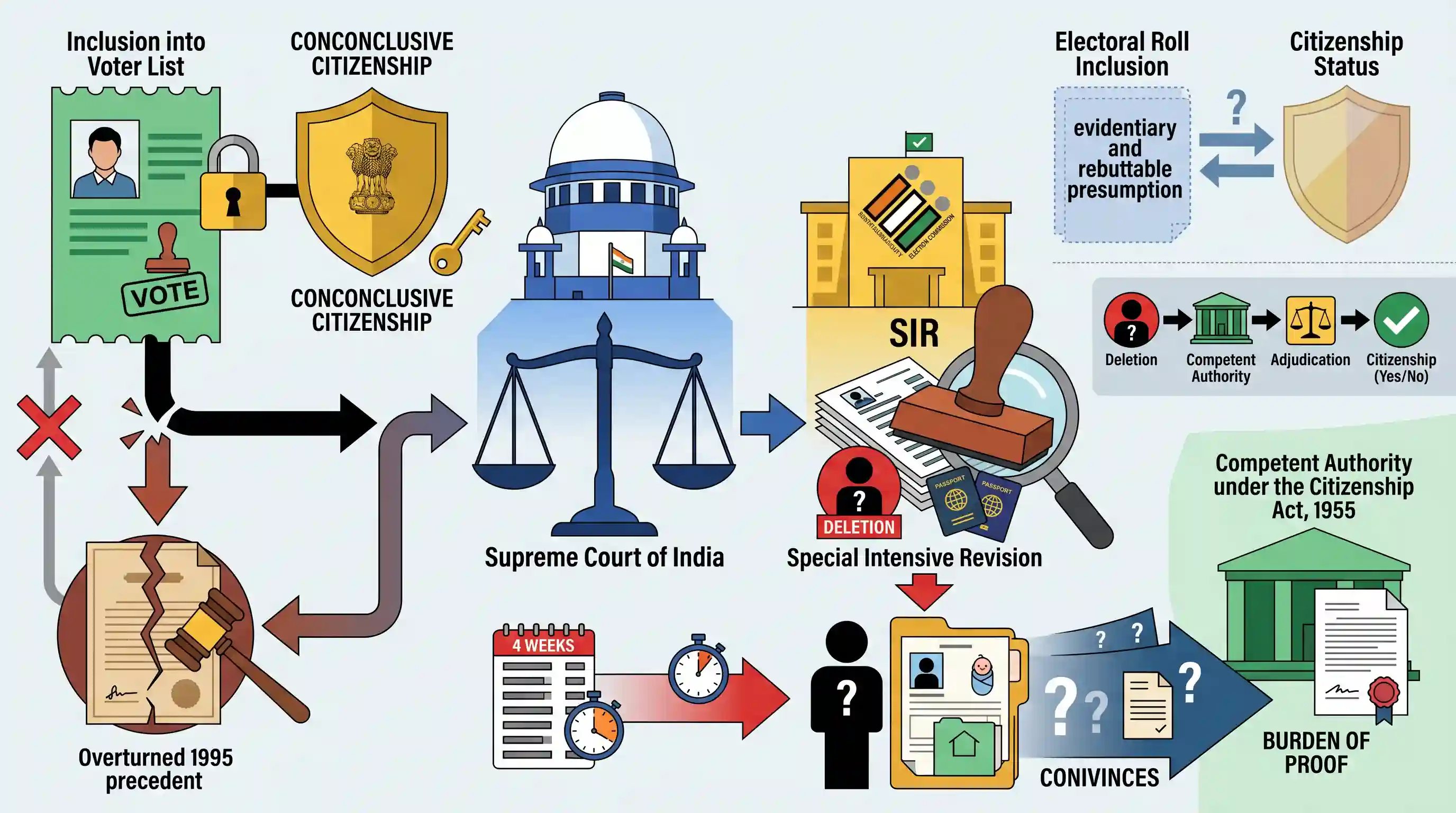
The Supreme Court upheld the Election Commission's Special Intensive Revision (SIR) process, ruling that while the EC can examine citizenship questions contextually during electoral roll revision, a deletion from the roll doesn't definitively strip a person of Indian citizenship. Instead, the burden of proof shifts to the individual to prove their citizenship before a Competent Authority under the Citizenship Act, 1955. The SC mandated the EC to forward the list of deleted names to this authority within four weeks. The ruling clarified that inclusion in the electoral roll creates only an evidentiary and rebuttable presumption of citizenship, overturning the 1995 Lal Babu Hussein precedent that had deemed it conclusive.
Key Points
- The Supreme Court directed the Election Commission (EC) to submit names deleted from electoral rolls during the Special Intensive Revision (SIR) to the Competent Authority under the Citizenship Act, 1955.
- Deletion from the voter's list by the EC is 'prima facie and contextual' and does not serve as a definitive declaration that an individual is a non-citizen.
- Once a name is deleted from the electoral roll on citizenship grounds, the burden shifts to the individual to prove their citizenship before the Competent Authority.
- The judgment overturned the 1995 Lal Babu Hussein precedent, ruling that inclusion in the electoral roll provides an evidentiary, rebuttable presumption of citizenship rather than a conclusive one.
- The SC validated the SIR process, stating that judicial interventions provided the necessary procedural safeguards to make it constitutionally compliant despite initial transparency issues.
Important Terms
Special Intensive Revision (SIR)

A comprehensive house-to-house verification drive by the Election Commission to update electoral rolls by removing deceased, shifted, or ineligible entries, including non-citizens.
UPSC context
GS Paper II: Statutory bodies and electoral reforms; tests understanding of the Election Commission's administrative powers.
Citizenship Act, 1955
The primary legislation enacted under Article 11 of the Constitution to regulate the acquisition, determination, and termination of Indian citizenship.
UPSC context
GS Paper II: Fundamental rights and citizenship; critical for understanding the legal basis of being an Indian national.
Competent Authority
The designated administrative body (typically under the Ministry of Home Affairs) empowered by the Citizenship Act to formally adjudicate an individual's citizenship status.
UPSC context
GS Paper II: Separation of powers; distinguishes between the Election Commission’s roll-management and the Executive’s citizenship-determination roles.
Representation of the People Act, 1950
Statutory framework governing the structural aspects of elections, including seat allocation, delimitation of constituencies, and the preparation/revision of electoral rolls.
UPSC context
GS Paper II: Salient features of the RP Act; essential for distinguishing roll preparation from election conduct (1951 Act).
Rebuttable Presumption
A legal assumption that holds true unless contrary evidence is presented to disprove it; used by the SC to describe electoral roll entries.
UPSC context
GS Paper II: Judiciary; tests knowledge of legal evidentiary standards applied to fundamental rights and civic status.
Lal Babu Hussein vs. ERO (1995)
A 1995 Supreme Court judgment that established procedural safeguards against arbitrary deletion from electoral rolls based on citizenship suspicion.
UPSC context
GS Paper II: Landmark judgments; provides the historical legal context for current electoral roll revision standards.
Prelims Trap
Inclusion of a name in the electoral roll serves as conclusive proof of Indian citizenship.
The SC recently ruled that electoral roll inclusion creates only an 'evidentiary and rebuttable presumption'. Overturning a 1995 precedent, it is no longer conclusive proof.
Static Concepts Connected
Who holds the legal authority to determine Indian citizenship?
- Central Government: Under the Citizenship Act 1955, formal adjudication of citizenship is the exclusive domain of the Ministry of Home Affairs and its designated Competent Authorities.
- Election Commission: The ECI can only make a prima facie assessment for electoral roll inclusion under RPA 1950; it cannot definitively strip citizenship.
- Burden of Proof: Section 9 of the Foreigners Act 1946 mandates that the burden to prove citizenship rests entirely on the individual, not the State.
What are the constitutional bases for electoral roll preparation?
- Article 326: Grants universal adult suffrage, specifying that voters must be citizens of India.
- Article 325: Mandates one general electoral roll per constituency, prohibiting discrimination on grounds of religion, race, caste, or sex.
- RPA 1950: Provides statutory backing. Section 16 explicitly disqualifies non-citizens from being registered in any electoral roll.
Cross-Topic Patterns
Assam NRC and D-Voter parallel
The SIR process parallels Assam's D-voter (Doubtful voter) issue, where disenfranchised individuals must similarly discharge the burden of proof before Foreigners Tribunals under the Foreigners Act, 1946.
Separation of Powers: Art 324 vs Art 11
Highlights jurisdictional boundaries: Article 324 empowers the EC to manage elections, but Article 11 grants Parliament exclusive authority to regulate citizenship, preventing the EC from making final citizenship adjudications.

Expect a 2026 Prelims statement differentiating EC's 'prima facie' powers from MHA's conclusive citizenship authority under the 1955 Act.
Linked PYQs · 3
Linked PYQs · 3
- 2021PrelimsGS1
With reference to India, consider the following statements : 1. There is only one citizenship and one domicile. 2. A citizen by birth only can become the Head of State. 3. A foreigner once granted the citizenship cannot be deprived of it under any circumstances. Which of the statements given above is/are correct?
- 2017PrelimsGS1
Right to vote and to be elected in India is a
- 2017PrelimsGS1
For election to the Lok Sabha, a nomination paper can be filed by
