Uttarakhand Completes Hearings for Majority of Electoral Roll Notices
Source:pioneer-edge ↗
Why It Matters
Understanding the mechanism of electoral roll preparation under the Representation of the People Act, 1950, is essential for UKPSC and UPSC polity sections. This includes statutory positions like Chief Electoral Officer (CEO), EROs, and AEROs, alongside practical components like ECI Forms (6, 7, and 8) used for addition, deletion, and correction in voter lists.
Summary
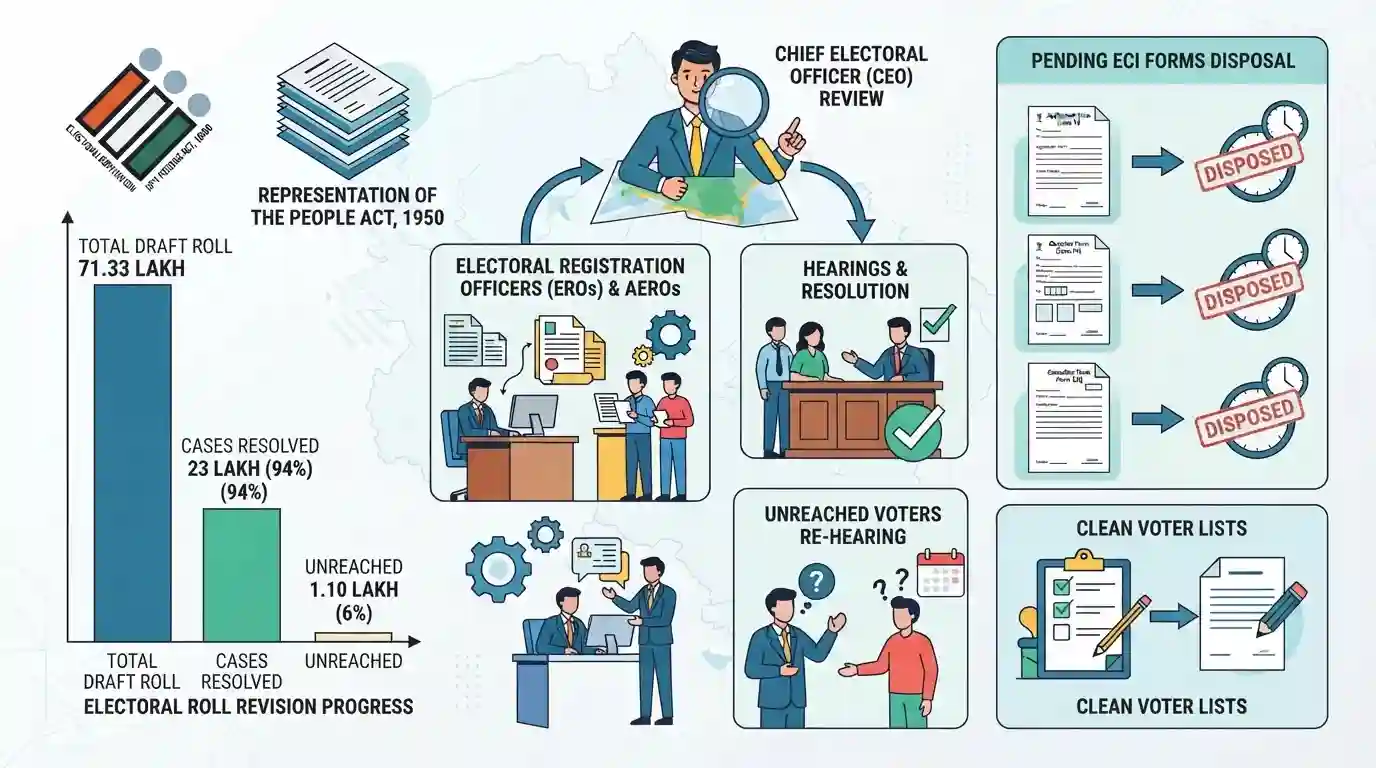
The Election Commission of India (ECI) has completed hearings for approximately 94% of the notices issued during the Special Intensive Revision (SIR) of electoral rolls in Uttarakhand [1.1]. Reviewed by Uttarakhand's Chief Electoral Officer (CEO) BVRC Purushottam, the SIR process targets 24.30 lakh unmapped voters and entries with anomalies out of the state's total draft roll of 71.33 lakh voters [1.1]. Electoral Registration Officers (EROs) and Assistant Electoral Registration Officers (AEROs) have resolved nearly 23 lakh cases, while 1.10 lakh unreached voters are being offered a re-hearing [1.1]. The CEO directed District DMs to dispose of all pending ECI Forms VI, VII, and VIII within a week to clean up the state voter lists [1.1].
Key Points
- The Election Commission of India has successfully heard 94% of notices (around 23 lakh out of 24.30 lakh) sent to unmapped and anomalous voters in Uttarakhand during the Special Intensive Revision (SIR) [1.1].
- Out of Uttarakhand's draft electoral roll of 71.33 lakh voters, notices were issued to 24.30 lakh voters regarding anomalies or unmapped details [1.1].
- Electoral Registration Officers (EROs) and Assistant Electoral Registration Officers (AEROs) have spearheaded the revision hearings, leaving only 1.10 lakh unreached voters who have been granted a re-hearing opportunity [1.1].
- Uttarakhand's Chief Electoral Officer (CEO) BVRC Purushottam directed the state's District Magistrates to ensure timely disposal of claims, objections, and ECI Forms VI, VII, and VIII within a week [1.1].
- The institutional hierarchy for the revision includes the Chief Electoral Officer, Additional CEO Vijay Kumar Jogdande, and District Magistrates functioning as key administrative links [1.1].
Important Terms
Special Intensive Revision (SIR) of Electoral Rolls

A nationwide, comprehensive exercise by the Election Commission of India to clean electoral rolls through house-to-house verification, eliminating deceased, duplicate, or shifted voters while registering eligible ones.
UPSC context
UKPSC GS Paper II (Polity & Governance). Relevant for topics on electoral reforms, voter registration, and ensuring free and fair democratic elections.
Representation of the People Act, 1950
A parliamentary act providing for the allocation of seats, delimitation of constituencies, voter qualifications, and preparation of electoral rolls for the Lok Sabha and State Legislative Assemblies.
UPSC context
UKPSC GS Paper II (Indian Polity). Important for understanding the statutory and legal framework governing democratic processes and elections in India.
Election Commission of India (ECI)
An autonomous constitutional authority established under Article 324 of the Indian Constitution, responsible for administering Union and State election processes in India.
UPSC context
UKPSC GS Paper II. Tests knowledge of key constitutional bodies, their mandate, structural composition, and roles in conducting democratic elections.
Chief Electoral Officer (CEO)
A state-level statutory officer designated or nominated by the Election Commission of India to supervise the preparation, revision, and conduct of all elections within a state.
UPSC context
UKPSC GS Paper II (Polity). Focuses on the machinery of election administration, decentralization, and state-specific electoral roll management processes.
ECI Voter Registration Forms (Form 6, 7, 8)
Prescribed statutory documents used under RPA 1950: Form 6 is for new voter registration, Form 7 for deletion objections, and Form 8 for correcting or shifting details.
UPSC context
UKPSC GS Paper II (Polity). Tests practical machinery of electoral rolls, citizen rights, and procedures for updating regional databases.
Prelims Trap
The State Election Commissioner appoints the Chief Electoral Officer (CEO) to oversee electoral rolls for Assembly elections.
The ECI, not the State Election Commissioner, nominates the CEO in consultation with the State Government under Section 13A of RPA 1950.
Static Concepts Connected
How do RPA 1950 and RPA 1951 differ regarding electoral administration?
- RPA 1950: Governs voter qualifications, preparation/revision of electoral rolls, allocation of seats, and delimitation of constituencies.
- RPA 1951: Handles actual conduct of elections, candidates' disqualifications, corrupt practices, and election dispute resolution.
What are the statutory purposes of ECI Forms 6, 7, and 8?
- Form 6: Used for registration of new electors and inclusion of names in the roll.
- Form 7: Submitted for raising objections against inclusion or requesting deletion of a voter.
- Form 8: Utilized for updating entries, shifting residence, replacing voter cards, or marking disability status.
Cross-Topic Patterns
ECI central control vs State autonomy
State IAS officers acting as ECI-directed CEOs and DEOs highlights the temporary centralization of state administrative machinery for federal electoral processes.
Voter roll purification vs Tribal migration
Intensive revisions in Uttarakhand must balance technical de-duplication with geographical realities of transhumance among Bhotiya tribes to prevent disenfranchisement.

Match-the-following questions on ECI Forms (6, 7, 8) and statutory authorities under RPA 1950 are highly probable.
Linked PYQs · 2
Linked PYQs · 2
- 2011UKPSC_PRELIMSGS1
The Chief Election Commissioner of India is appointed by
- 2012UKPSC_PRELIMSGS1
What is the tenure of Chief Election Commissioner of India?
