Voter roll deletions become flashpoint ahead of Bengal polls
Source:Indian Express ↗
Why It Matters
The issue of large-scale voter deletion directly impacts the constitutional right to vote and the democratic process, making it highly relevant for UPSC aspirants studying the Election Commission's role and the Representation of the People Act. It also provides a real-world case study of federal friction and the electoral strategies of regional versus national parties.
Summary
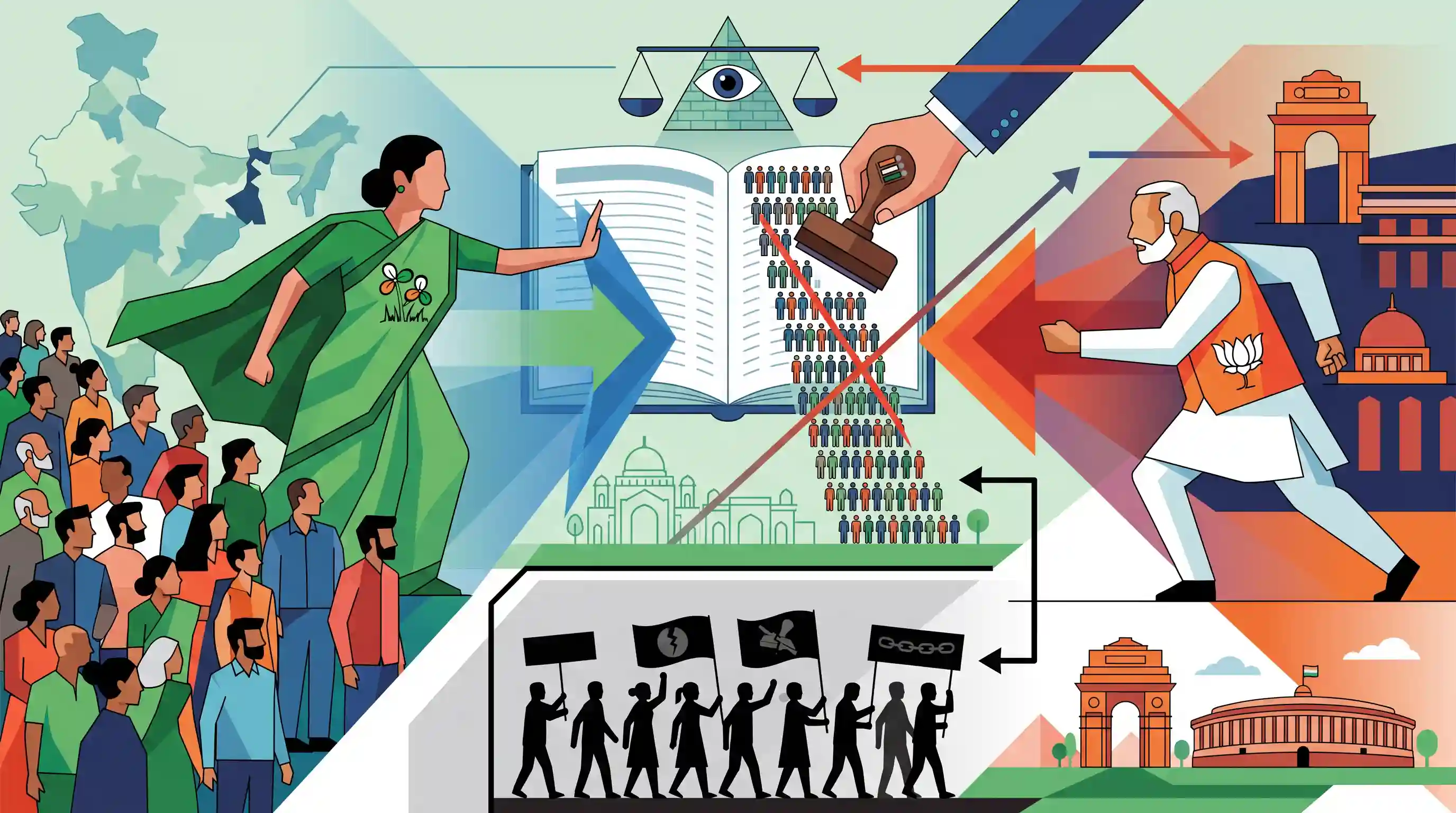
The article highlights the escalating political confrontation between the Trinamool Congress (TMC) and the Bharatiya Janata Party (BJP) as West Bengal prepares for upcoming elections. Chief Minister Mamata Banerjee is deploying strategic political tools to counter the BJP's influence. A significant flashpoint in this battle is the deletion of approximately 45,000 voters from the electoral rolls in Bhawanipur, prompting the TMC to stage a 'Black' protest in New Delhi. This development raises critical concerns regarding the integrity of the electoral process, the updating of voter lists, and the role of the Election Commission of India (ECI). Furthermore, the situation underscores the ongoing friction in Centre-State relations, showcasing how regional parties utilize local identity and state-level grievances to combat the centralization tendencies of national political entities.
Key Points
- The Trinamool Congress (TMC), led by Mamata Banerjee, is intensifying its electoral battle against the BJP ahead of the West Bengal polls, relying heavily on regional political strategies.
- A major point of contention is the alleged deletion of 45,000 voters from the electoral rolls in the Bhawanipur constituency, which has alarmed the TMC.
- The TMC has organized a 'Black' protest in New Delhi to highlight the issue of voter deletion and challenge the actions of electoral authorities.
- The controversy brings to the forefront the critical role of the Election Commission of India (ECI) in maintaining accurate electoral rolls and ensuring free and fair elections.
- The political face-off reflects the broader dynamics of Centre-State relations, with regional parties emphasizing state autonomy and local welfare to counter national parties.
Important Terms
Representation of the People Act (RPA)

Two landmark legislations (1950 and 1951) that provide the legal framework for Indian elections, covering voter qualifications, preparation of electoral rolls, and the actual conduct of polls.
UPSC context
GS-II: Electoral reforms and governance. Essential for understanding the statutory basis of the democratic process.
Election Commission of India (ECI)
A permanent constitutional body established under Article 324, empowered to superintend, direct, and control elections to Parliament, State Legislatures, and the offices of President and Vice-President.
UPSC context
GS-II: Constitutional bodies. Tests knowledge of the commission's independence and plenary powers.
Special Intensive Revision (SIR)
An exhaustive process of updating electoral rolls conducted by the ECI, often involving door-to-door verification to ensure the inclusion of new voters and deletion of ineligible entries.
UPSC context
GS-II: Election administration. Relevant for questions on electoral integrity and voter disenfranchisement.
Electoral Rolls
The official list of citizens in a constituency who are eligible to vote in an election, maintained and updated under the superintendence of the ECI.
UPSC context
GS-II: Salient features of the RPA. Tests understanding of universal adult suffrage and voter registration issues.
Federalism
A constitutional system of power-sharing between the Union and the States, characterized in India by a strong center but increasingly influenced by state-level political dynamics.
UPSC context
GS-II: Federal structure. Tests knowledge of the tension between national centralization and state-level autonomy.
Regional Parties
Political entities whose influence and operations are confined to a specific state or region, focusing primarily on local identity, language, or developmental interests.
UPSC context
GS-II: Role of regional parties in a coalition and federal setup. Tests dynamics of party competition.
Prelims Trap
The Election Commission can add or delete names from the electoral roll at any time before the polling date.
Under Section 23(3) of the Representation of the People Act, 1950, no additions or deletions can be made to the roll after the last date for filing nominations.
Static Concepts Connected
Who is statutorily responsible for updating electoral rolls?
- Article 324: It vests the overall superintendence, direction, and control of electoral roll preparation in the Election Commission of India (ECI).
- RPA 1950: Provides the specific statutory framework for the preparation, revision, and updating of electoral rolls for each constituency.
- Designated Officer: The Electoral Registration Officer (ERO), appointed by the ECI in consultation with the State Government, is statutorily responsible for the rolls.
What is the exact legal status of the Right to Vote in India?
- Constitutional Right: It is recognised as a Constitutional Right enshrined under Article 326 (universal adult suffrage), not a Fundamental Right.
- Statutory Conditions: The exercise of this right is governed by conditions and disqualifications (e.g., non-residence, corrupt practices) laid out in the Representation of the People Acts.
Cross-Topic Patterns
Electoral Machinery & Federal Friction
The reliance of the ECI on state government staff (e.g., District Magistrates acting as DEOs) frequently triggers Centre-State friction regarding the control of administrative machinery during contentious regional elections.
Aadhaar-Voter ID Linking & Roll Purification
The drive to weed out duplicate voters via the Election Laws (Amendment) Act 2021 (Aadhaar linking) often overlaps with allegations of mass, targeted voter deletions and sparks right-to-privacy debates.

2026 Prelims may feature a multi-statement question contrasting RPA 1950 (electoral rolls preparation) with RPA 1951 (actual election conduct).
Linked PYQs · 3
Linked PYQs · 3
- 2017PrelimsGS1
Right to vote and to be elected in India is a
- 2022MainsGS2
“While the national political parties in India favour centralisation, the regional parties are in favour of State autonomy.” Comment.
- 2022MainsGS2
Discuss the procedures to decide the disputes arising out of the election of a Member of the Parliament or State Legislature under The Representation of the People Act, 1951. What are the grounds on which the election of any returned candidate may be declared void ? What remedy is available to the aggrieved party against the decision ? Refer to the case laws.
