ECI Special Intensive Revision of Voter Rolls
Source:The Hindu ↗
Why It Matters
This article strikes at the core of India's electoral democracy by questioning the jurisdictional limits of the Election Commission of India (ECI) versus Parliament. It is highly relevant for GS Paper 2 (Polity and Governance) as it touches upon the Representation of the People Act, constitutional articles (324, 326, 327), and the evolving challenges of balancing voter enfranchisement with rigorous citizenship verification.
Summary
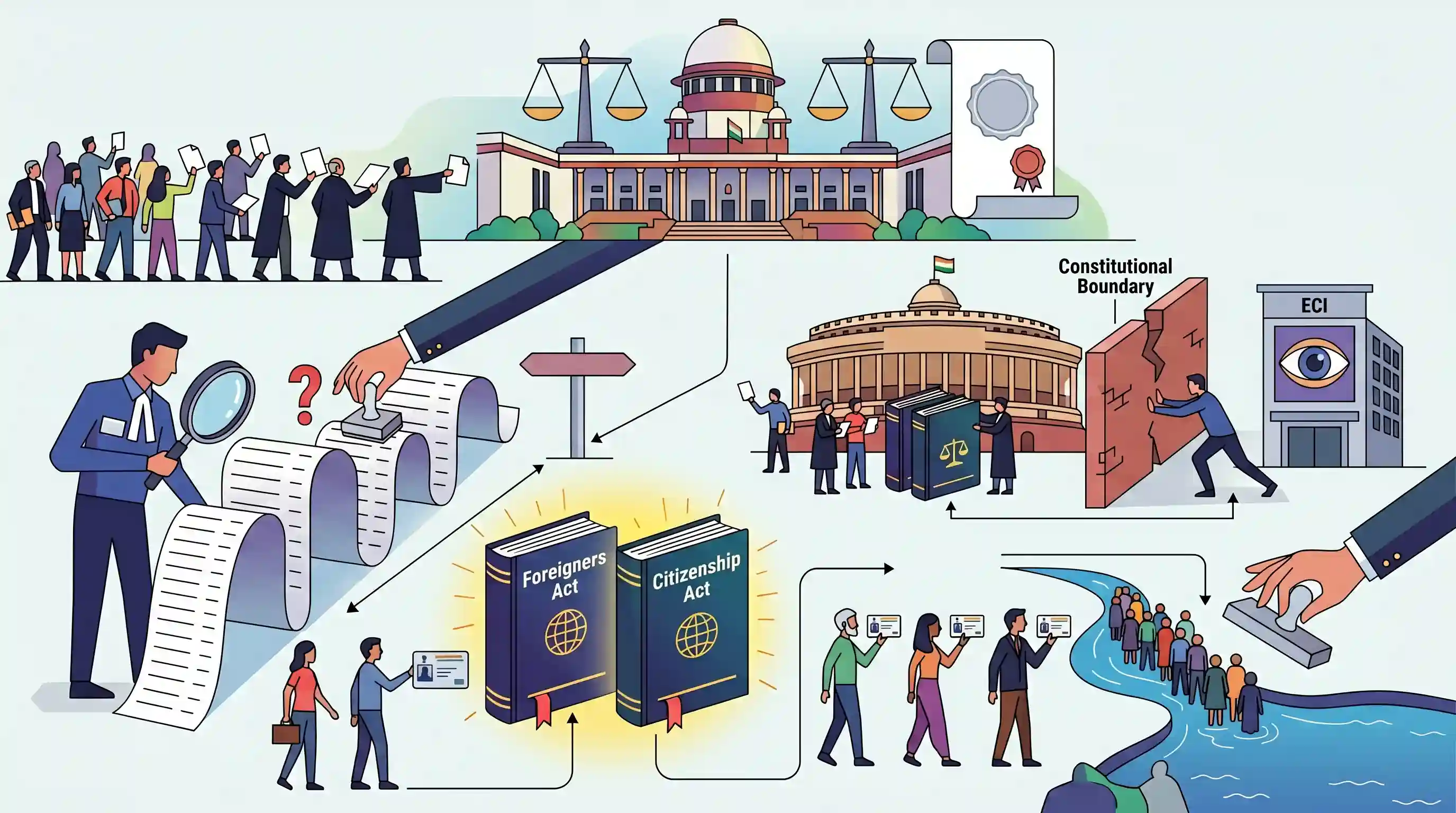
The Supreme Court has reserved its order on a batch of petitions challenging the Election Commission of India's (ECI) authority to conduct a Special Intensive Revision (SIR) of electoral rolls en masse. Senior advocates argued that the ECI is exceeding its jurisdiction by attempting to determine citizenship, a function governed by the Foreigners Act and Citizenship Act, not the Representation of the People Act (ROPA). They emphasized the constitutional boundary between the ECI's superintending power under Article 324 and Parliament's legislative authority under Article 327. Concerns were also raised over Aadhaar integration, warning that its use as a residency marker might allow foreign nationals to improperly enter the voter registry.
Key Points
- The Supreme Court is examining whether the Election Commission of India (ECI) has the jurisdiction to conduct a Special Intensive Revision (SIR) of voter rolls en masse across several states.
- Petitioners argue that the ECI's powers under Article 324 are limited by the Representation of the People Act (ROPA) and Article 327, which gives Parliament the authority to legislate on matters related to electoral rolls.
- A core issue is the determination of citizenship; advocates assert that citizenship verification falls strictly under the Foreigners Act and the Citizenship Act, not under the ECI's purview via Booth Level Officers (BLOs).
- The linking of Aadhaar to voter registration was flagged as a vulnerability, as foreign nationals with Aadhaar cards might exploit it to gain entry into electoral rolls, blurring the line between mere residency and legal citizenship.
- Delegating citizenship determination to BLOs during en masse revisions could place an unreasonable burden of proof on common citizens and risk mass disenfranchisement.
Important Terms
Special Intensive Revision (SIR)

An ECI-led large-scale, door-to-door verification drive combining fresh enumeration with existing roll updates to remove duplicates, deceased entries, and ineligible voters through house-to-house field verification.
UPSC context
GS Paper 2; Electoral Reforms and ECI mandate. Tests understanding of administrative measures to ensure 'one person, one vote'.
Article 324
Constitutional provision vesting the superintendence, direction, and control of all elections to Parliament and State Legislatures in the Election Commission of India.
UPSC context
GS Paper 2; Constitutional Bodies. Focuses on the ECI's plenary power versus legislative boundaries.
Representation of the People Act, 1950
Statute governing the allocation of seats, delimitation of constituencies, voter qualifications, and the preparation/revision of electoral rolls before the actual conduct of elections.
UPSC context
GS Paper 2; Salient features of the RPA. Tests distinction between roll preparation (1950) and conduct (1951).
Article 327
Empowers Parliament to legislate on all matters relating to or in connection with elections to either House of Parliament or State Legislatures, including electoral rolls.
UPSC context
GS Paper 2; Separation of Powers. Tests the interplay between ECI's independent authority and Parliament's legislative domain.
Aadhaar Act, 2016
Mandates that the Aadhaar number or its authentication does not, by itself, confer any right of or be proof of citizenship or domicile.
UPSC context
GS Paper 2 & 3; Privacy and Governance. Relevant for debates on residency-based identification versus nationality requirements.
Foreigners Act, 1946
Legislation conferring the Central Government with powers to regulate the entry, stay, and departure of foreign nationals and determine their status through Foreigners Tribunals.
UPSC context
GS Paper 2; Citizenship. Tests the jurisdictional boundary between electoral roll maintenance and formal citizenship determination.
Prelims Trap
"The ECI determines voter citizenship under its Representation of the People Act powers."
Citizenship determination falls strictly under the Citizenship Act and Foreigners Act. The ECI prepares electoral rolls but cannot usurp statutory citizenship adjudication.
Static Concepts Connected
How do Articles 324 and 327 divide electoral authority?
- Article 324: Grants the Election Commission the plenary power of superintendence, direction, and control over elections.
- Article 327: Empowers Parliament to enact laws regarding the preparation of electoral rolls and delimitation (e.g., RPA 1950).
- The Boundary: ECI's plenary powers under Art 324 are subject to, and cannot override, valid laws made by Parliament under Art 327.
What are the legal limits of Aadhaar regarding citizenship?
- Section 9: The Aadhaar Act 2016 explicitly states that an Aadhaar number is only proof of identity and residence, not citizenship or domicile.
- Residency basis: Foreign nationals residing in India for 182+ days can obtain Aadhaar, making it fundamentally flawed as the sole proof for voter registration.
Cross-Topic Patterns
Aadhaar-Voter ID linkage vulnerabilities
Efforts to link Aadhaar to voter IDs (Election Laws Amendment Act 2021) face scrutiny not just for privacy concerns (Puttaswamy), but for inadvertently blurring mere residency with legal citizenship.
NRC tribunals vs ECI administrative reach
The controversy over ECI Booth Level Officers (BLOs) demanding proof of citizenship mirrors the statutory complexities and burden-of-proof debates seen in Foreigners Tribunals during the Assam NRC.

Expect a Prelims statement contrasting ECI's Art 324 plenary powers with Parliament's Art 327 authority over voter qualifications.
Linked PYQs · 3
Linked PYQs · 3
- 2017PrelimsGS1
Right to vote and to be elected in India is a
- 2022MainsGS2
Discuss the role of the Election Commission of India in the light of the evolution of the Model Code of Conduct.
- 2022MainsGS2
Discuss the procedures to decide the disputes arising out of the election of a Member of the Parliament or State Legislature under The Representation of the People Act, 1951. What are the grounds on which the election of any returned candidate may be declared void ? What remedy is available to the aggrieved party against the decision ? Refer to the case laws.
