Special Intensive Revision Drops Voters from Uttarakhand Rolls
Source:The Hindu ↗
આ શા માટે મહત્વનું છે
The integrity of electoral rolls forms the bedrock of credible democratic elections. Exercises like the Special Intensive Revision (SIR) undertaken by the Election Commission ensure transparency, eliminate bogus or duplicate voting, and highlight institutional administrative challenges in maintaining accurate voter databases.
સારાંશ
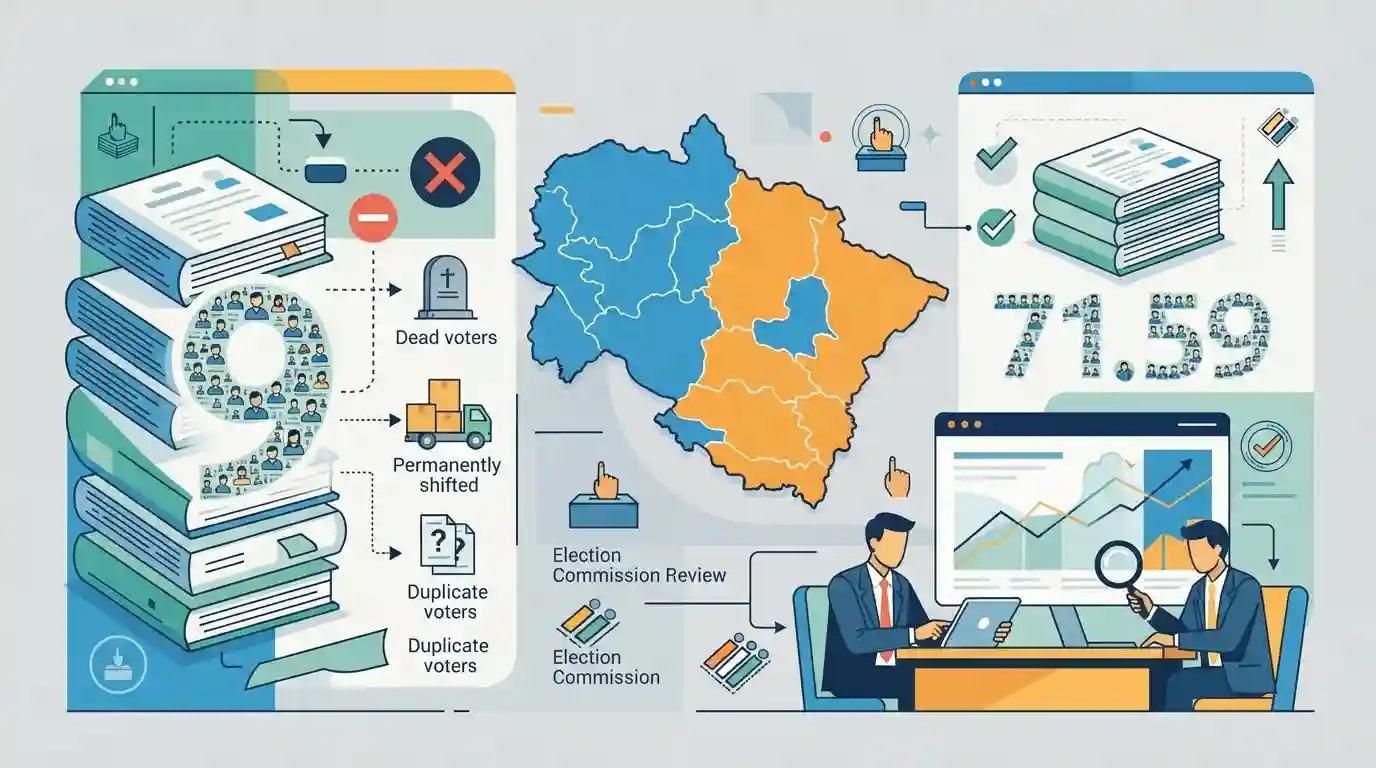
A Special Intensive Revision (SIR) exercise conducted in Uttarakhand led to the deletion of approximately nine lakh names from the State's electoral rolls, reducing the total voter base to 71.59 lakh. The deletions primarily target dead, permanently shifted, and duplicate voters, highlighting administrative measures by the Election Commission to maintain clean and updated voter lists.
મુખ્ય મુદ્દા
- The Special Intensive Revision (SIR) exercise in Uttarakhand resulted in the removal of nearly 9 lakh names from the voter lists.
- The drop was attributed to the elimination of dead, shifted, and duplicate voters, bringing the total registered voter count down to 71.59 lakh.
- The exercise highlights the continuous efforts of the Election Commission to ensure clean, accurate, and error-free electoral rolls.
મહત્વપૂર્ણ શબ્દો
Special Intensive Revision (SIR)

A comprehensive administrative exercise conducted by the Election Commission of India involving house-to-house enumeration to update voter lists, delete dead, shifted, or duplicate voters, and ensure accurate electoral rolls.
UPSC context
Important for GS Paper II (Polity and Governance - Electoral Reforms and Election Commission functioning).
Election Commission of India
An autonomous constitutional authority responsible for administering election processes in India under Article 324 of the Constitution, ensuring free and fair elections to Parliament, State Legislatures, and offices of the President and Vice-President.
UPSC context
Core topic under GS Paper II (Constitutional Bodies, Polity and Governance).
Chief Electoral Officer Uttarakhand
The designated head of the election department in a state, working under the direct control and supervision of the Election Commission of India to supervise electoral roll revisions and election conduct.
UPSC context
Relevant for GS Paper II (Administrative machinery for elections and decentralized governance).
પ્રિલિમ્સ ટ્રેપ
Special Intensive Revision (SIR) of electoral rolls requires fresh parliamentary legislation before state-level implementation.
Aspirants often assume special revisions require explicit legislative amendment for every state exercise, missing that the ECI derives continuous statutory power directly from Section 21 of the Representation of the People Act, 1950.
સંલગ્ન સ્થિર ખ્યાલો
What are the constitutional and statutory provisions governing the preparation and revision of electoral rolls in India?
- Article 324: Superintendence power vested in Election Commission of India under Article 324 of the Constitution.
- RPA 1950 Section 21: Statutory power to revise rolls annually or intensively derived from Section 21 of the Representation of the People Act, 1950.
- Ground Execution: Ground-level verification is conducted by Booth Level Officers (BLOs) following draft publication and claims/objections process.
આંતર-વિષય પેટર્ન
Electoral Rolls + Border State Demographics
Large-scale voter roll purges in border states like Uttarakhand raise national security concerns regarding demographic shifts and illegal immigration, linking administrative electoral purity with border governance.
ECI Electoral Database + Digital Governance
The digital modernization of electoral databases via Booth Level Officers connects administrative transparency with the broader push toward e-governance and unique identification frameworks.

ECI's statutory powers for voter roll revision under RPA 1950 and Article 324 will likely be tested via a statement-based polity question.
સંલગ્ન PYQ · 3
સંલગ્ન PYQ · 3
- 2024MainsGS2
Examine the need for electoral reforms as suggested by various committees with particular reference to "one nation one election" principle.
- 2017MainsGS2
To enhance the quality of democracy in India the Election Commission of India has proposed electoral reforms in 2016. What are the suggested reforms and how far are they significant to make democracy successful?
- 2017PrelimsGS1
Consider the following statements: 1. The Election Commission of India is a five-member body. 2. Union Ministry of Home Affairs decides the election schedule for the conduct of both general elections and bye-elections. 3. Election Commission resolves the disputes relating to splits/mergers of recognised political parties. Which of the statements given above is/are correct?
