Maharashtra Electoral Rolls Revision Timeline And Process
Source:thelivenagpur ↗
Why It Matters
Understanding the mechanisms of voter registration, the revision of electoral rolls, and the roles of the Election Commission is fundamentally tied to the functioning of India's democratic and electoral processes, a central theme in Polity.
Summary
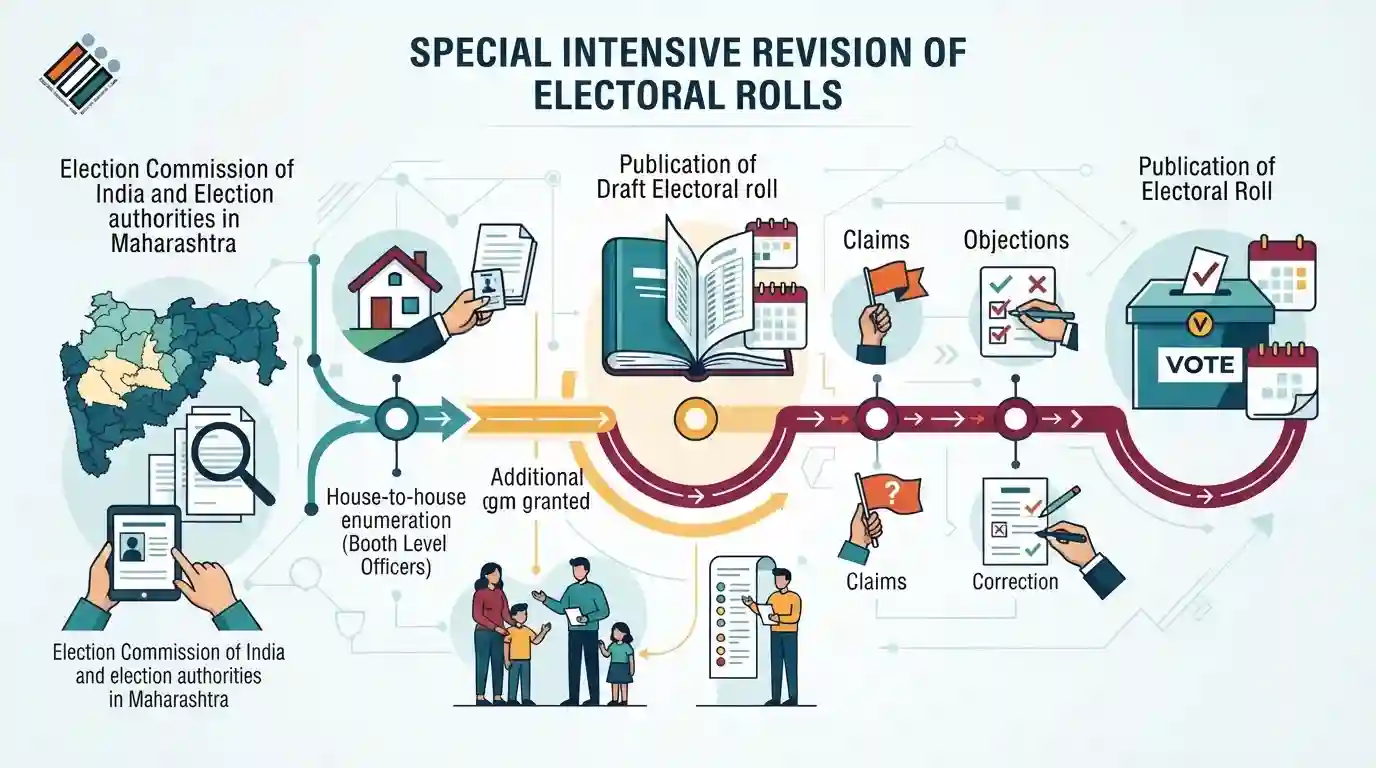
The Election Commission has extended the timeline for the Special Intensive Revision (SIR) of electoral rolls in Maharashtra, giving election authorities additional time to process voter registrations and claims. Following a request from the Maharashtra Chief Electoral Officer, the final electoral roll publication has been delayed from October 7 to November 4, 2026. The draft roll will be published on August 31, initiating an extended period until October 29 for the filing of claims and objections based on the recent house-to-house enumeration conducted by Booth Level Officers.
Key Points
- The Election Commission (EC) has extended the timeline for the Special Intensive Revision (SIR) of electoral rolls in Maharashtra.
- The final electoral roll is now scheduled to be published on November 4, instead of October 7.
- The deadline extension allows more time for scrutinising information from the door-to-door enumeration process, processing claims, and objections.
- The draft electoral roll will be published on August 31, and the period for filing claims and objections will run from August 31 to October 29.
Important Terms
Special Intensive Revision (SIR)

A comprehensive exercise by the Election Commission to update and verify electoral rolls via house-to-house enumeration. It removes duplicates, deceased, and ineligible voters while ensuring all eligible citizens are registered.
UPSC context
Relevant for GS Paper 2 (Electoral Reforms/Statutory Bodies). Tests understanding of processes ensuring free, fair elections and accurate voter databases.
Election Commission of India (ECI)
A permanent, independent constitutional body established under Article 324 to superintend, direct, and control elections to Parliament, State Legislatures, and the offices of President and Vice President.
UPSC context
Crucial for GS Paper 2 (Constitutional Bodies). Tests knowledge of its mandate, Article 324, structure, and role in conducting elections.
Chief Electoral Officer (CEO)
A statutory officer deputed by the Election Commission to supervise the preparation, revision, and correction of all electoral rolls and conduct elections in a state or union territory.
UPSC context
Important for GS Paper 2 (Elections). Tests understanding of the administrative machinery under the Representation of the People Act, 1950.
Booth Level Officer (BLO)
A local government or semi-government official serving as the grassroots representative of the Election Commission, responsible for verifying voter details and maintaining accurate electoral rolls for their assigned booth.
UPSC context
Relevant for GS Paper 2 (Electoral Reforms/Governance). Focuses on grassroots election machinery and procedures for electoral roll maintenance.
Prelims Trap
The Special Intensive Revision of electoral rolls for Maharashtra Assembly elections is conducted under the guidance of the State Election Commission.
Electoral rolls for Parliamentary and Assembly elections are prepared under the superintendence of the Election Commission of India (ECI), not the State Election Commission (SEC), which only handles local body polls.
Static Concepts Connected
How do RPA 1950 and RPA 1951 divide electoral responsibilities?
- RPA 1950 focus: Governs voter qualification, seat allocation, constituency delimitation, and preparation of electoral rolls.
- RPA 1951 focus: Deals with actual election conduct, candidate qualifications/disqualifications, corrupt practices, and dispute resolution.
- CEO Role: The Chief Electoral Officer is designated under RPA 1950 to supervise state-level roll preparation.
Cross-Topic Patterns
ECI vs SEC electoral roll integration
Harmonizing assembly rolls (ECI) with local panchayat/municipal rolls (SEC) highlights administrative coordination, avoiding costly duplication of house-to-house BLO operations.

Expect a multi-statement question on RPA 1950 vs 1951 statutory divisions and ECI's control over the state electoral machinery.
Linked PYQs · 2
Linked PYQs · 2
- 2024MPSC_PRELIMSGS1
Which Articles in the Constitution provide for the electoral system in our country ?
- 2018MPSC_PRELIMSGS1
On 26th November, 1949, which of the following provisions of the Constitution of India came into effect ? a. Citizenship b. Elections (Article-324) c. Provisional Parliament d. Fundamental Rights Answer Options :
