Electoral Roll Revision in Telangana and Administrative Challenges
Source:The Hindu ↗
Why It Matters
Maintaining an accurate electoral roll is fundamental to conducting free and fair elections. The Special Intensive Revision (SIR) exercise highlights the practical administrative challenges and solutions in verifying voter details, reflecting on the broader aspects of electoral governance under the purview of the ECI.
Summary
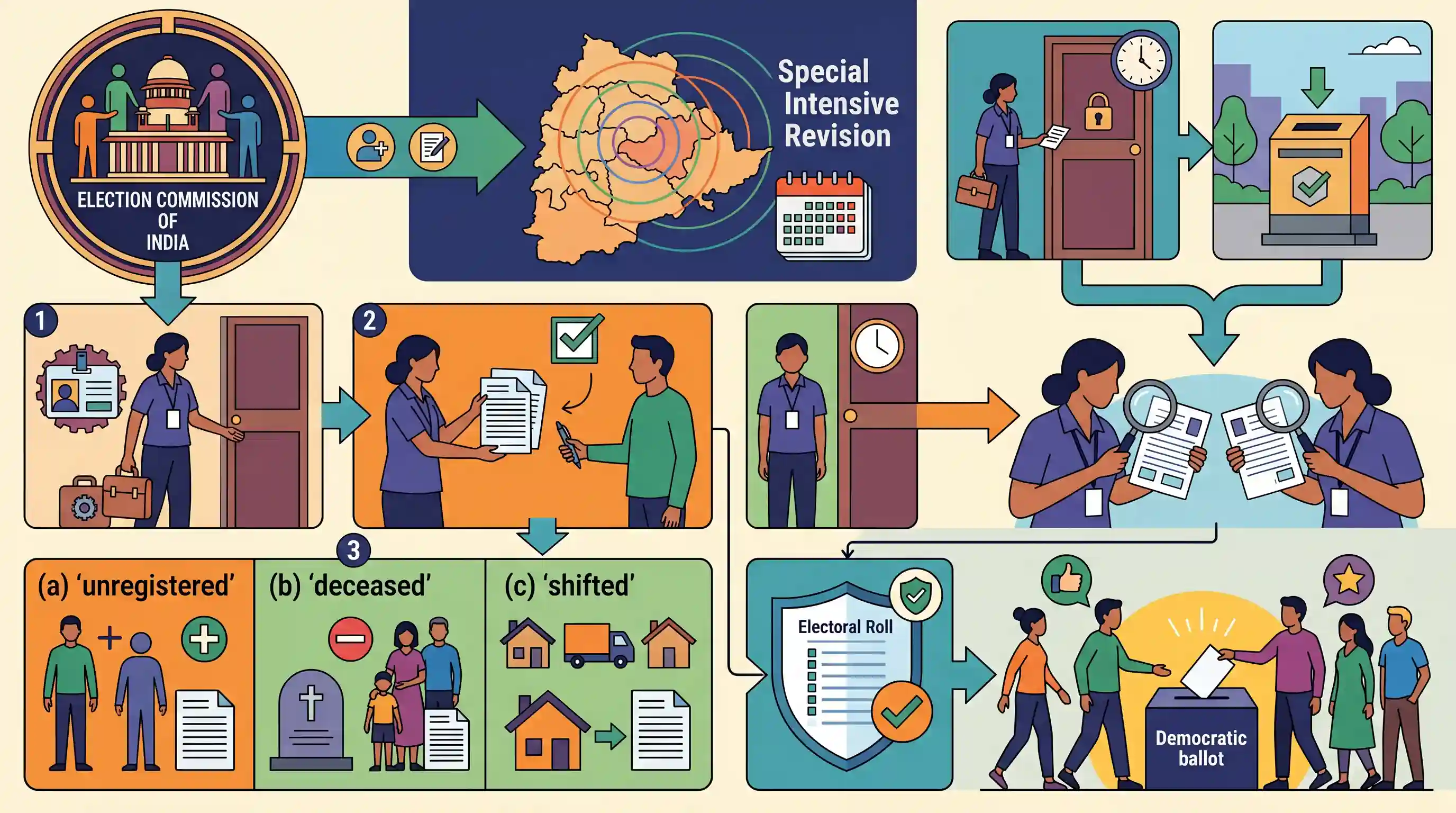
The Election Commission of India has initiated a Special Intensive Revision (SIR) of electoral rolls in Telangana. As part of the exercise, Booth Level Officers (BLOs) will conduct door-to-door visits over a month to distribute Enumeration Forms. The initiative aims to capture accurate details regarding unregistered, deceased, or shifted voters. Electors who are unavailable during the visits can use drop-box facilities, with subsequent physical verification ensuring the integrity of the updated voter list. This administrative effort is a key component of ground-level election management and democratic participation.
Key Points
- The Election Commission of India (ECI) launched a Special Intensive Revision (SIR) of electoral rolls in Telangana.
- Booth Level Officers (BLOs) are conducting house-to-house visits from June 25 to July 24 to distribute Enumeration Forms.
- The objective is to accurately identify and update details of unregistered, dead, and shifted electors to ensure a flawless voter list.
- For voters unavailable during visits, a drop-box facility is provided, which will be followed by physical verification by BLOs.
Important Terms
Special Intensive Revision (SIR)

A thorough ECI exercise to update electoral rolls via house-to-house enumeration. It involves fresh data collection to eliminate deceased, shifted, or duplicate voters, ensuring roll integrity before major elections.
UPSC context
GS II: Electoral Reforms. Tests understanding of administrative mechanisms used to ensure "free and fair" elections via accurate voter databases.
Election Commission of India (ECI)
A permanent constitutional body (Article 324) responsible for directing and controlling the preparation of electoral rolls and conducting elections to Parliament, State Legislatures, and the offices of President/Vice-President.
UPSC context
GS II: Constitutional Bodies. Crucial for questions on election management, independence of the commission, and the Model Code of Conduct.
Booth Level Officer (BLO)
A grassroots ECI representative, usually a local government official (e.g., teacher or village worker), responsible for maintaining the electoral roll, conducting physical verifications, and facilitating voter registration at the polling booth level.
UPSC context
GS II: Governance. Highlights the "last-mile" administrative link in the democratic process and the implementation of the Representation of the People Act.
Greater Hyderabad Municipal Corporation (GHMC)
The civic body responsible for Hyderabad's urban administration. In the electoral context, its Commissioner often serves as the District Election Officer (DEO) for the district's Assembly constituencies.
UPSC context
GS II: Local Governance & Federalism. Pertains to the role of urban local bodies and their administrative overlap with state/central election machinery.
Representation of the People Act, 1950
The primary legal framework (along with the RPA 1951) governing the allocation of seats, delimitation of constituencies, and the preparation/revision of electoral rolls in India.
UPSC context
GS II: Statutory Bodies/Electoral Laws. A core legislative topic frequently tested in Prelims and Mains regarding voter eligibility and roll preparation.
Prelims Trap
"The Representation of the People Act, 1951 governs the preparation and revision of electoral rolls."
Preparation, revision, and maintenance of electoral rolls are governed by the RPA 1950. The RPA 1951 deals exclusively with the actual conduct of elections.
Static Concepts Connected
How is the preparation of electoral rolls legally governed in India?
- Constitutional Mandate: Article 324 vests the superintendence, direction, and control of electoral roll preparation in the Election Commission of India.
- Statutory Framework: The Representation of the People Act, 1950 specifically regulates the preparation, revision, and ongoing maintenance of electoral rolls.
- Qualifying Dates: Post-2021 amendments, there are four qualifying dates (Jan 1, Apr 1, Jul 1, Oct 1) annually for citizens to register as voters.
What distinguishes Special Intensive Revision (SIR) from Special Summary Revision (SSR)?
- Intensive Revision (SIR): Involves proactive, door-to-door verification by Booth Level Officers (BLOs) to comprehensively update the voter list by capturing unregistered or shifted voters.
- Summary Revision (SSR): Relies primarily on citizens voluntarily filing claims and objections after a draft electoral roll is published.
Cross-Topic Patterns
Aadhaar linkage & Electoral Rolls
The 2021 Election Laws Amendment permitted voluntary Aadhaar linking for electoral roll purification, which directly informs and aids BLO verification exercises on the ground.
Delimitation & Demographic Mapping
Ground-level demographic data updated via SIR provides baseline accuracy for future delimitation exercises, connecting Article 324 (electoral rolls) to Article 82 (readjustment after census).

Expect a Prelims question testing the difference between RPA 1950 (rolls) & 1951 (conduct), and the four new qualifying registration dates.
Linked PYQs · 3
Linked PYQs · 3
- 2017PrelimsGS1
Right to vote and to be elected in India is a
- 2017PrelimsGS1
For election to the Lok Sabha, a nomination paper can be filed by
- 2022MainsGS2
Discuss the procedures to decide the disputes arising out of the election of a Member of the Parliament or State Legislature under The Representation of the People Act, 1951. What are the grounds on which the election of any returned candidate may be declared void ? What remedy is available to the aggrieved party against the decision ? Refer to the case laws.
