Draft electoral rolls reveal mass deletion of electors nationwide
Source:Indian Express ↗
Why It Matters
The accuracy of electoral rolls is fundamental to conducting free and fair elections in a democracy. Mass deletions highlight the balance the Election Commission must strike between eliminating fraudulent entries and safeguarding the constitutional right to vote for all eligible citizens.
Summary
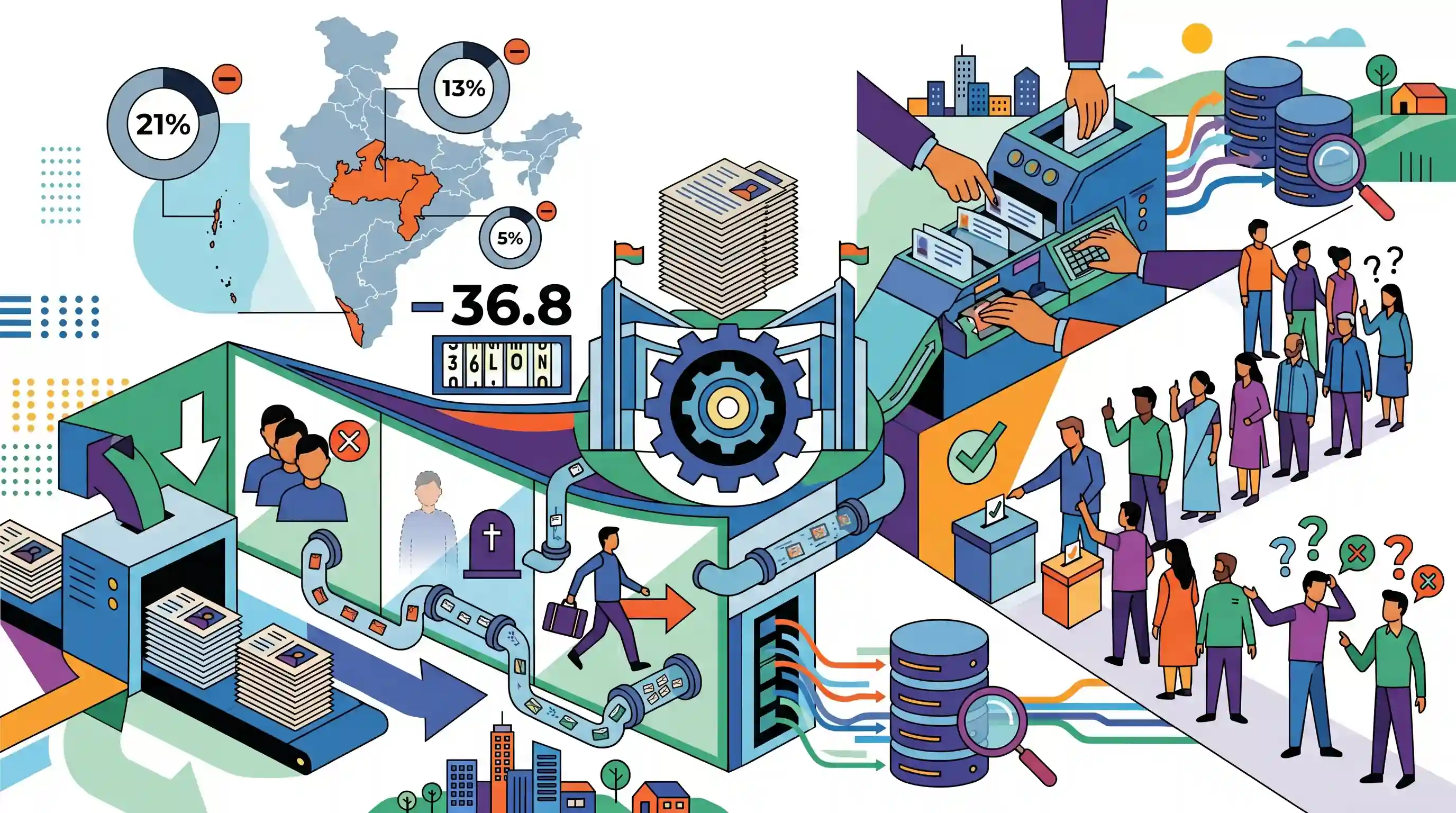
Recent draft electoral rolls published by the Election Commission of India reveal that 3.68 crore electors have been deleted nationwide. The Andaman and Nicobar Islands recorded the highest deletion rate at 21%, while states like Kerala, Madhya Pradesh, and Chhattisgarh saw deletions of up to 13%. While regular revisions are mandated under the Representation of the People Act, 1950 to weed out duplicate, dead, or shifted voters, such high percentages of deletions also bring forth concerns regarding the inadvertent exclusion of legitimate voters, highlighting the administrative challenges of maintaining an accurate electoral database.
Key Points
- The Election Commission of India removed 3.68 crore electors from the draft rolls during the recent revision exercise.
- The Andaman and Nicobar Islands witnessed the highest proportion of deletions, with 21% of its electors removed.
- Kerala, Madhya Pradesh, and Chhattisgarh also recorded significant reductions, with up to 13% of electors deleted from the draft rolls.
- The deletion of voters is typically undertaken to remove duplicate entries, deceased individuals, and those who have permanently migrated, ensuring the integrity of the electoral roll.
- Such large-scale purges often raise concerns among civil rights groups regarding the potential arbitrary disenfranchisement of legitimate voters.
Important Terms
Election Commission of India (ECI)

A permanent constitutional body under Article 324 responsible for the superintendence, direction, and control of elections to Parliament, State Legislatures, and the offices of President and Vice-President.
UPSC context
GS Paper II: Constitutional Bodies. Crucial for understanding the institutional framework of Indian democracy and electoral governance.
Representation of the People Act, 1950
A central legislation governing seat allocation, delimitation of constituencies, voter qualifications, and the administrative preparation of electoral rolls for the Lok Sabha and State Legislatures.
UPSC context
GS Paper II: Governance/Statutory Bodies. It forms the legal basis for voter registration and the pre-election administrative framework.
Special Intensive Revision (SIR)
A comprehensive, house-to-house verification drive conducted by the ECI to update voter lists by removing deceased, shifted, or duplicate entries and registering new eligible voters.
UPSC context
GS Paper II: Electoral Reforms. Tests knowledge of intensive administrative measures to ensure electoral roll integrity and prevent voter exclusion.
Article 324
The fundamental constitutional provision that grants the Election Commission the 'plenary power' of superintendence, direction, and control over the preparation of electoral rolls and conduct of elections.
UPSC context
GS Paper II: Indian Constitution. Central to debates on the autonomy and powers of the Election Commission of India.
Electoral Roll
The official list of persons registered and eligible to vote in a specific constituency, maintained and updated periodically to uphold the principle of universal adult suffrage.
UPSC context
GS Paper II: Elections. The accuracy of this list is a primary concern for democratic inclusion and the prevention of electoral fraud.
Booth Level Officer (BLO)
A ground-level official appointed by the Election Commission to perform tasks like house-to-house verification, distribution of forms, and maintaining local voter data accuracy.
UPSC context
GS Paper II: Governance/Elections. Represents the frontline of electoral administration; critical for ground-truth verification during intensive revisions.
Prelims Trap
The preparation and revision of electoral rolls are governed by the Representation of the People Act, 1951.
RPA 1950 exclusively handles electoral rolls, voter qualifications, and delimitation. RPA 1951 deals with the actual conduct of elections, offenses, and dispute resolution.
Static Concepts Connected
How does RPA 1950 differ from RPA 1951?
- RPA 1950: Deals with the allocation of seats, delimitation of constituencies, voter qualifications, and the preparation of electoral rolls.
- RPA 1951: Covers the actual conduct of elections, qualifications/disqualifications for membership, corrupt practices, and electoral offenses.
What is the nature of the Right to Vote in India?
- Constitutional Right: The Supreme Court has clarified it is a Constitutional Right originating from Article 326 (Universal Adult Suffrage), not a Fundamental Right.
- Statutory Regulation: While derived from the Constitution, the active exercise of this right is shaped, regulated, and restricted by the Representation of the People Act.
Cross-Topic Patterns
Voter ID & Aadhaar Linkage
Purging duplicate voters brings up the Election Laws (Amendment) Act, 2021, which facilitates linking Aadhaar with electoral rolls, repeatedly triggering debates regarding the Puttaswamy right to privacy judgment.
Migrant Voters & Remote Voting
The deletion of "shifted" voters highlights the challenge of domestic migrant enfranchisement, connecting directly to the ECI's recent, highly debated push for Remote Electronic Voting Machines (RVMs).

Expect a tricky 2026 Prelims statement swapping provisions of RPA 1950 and 1951, specifically targeting the ECI's roll revision powers.
Linked PYQs · 3
Linked PYQs · 3
- 2017PrelimsGS1
Right to vote and to be elected in India is a
- 2017PrelimsGS1
For election to the Lok Sabha, a nomination paper can be filed by
- 2024MainsGS2
Examine the need for electoral reforms as suggested by various committees with particular reference to "one nation one election" principle.
