Kerala High Court seeks probe report on sinking of ship MSC Elsa 3
Source:The Hindu ↗
Why It Matters
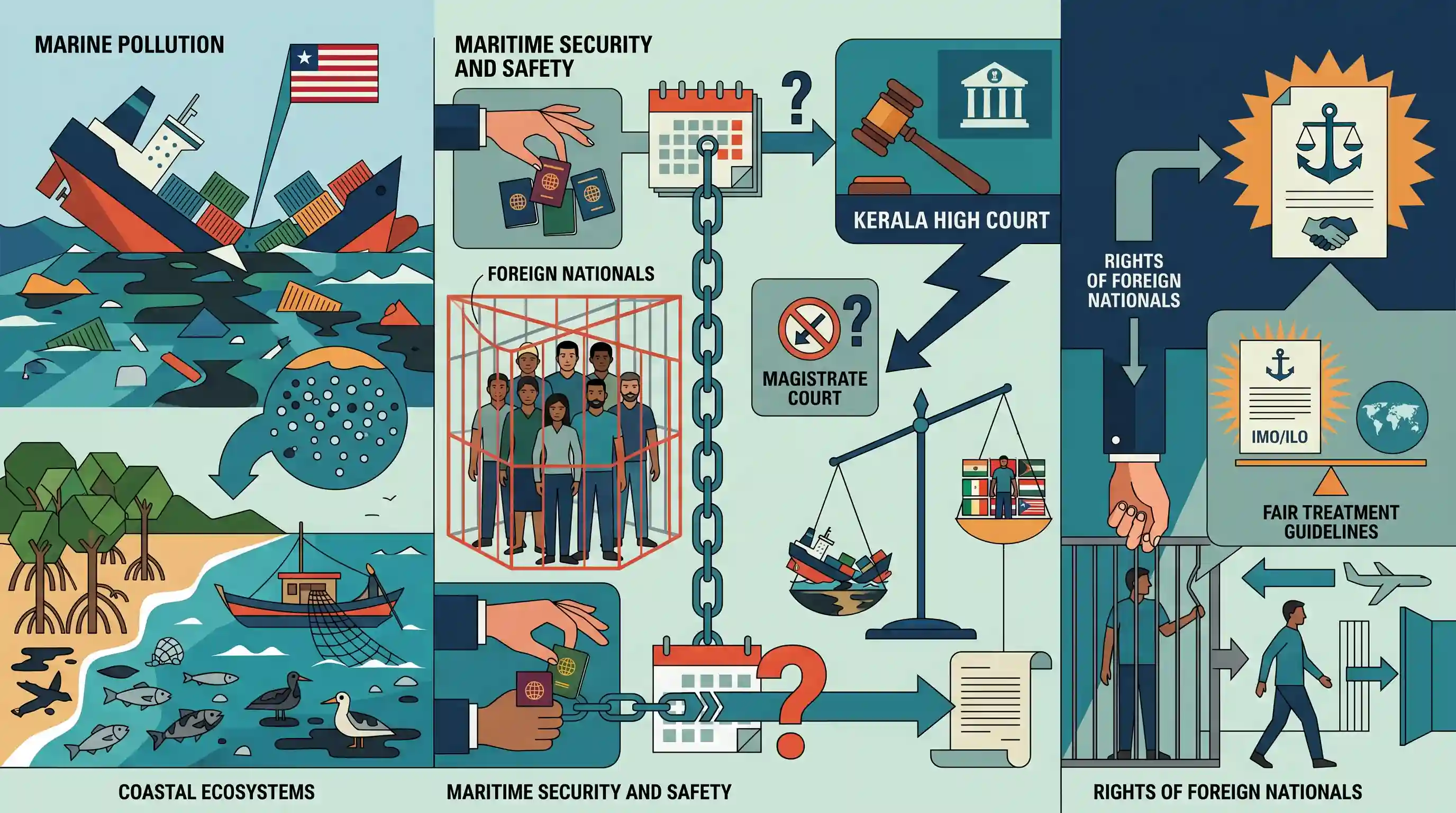
The incident highlights the environmental hazards posed by maritime accidents to India's coastal ecosystems. It also raises important legal and human rights questions regarding the detention of foreign seafarers, touching upon international maritime guidelines and the role of the judiciary in ensuring timely investigations and protecting individual liberties.
Summary
The Kerala High Court has directed a magistrate court to report on the delay in investigating the sinking of the Liberia-flagged ship MSC Elsa 3 off the Alappuzha coast, which caused extensive marine pollution in May 2025. The foreign crew members petitioned the court for the return of their passports and permission to leave India, alleging prolonged detention. The Court emphasized that their liberty should not be compromised merely because of their nationality, referencing guidelines for the fair treatment of seafarers involved in maritime accidents.
Key Points
- The Kerala High Court sought a report regarding the delay in investigating the criminal case against the crew of the sunken ship MSC Elsa 3.
- The sinking of the Liberia-flagged vessel in May 2025 caused severe marine and coastal pollution off the coast of Kerala.
- Stranded foreign crew members approached the court seeking the release of their passports to return to their home countries.
- The court underscored that the liberty of foreign nationals must be respected and referenced international guidelines for the fair treatment of seafarers after maritime accidents.
Important Terms
IMO/ILO Guidelines on Fair Treatment of Seafarers

A non-binding international framework adopted by the IMO and ILO to ensure seafarers are treated fairly during accident investigations and protected from unwarranted criminalization or prolonged detention.
UPSC context
GS Paper II (IR) and Paper III (Security). Tests knowledge of international labor standards and maritime legal frameworks.
Article 21 of the Indian Constitution
A fundamental right guaranteeing that no person (including foreign nationals) shall be deprived of life or personal liberty except according to procedure established by law.
UPSC context
GS Paper II (Polity). Essential for understanding the universality of fundamental rights and judicial protection for foreigners.
Merchant Shipping Act, 1958
The primary Indian legislation regulating maritime safety, crew welfare, and marine pollution; Part XIA specifically empowers the government to prevent and contain oil pollution.
UPSC context
GS Paper III (Environment/Infrastructure). Tests awareness of domestic laws governing maritime accidents and environmental liability.
Polluter Pays Principle
An environmental law doctrine holding that the party responsible for pollution should bear the costs of managing it to prevent damage to human health or the environment.
UPSC context
GS Paper III (Environment). A core principle of Indian environmental jurisprudence often cited in National Green Tribunal and High Court rulings.
Admiralty Jurisdiction
The legal authority of designated High Courts (like Kerala) to hear maritime claims, including ship arrests and compensation for marine pollution, under the Admiralty Act, 2017.
UPSC context
GS Paper II (Judiciary). Relevant for understanding the specialized jurisdiction of courts in international maritime disputes.
Prelims Trap
Constitutional protections against prolonged detention under Article 21 are exclusively reserved for Indian citizens.
Article 21 (Right to Life and Liberty) applies to 'all persons'—citizens and foreigners alike—unlike Articles 15, 16, 19, 29, and 30 which are citizen-only.
Static Concepts Connected
Which Fundamental Rights are available to foreign nationals in India?
- Article 14: Equality before law and equal protection of laws within the territory of India.
- Article 21: Protection of life and personal liberty, preventing arbitrary or prolonged detention of foreign nationals by the State.
- Citizen-only Exceptions: Articles 15, 16, 19, 29, and 30 (discrimination, public employment, core freedoms, cultural/educational rights) are exclusively for citizens.
What are 'Flags of Convenience' (FoC) in international maritime operations?
- Definition: The business practice of registering a commercial ship in a sovereign state different from that of the ship's actual owners.
- Regulatory Arbitrage: Owners use FoC registries (like Liberia or Panama) to bypass strict environmental regulations, lower operating costs, and obscure beneficial ownership.
- Accountability Void: It severely complicates the enforcement of financial liability and crew repatriation during maritime disasters or marine pollution incidents.
Cross-Topic Patterns
Flags of Convenience & Coastal Security
Flags of Convenience (FoC) vessels obscure beneficial ownership, hampering not just environmental liability but also coastal security and anti-piracy operations in the Indian Ocean.
Judiciary & Maritime Treaties
Courts frequently invoke IMO/ILO seafarer guidelines to reinforce Article 21 rights, bridging domestic constitutional mandates with international maritime conventions.

A 2026 polity/environment hybrid question will likely cross 'Flags of Convenience' liabilities with Article 21 rights for foreign nationals.
Linked PYQs · 2
Linked PYQs · 2
- 2023MainsGS3
What is oil pollution? What are its impacts on the marine ecosystem? In what way is oil pollution particularly harmful for a country like India?
- 2023MainsGS2
‘Sea is an important Component of the Cosmos’ Discuss in the light of the above statement the role of the IMO (International Maritime Organisation) in protecting environment and enhancing maritime safety and security.
