Implementation Challenges in Single Use Plastic Ban Enforcement
Source:The Hindu ↗
Why It Matters
Highlights the practical challenges of enforcing environmental regulations like the single-use plastic ban at the municipal level, demonstrating the limitations of end-user fines and the necessity of tackling pollution at the manufacturing source.
Summary
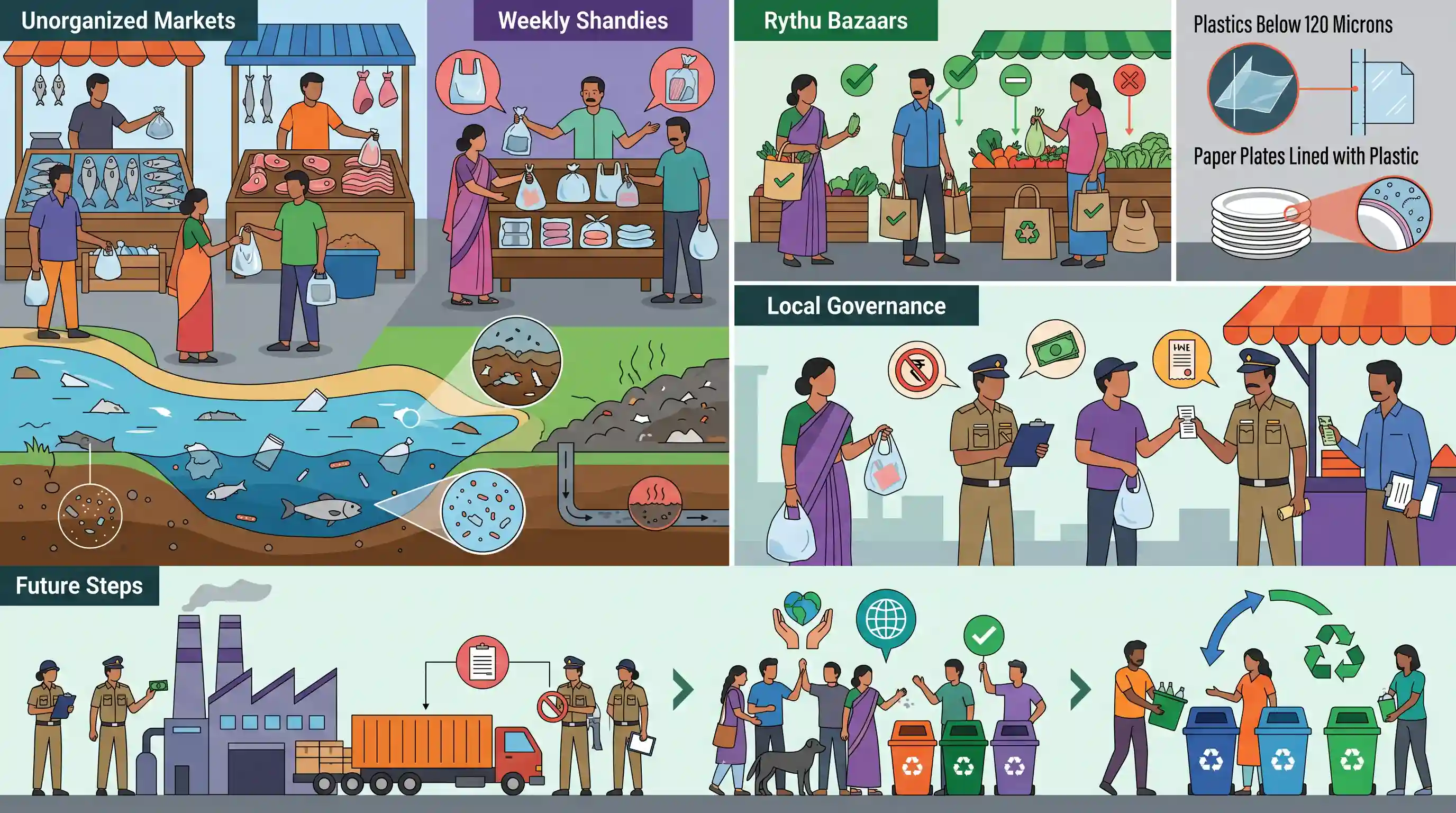
The single-use plastic ban in Visakhapatnam is encountering severe implementation challenges, particularly in unorganized markets such as fish, meat, and weekly shandies, despite relative success in rythu bazaars. Environmentalists point out that plastics below 120 microns and paper plates lined with thin plastic are still widely used, causing long-term environmental degradation. Although the Greater Visakhapatnam Municipal Corporation (GVMC) is enforcing fines through its Public Health Department, experts emphasize that genuine change requires penalizing manufacturers and suppliers, alongside fostering greater public awareness and citizen participation in waste management.
Key Points
- Implementation of the single-use plastic ban is failing in unorganized sectors like meat markets and weekly shandies in Visakhapatnam, despite success in rythu bazaars.
- Environmentalists highlight the continued threat from plastics below 40-120 microns, which are non-degradable and harmful to the ecosystem.
- Everyday items like paper plates lined with thin plastic sheets further compound the plastic waste crisis.
- While the Greater Visakhapatnam Municipal Corporation (GVMC) conducts inspections and levies fines, experts argue this is insufficient without targeting manufacturers and bulk suppliers.
- Solving the plastic waste issue requires consistent enforcement by local bodies, combined with sustained public awareness and citizen responsibility.
Important Terms
Single-use plastic (SUP)

Plastic items designed to be used once before being discarded or recycled, known for low utility and high littering potential.
UPSC context
GS III: Environmental Pollution. Tests awareness of non-biodegradable waste impacts and India's 2022 nationwide ban on specific items.
Plastic Waste Management (PWM) Rules
The legal framework (2016; amended 2022, 2024) regulating plastic manufacture and waste, mandating minimum thickness (120 microns) for carry bags.
UPSC context
GS III: Conservation/Environmental Laws. Tests knowledge of statutory limits and phased implementation of pollution control measures.
Extended Producer Responsibility (EPR)
Policy making producers, importers, and brand owners (PIBOs) responsible for the collection and environmentally sound disposal of post-consumer plastic waste.
UPSC context
GS III: Environmental Economics. Central to the 'Polluter Pays' principle and shifting the waste management burden to manufacturers.
Microplastics
Small plastic particles less than 5mm in size that persist in the environment, causing bioaccumulation in the food chain and marine ecosystems.
UPSC context
GS III: Science & Environment. Tests understanding of ecological hazards, trophic transfer, and human health impacts.
Urban Local Bodies (ULBs)
Statutory local government entities, such as Municipal Corporations, mandated to enforce waste management rules and sanitation at the grassroots urban level.
UPSC context
GS II: Governance. Tests the functional devolution to local governments under the 74th Constitutional Amendment Act.
Circular Economy
An economic model focused on minimizing waste by making products durable and ensuring they are reused, repaired, or recycled back into production.
UPSC context
GS III: Sustainable Development. Relevant for resource efficiency and achieving Sustainable Development Goal (SDG) 12.
Prelims Trap
"The Plastic Waste Management Rules currently mandate a minimum thickness of 50 microns for plastic carry bags."
The minimum thickness was increased to 75 microns in 2021, and further raised to 120 microns effective December 31, 2022, to facilitate better collection and recycling.
Static Concepts Connected
What is Extended Producer Responsibility (EPR) in plastic waste management?
- Polluter Pays: Shifts the physical and financial responsibility of end-of-life plastic waste management away from municipalities to the producers, importers, and brand owners.
- Mandatory Targets: Mandates specific targets for collection, recycling, and the mandatory use of recycled plastic content in packaging.
- Market Mechanism: EPR certificates can be traded on a centralized portal, incentivizing companies to exceed their recycling targets for financial gain.
Why are composite items like plastic-lined paper plates an environmental hazard?
- Recycling Barrier: Separating the ultra-thin plastic lining from the paper base requires specialized processes, making recycling economically and technologically unviable.
- Microplastic Generation: When dumped, the biodegradable paper decomposes rapidly while the thin plastic fragments into microplastics, persisting in soil and aquatic ecosystems.
- Contamination: Mixed disposal with wet waste disrupts composting processes and creates toxic leachates in landfills.
Cross-Topic Patterns
74th Amendment and ULB Capacity
The struggle of Urban Local Bodies to enforce environmental regulations like the plastic ban highlights systemic capacity and financial constraints within decentralized governance (74th Amendment).
Coastal Cities and Marine Microplastics
Plastic waste mismanagement in coastal cities like Visakhapatnam directly translates to marine microplastic pollution, threatening aquatic food webs and violating SDG 14 (Life Below Water).

Expect a multi-statement Prelims question testing the exact 120-micron limit under PWM Amendment Rules 2021 alongside the EPR framework.
Linked PYQs · 4
Linked PYQs · 4
- 2018MainsGS3
What are the impediments in disposing the huge quantities of discarded solid wastes which are continuously being generated? How do we remove safely the toxic wastes that have been accumulating in our habitable environment?
- 2024MainsGS2
Analyse the role of local bodies in providing good governance at local level and bring out the pros and cons merging the rural local bodies with the urban local bodies.
- 2024PrelimsGS1
Consider the following statements : Statement-I: Many chewing gums found in the market are considered a source of environmental pollution. Statement-II : Many chewing gums contain plastic as gum base. Which one of the following is correct in respect of the above statements?
- 2025PrelimsGS1
Consider the following: I. Cigarette butts II. Eyeglass lenses III. Car tyres How many of them contain plastic?
