Supreme Court Observations on Environmental Litigation
Source:Indian Express ↗
Why It Matters
It provides crucial insights into the judiciary's stance on the 'environment vs. development' debate, directly relevant to GS-3 (EIA, infrastructure, and ecology) and GS-2 (Judicial intervention, NGT). The case also touches upon important factual aspects regarding coastal infrastructure clearances and marine biodiversity conservation.
Summary
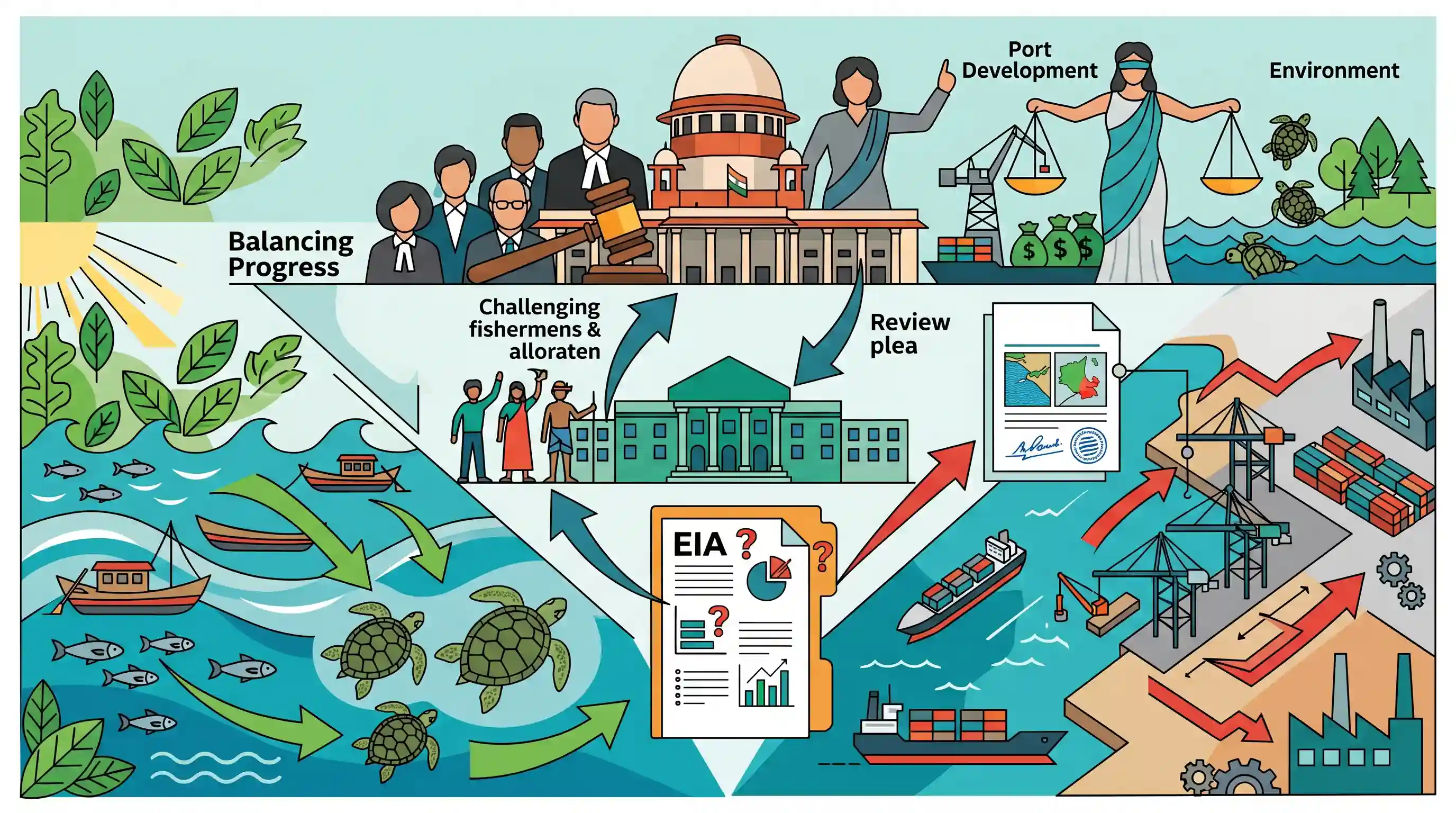
The Supreme Court expressed concern over environmental litigations being used primarily to halt development projects, emphasizing the need to balance progress with environmental protection. While hearing a plea against the NGT's refusal to quash environmental and CRZ clearances for Gujarat's Pipavav Port expansion, the Court urged activists to offer practical suggestions for sustainable development rather than just stalling projects. The petitioners alleged discrepancies in the Environmental Impact Assessment (EIA) report regarding impacts on Saurashtra's fisheries and marine species like Olive Ridley turtles. Ultimately, the Court permitted a review plea before the NGT to address these specific EIA concerns.
Key Points
- The Supreme Court criticized the trend of using environmental litigation solely to stall infrastructure projects, urging activists to propose constructive safeguards for sustainable development instead.
- The remarks were made during a hearing regarding the environmental and coastal regulation zone (CRZ) clearances for the expansion of Pipavav Port in Gujarat.
- Petitioners challenged the Environmental Impact Assessment (EIA) report, arguing it ignored the presence of marine mammals like humpback whales and Olive Ridley turtles, and the impact on the region's fisheries.
- The Court maintained that the transient movement of marine species does not necessarily denote a nesting ground, but allowed the appellant to file a review plea before the NGT regarding EIA deficiencies.
- Separately, the NGT has mandated strict compliance with conservation measures in Tamil Nadu and Andhra Pradesh due to a surge in Olive Ridley turtle deaths.
Important Terms
Environmental Impact Assessment (EIA)

A statutory process under the Environment Protection Act, 1986, to evaluate the potential environmental, social, and economic impacts of a proposed project before approval.
UPSC context
GS3: Environment; essential for understanding regulatory compliance, project clearances, and balancing industrial growth with ecological preservation.
Coastal Regulation Zone (CRZ)
Coastal stretches notified by the Central Government to protect fragile marine ecosystems while allowing regulated development based on High Tide and Low Tide lines.
UPSC context
GS3: Environment & Disaster Management; critical for questions on coastal ecology, blue economy, and infrastructure regulation in sensitive zones.
National Green Tribunal (NGT)
A specialized judicial body established under the NGT Act, 2010, for the expeditious disposal of cases involving environmental protection and forest conservation.
UPSC context
GS2: Statutory bodies; GS3: Environment; tests knowledge of environmental adjudication, quasi-judicial powers, and the "Polluter Pays" principle.
Olive Ridley Turtles
The smallest and most abundant sea turtle species, known for their unique mass nesting (arribada) and protected under Schedule I of the Wildlife Protection Act.
UPSC context
GS3: Biodiversity & Conservation; frequent topic in Prelims regarding species status, nesting sites like Gahirmatha, and conservation threats.
Sustainable Development
Development that meets present needs without compromising future generations' ability to meet theirs, balancing economic growth with social equity and environmental integrity.
UPSC context
GS3: Economy & Environment; a foundational concept for ethics, environmental policy, and global development goals (SDGs).
Prelims Trap
"The Saurashtra coast is recognized as a major arribada nesting site for Olive Ridley turtles."
The SC explicitly distinguished transient marine movement near Gujarat from actual mass nesting grounds (arribadas), which primarily occur on the Odisha coast.
Static Concepts Connected
What is the appellate jurisdiction of the NGT regarding environmental clearances?
- Statutory mandate: Hears civil cases under 7 key environmental laws, including the Environment (Protection) Act, 1986, which governs EIA and CRZ.
- Clearance reviews: Holds appellate power to review, modify, or quash Environmental Impact Assessment (EIA) and Coastal Regulation Zone (CRZ) clearances if deficiencies are found.
How are Coastal Regulation Zones (CRZ) classified under the EPA 1986?
- CRZ-I (Sensitive): Ecologically sensitive areas like nesting grounds, mangroves, and corals. Strict restrictions apply, generally prohibiting new construction.
- CRZ-II to IV: Covers developed urban coastal areas (II), relatively undisturbed rural coasts (III), and the aquatic area up to territorial limits (IV).
Cross-Topic Patterns
Judicial pushback on PIL misuse
The SC's critical view of project-stalling links to the broader GS2 debate on PIL misuse and the GS3 challenge of balancing port infrastructure with EIA compliance.
Mega-ports vs. Marine Ecology
Maps alongside recent controversies over the Vadhavan port and Great Nicobar projects, highlighting a recurring pattern of EIA/CRZ friction in India's coastal infrastructure push.

Expect a GS3 Mains question analyzing the judiciary's shifting stance from absolute environmentalism to facilitating sustainable infrastructure.
Linked PYQs · 4
Linked PYQs · 4
- 2024MainsGS3
What role do environmental NGOs and activists play in influencing Environmental Impact Assessment (EIA) outcomes for major projects in India? Cite four examples with all important details.
- 2020MainsGS3
How does the draft Environment Impact Assessment (EIA) Notification, 2020 differ from the existing EIA Notification, 2006?
- 2019PrelimsGS1
Consider the following statements: 1. Some species of turtles are herbivores. 2. Some species of fish are herbivores. 3. Some species of marine mammals are herbivores. 4. Some species of snakes are viviparous. Which of the statements given above are correct?
- 2015PrelimsGS1
Which one of the following is the national aquatic animal of India?
