Maritime Disaster Management and Coastal Security Preparedness
Source:Indian Express ↗
Why It Matters
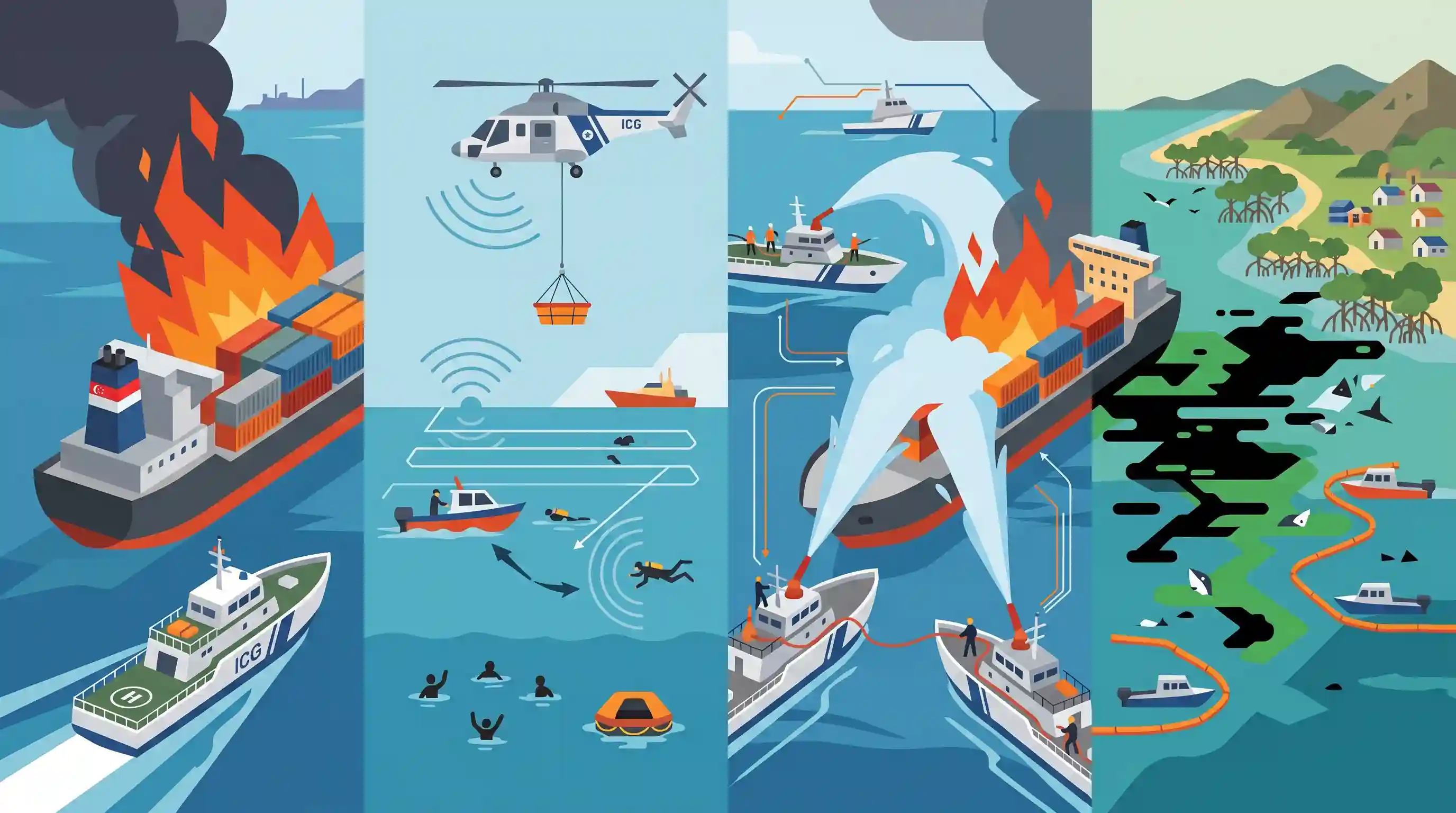
Shipping disasters near the Indian coastline pose dual threats: loss of life and severe ecological damage (e.g., oil or chemical spills). This incident highlights the critical capacity of the Indian Coast Guard in mitigating maritime disasters, a highly relevant topic under GS3 Disaster Management, Security, and Environmental Conservation.
Summary
A major fire broke out on a Singapore-flagged container ship off the Kerala coast, leaving four crew members missing and prompting urgent intervention by maritime authorities. The Indian Coast Guard initiated extensive search and rescue operations and deployed resources to extinguish the blaze. The incident brings to the forefront the operational challenges of maritime disaster management, the vital role of the Coast Guard in safeguarding India's territorial waters, and the looming threat of marine pollution and ecological damage to coastal areas caused by shipping hazards.
Key Points
- A Singapore-flagged container ship caught fire off the coast of Kerala, creating a severe maritime emergency.
- Four crew members were reported missing, triggering immediate search and rescue (SAR) operations.
- The Indian Coast Guard (ICG) and associated maritime agencies spearheaded the firefighting and rescue missions to contain the damage.
- The incident underscores the importance of robust coastal disaster management and highlights the ecological risks of marine pollution stemming from shipping accidents.
Important Terms
Indian Coast Guard (ICG)

A statutory maritime law enforcement and search-and-rescue agency established under the Coast Guard Act, 1978. Operating under the Ministry of Defence, it protects India's maritime interests and coastal security.
UPSC context
GS Paper III: Internal Security/Disaster Management. Tests maritime security architecture and 'first responder' roles in coastal emergencies.
National Oil Spill Disaster Contingency Plan (NOS-DCP)
India's institutional framework for coordinating responses to oil spills at sea. The Indian Coast Guard is the designated Central Coordinating Authority for its implementation in Indian maritime zones.
UPSC context
GS Paper III: Environment/Disaster Management. Key for questions on marine pollution mitigation and institutional preparedness.
Flag State
The jurisdiction under whose laws a commercial vessel is registered. The flag state (e.g., Singapore) is responsible for regulating the ship’s safety, crew, and environmental compliance under international law.
UPSC context
GS Paper II: International Relations. Essential for understanding maritime jurisdiction, liability, and UNCLOS legal frameworks.
International Maritime Dangerous Goods (IMDG) Code
An international guideline for the safe waterborne transport of hazardous materials. It aims to prevent marine pollution and ensure the safety of the ship and crew during transit.
UPSC context
GS Paper III: Disaster Management. Relevant for discussions on hazardous cargo handling and roots of maritime accidents.
Exclusive Economic Zone (EEZ)
A maritime zone extending up to 200 nautical miles from the baseline, over which a coastal state has sovereign rights for resource exploration and environmental protection.
UPSC context
GS Paper II: International Relations/Geography. Central to UNCLOS and India's maritime sovereignty and resource management.
Search and Rescue (SAR)
The search for and provision of aid to people who are in distress or imminent danger at sea, coordinated in India by the Indian Coast Guard.
UPSC context
GS Paper III: Disaster Management. Tests understanding of humanitarian protocols and maritime emergency response efficiency.
Prelims Trap
"The Indian Navy is the nodal agency for responding to marine oil spills in India's Maritime Zones."
The Indian Coast Guard (ICG), not the Indian Navy or NDMA, is the designated Central Coordinating Authority for marine oil/chemical spills under the NOS-DCP.
Static Concepts Connected
What is the framework for marine pollution and rescue response in India?
- Nodal Agency: The Indian Coast Guard (ICG) acts as the Central Coordinating Authority executing the National Oil Spill Disaster Contingency Plan (NOS-DCP).
- Global Treaty: The MARPOL Convention, managed by the IMO, is the principal global treaty addressing marine pollution (oil, chemicals, sewage) from ships.
- Technical Support: INCOIS (under MoES) provides the Search and Rescue Aid Tool (SARAT) to estimate the probable location of missing objects at sea.
What are India's obligations under the Maritime Search and Rescue (SAR) Convention 1979?
- ISRR Responsibility: India is mandated to provide search and rescue services within its designated Indian Search and Rescue Region (ISRR) in the Indian Ocean.
- Operational Coordination: The Indian Coast Guard coordinates these international maritime distress responses through dedicated Maritime Rescue Coordination Centres (MRCCs).
Cross-Topic Patterns
Disaster Management + Ocean Tech (INCOIS)
Maritime rescue operations increasingly test the integration of space and ocean technology, heavily relying on INCOIS's Search and Rescue Aid Tool (SARAT) to model ocean currents and track missing vessels.
Maritime Security + Environmental Law (MARPOL)
Ship fires immediately trigger ecological concerns, linking disaster management with India's enforcement of the IMO's MARPOL Convention regarding hazardous chemical and oil spills in territorial waters.

Expect a Prelims pairing of INCOIS tools (SARAT) with ICG mandates, or a GS3 Mains question on coastal disaster and spill preparedness.
Linked PYQs · 3
Linked PYQs · 3
- 2025MainsGS3
Why is maritime security vital to protect India's sea trade? Discuss maritime and coastal security challenges and the way forward.
- 2022MainsGS3
What are the maritime security challenges in India ? Discuss the organisational, technical and procedural initiatives taken to improve the maritime security.
- 2023MainsGS3
What is oil pollution? What are its impacts on the marine ecosystem? In what way is oil pollution particularly harmful for a country like India?
