Customs Simplification Planned as Next Major Economic Reform
Source:The Hindu ↗
Why It Matters
Taxation reforms (like GST and Customs) are core GS3 economy topics. The push for rationalizing customs duties has direct implications for India's foreign trade, manufacturing competitiveness, and integration into global value chains. Additionally, the twin macroeconomic indicators mentioned—robust GDP growth led by services, alongside currency depreciation—are frequent focal points for UPSC Prelims (exchange rate impacts) and Mains (growth patterns).
Summary
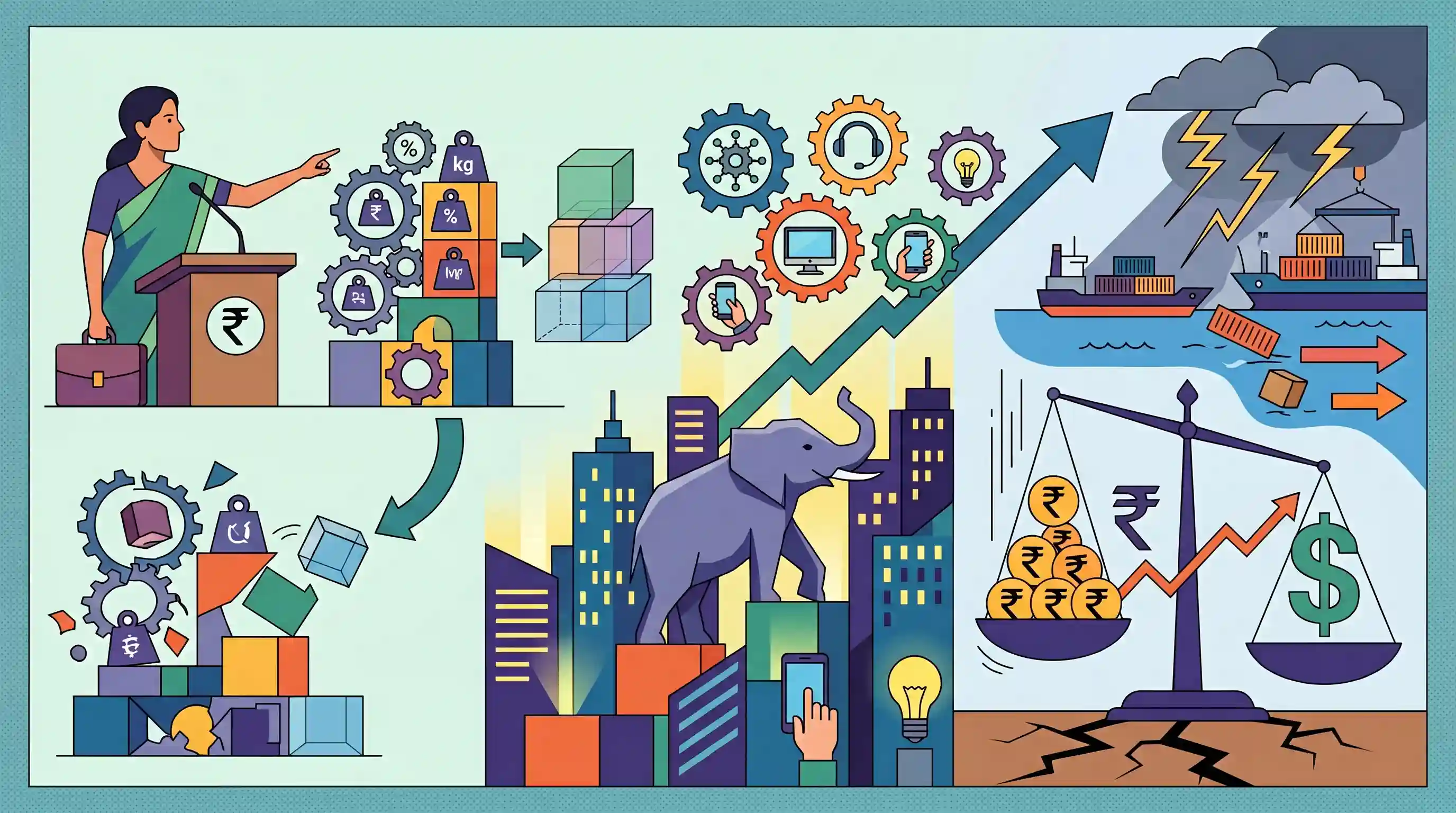
Ahead of Budget 2026, Finance Minister Nirmala Sitharaman highlighted that simplifying customs and making them more transparent will be the government's next big reform. This will involve comprehensive customs duty rate rationalisation, building on past efforts like the elimination of additional customs tariff rates on industrial goods. While the Indian economy demonstrates strong resilience with an 8.2% GDP growth in the second quarter—spearheaded by the services sector—the depreciating rupee (crossing 90 per US dollar) and global supply-chain disruptions pose challenges for the export sector.
Key Points
- Union Finance Minister announced that simplification of Customs will be the next major reform focus for Budget 2026.
- The reforms aim to make customs less cumbersome, transparent, predictable, and will include comprehensive customs duty rate rationalisation.
- In the previous budget, the government had eliminated seven additional customs tariff rates on industrial goods to reduce supply-chain leakages.
- India's GDP grew by 8.2% in the second quarter, averaging 8% in the first half, largely driven by double-digit growth in the services sector.
- The Indian rupee has depreciated, breaching the 90-a-dollar level, raising concerns about export competitiveness amid global supply-chain disruptions.
Important Terms
Customs Duty Rationalisation

The systematic reduction and simplification of import/export tariff slabs to remove inconsistencies, reduce litigation, and lower the cost of raw materials for domestic industry.
UPSC context
GS Paper 3 (Economy); crucial for understanding taxation reforms and trade policy competitiveness.
CBIC (Central Board of Indirect Taxes and Customs)
The apex statutory body under the Ministry of Finance that administers indirect taxes including GST, Customs, and Central Excise in India.
UPSC context
GS Paper 2 (Statutory Bodies); GS Paper 3 (Fiscal Policy implementation).
Inverted Duty Structure
A situation where import duties on raw materials are higher than on finished goods, making domestic manufacturing uncompetitive against cheaper imported final products.
UPSC context
GS Paper 3 (Industrial Growth); a major hurdle for 'Make in India' and manufacturing.
Rupee Depreciation
A market-driven decrease in the value of the Rupee against foreign currencies, which typically boosts exports but increases the cost of imports like crude oil.
UPSC context
GS Paper 3 (External Sector); tests knowledge of exchange rate dynamics and trade balance.
Trade Facilitation
Simplification of cross-border trade procedures through digital and transparent systems to reduce the 'dwell time' and logistics costs for importers and exporters.
UPSC context
GS Paper 3 (Economy); linked to ease of doing business and WTO agreements.
Indirect Taxation
Taxes levied on the consumption of goods and services (e.g., GST, Customs) rather than on income, where the tax burden is passed to the consumer.
UPSC context
GS Paper 3 (Budgeting/Taxation); core topic for fiscal policy and tax structure analysis.
Prelims Trap
"Basic Customs Duty and all other import levies were subsumed under the Goods and Services Tax (GST)."
While Countervailing Duty (CVD) and Special Additional Duty (SAD) were replaced by IGST on imports, Basic Customs Duty (BCD) was explicitly kept outside GST.
Static Concepts Connected
What are the key components of import taxation in India post-GST?
- Basic Customs Duty: The primary tariff levied under the Customs Act, 1962; explicitly kept outside the purview of the Goods and Services Tax framework.
- IGST on imports: Replaced Countervailing Duty (CVD) and Special Additional Duty (SAD) to ensure tax parity between imported and domestically produced goods.
- Surcharges and Cesses: Levies like the Social Welfare Surcharge (SWS) are calculated on the aggregate of customs duties (excluding IGST and GST Compensation Cess).
How does currency depreciation impact India's macroeconomic stability?
- Export competitiveness: Domestic goods become cheaper internationally, theoretically boosting export volumes and stabilizing trade balances amid global supply chain disruptions.
- Imported inflation: Escalates the domestic cost of inelastic structural imports like crude oil, edible oils, fertilizers, and critical electronic components.
- External debt burden: Inflates the rupee repayment liability for Indian corporate entities holding unhedged External Commercial Borrowings (ECBs).
Cross-Topic Patterns
Customs rationalisation + Inverted duty
Reducing tariffs on intermediate inputs corrects the inverted duty structure, aligning with Make in India goals to boost the lagging manufacturing sector's share in GDP.
Currency depreciation + Imported inflation
The rupee breaching 90/USD challenges RBI's inflation targeting mandate by escalating cost-push pressures from inelastic imports, even as it aids export competitiveness.

Expect a multi-statement question linking Basic Customs Duty exceptions, inverted duty structures, and impacts of a depreciating Rupee on CAD.
Linked PYQs · 5
Linked PYQs · 5
- 2019MainsGS3
Enumerate the indirect taxes which have been subsumed in the Goods and Services Tax (GST) in India. Also, comment on the revenue implications of the GST introduced in India since July 2017.
- 2025MainsGS3
What are the challenges before the Indian economy when the world is moving away from free trade and multilateralism to protectionism and bilateralism? How can these challenges be met?
- 2022PrelimsGS1
With reference to the Indian economy, consider the following statements: 1. If the inflation is too high, Reserve Bank of India (RBI) is likely to buy government securities. 2. If the rupee is rapidly depreciating, RBI is likely to sell dollars in the market. 3. If interest rates in the USA or European Union were to fall, that is likely to induce RBI to buy dollars. Which of the statements given above are correct?
- 2021PrelimsGS1
Consider the following statements : The effect of devaluation of a currency is that it necessarily 1. improves the competitiveness of the domestic exports in the foreign markets 2. increases the foreign value of domestic currency 3. improves the trade balance Which of the above statements is/are correct?
- 2019PrelimsGS1
Which one of the following is not the most likely measure the Government/RBI takes to stop the slide of Indian rupee?
