Sikkim statehood and sustainable organic tourism development model
Source:The Hindu ↗
Why It Matters
Sikkim's model of 100% organic farming and sustainable tourism serves as a direct case study for GS3 topics related to agriculture, environment, and infrastructure (like ropeways under Parvatmala). Its 50th Statehood Day also ties into GS1 post-independence consolidation of Indian states.
Summary
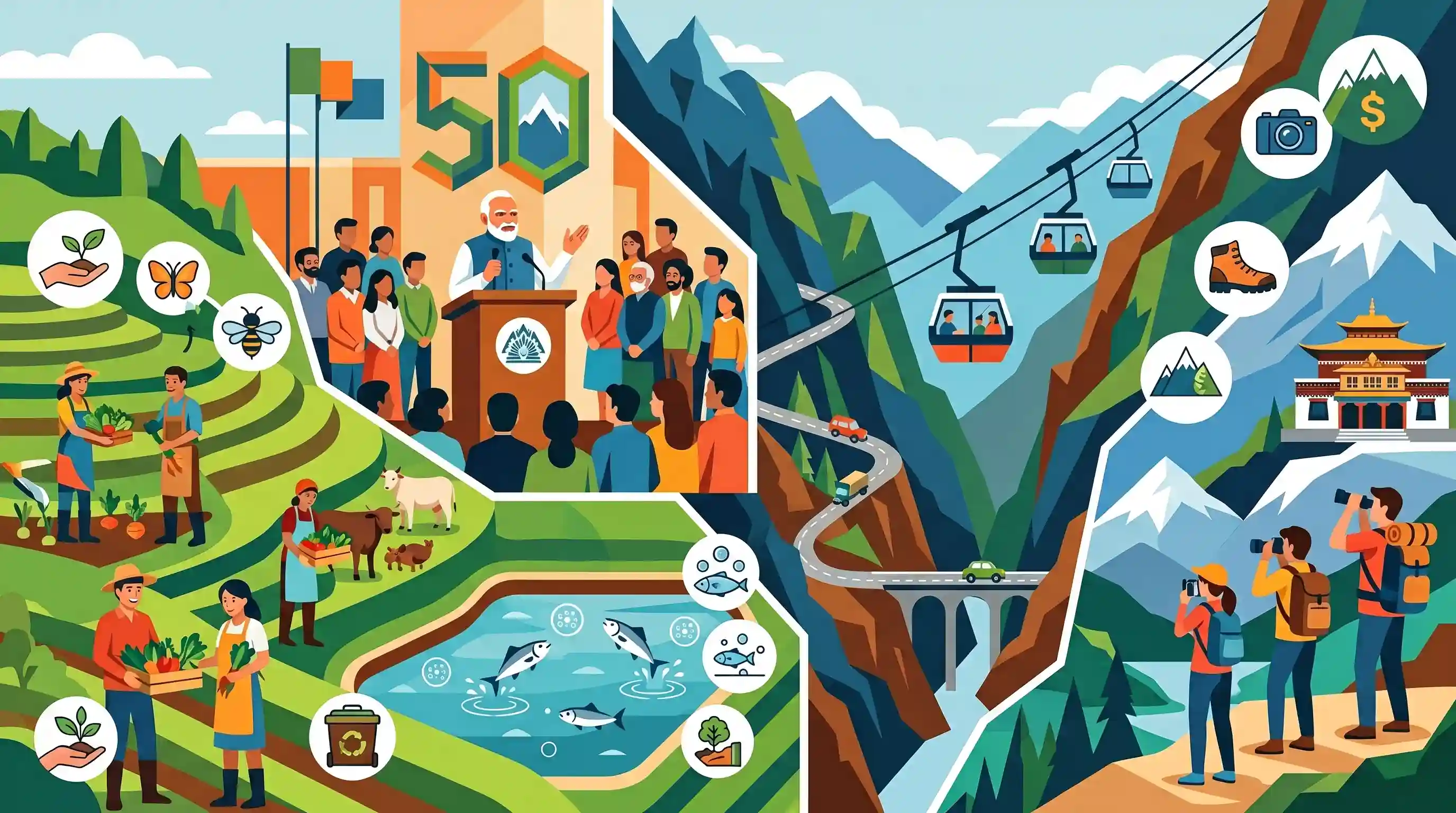
Prime Minister Narendra Modi addressed Sikkim's 50th Statehood Day, commemorating its 1975 accession to India. He envisioned the state as a future global tourism hub, lauding its 100% organic farming model as an exemplar of sustainable development. The event highlighted new infrastructure projects, including ropeways for better hilly terrain connectivity, and the development of India's first organic fishery cluster in Soreng.
Key Points
- Sikkim celebrated its 50th Statehood Day, marking 50 years since its accession to the Indian Union through a 1975 referendum.
- Prime Minister Modi highlighted Sikkim's potential to become a global hub for tourism and a powerhouse in sports.
- The state was praised as a 'model of development with nature' due to its 100% organic farming practices.
- Infrastructure initiatives like the Pelling Ropeway were emphasized to improve connectivity and tourism in hilly terrains where road construction is difficult.
- Soreng district is slated to be developed as India's first organic fishery cluster.
Important Terms
36th Constitutional Amendment Act, 1975

The legal instrument that granted Sikkim full statehood as the 22nd state of the Indian Union on May 16, 1975, abolishing the Chogyal monarchy.
UPSC context
GS Paper II (Polity) and Paper I (Post-Independence Consolidation); essential for understanding federalism and territorial integration.
Article 371F
A special constitutional provision that protects Sikkim's unique laws, land rights, and cultural identity, ensuring the preservation of its distinct heritage within the Indian Union.
UPSC context
GS Paper II (Polity); tests knowledge of special provisions for certain states to manage regional aspirations.
1975 Referendum
A public vote held on April 14, 1975, where over 97% of Sikkimese citizens voted to abolish the monarchy and fully merge with India.
UPSC context
GS Paper I (Post-Independence History); critical for understanding the democratic transition of formerly princely/protectorate states.
Sikkim Organic Mission
Launched in 2010, this policy framework led to Sikkim becoming the world’s first 100% organic state in 2016 by phasing out chemical fertilizers and pesticides.
UPSC context
GS Paper III (Agriculture & Environment); a benchmark case study for sustainable development and ecological conservation.
PM-DevINE Scheme
A Central Sector scheme (PM’s Development Initiative for North East Region) that funds infrastructure and social development projects to address developmental gaps in the NE states.
UPSC context
GS Paper II (Governance) and Paper III (Infrastructure); focuses on regional planning and North East integration.
Organic Fishery Cluster (Soreng)
India's first-ever chemical-free fish farming hub launched in Soreng, Sikkim (2025), aiming to produce organic, antibiotic-free fish for global eco-conscious markets.
UPSC context
GS Paper III (Economy/Agriculture); relevant for the "Blue Revolution" and diversification of organic farming.
Pelling Ropeway Project
A modern 962-meter cable car project connecting Pelling to the Sangag Choeling monastery, designed to boost eco-tourism and hilly terrain connectivity.
UPSC context
GS Paper III (Infrastructure/Tourism); illustrates sustainable transport solutions in fragile Himalayan ecosystems.
Prelims Trap
Sikkim was granted full statehood and integrated as the 22nd state of India through the 35th Constitutional Amendment Act.
The 35th Amendment (1974) only made Sikkim an 'Associate State'. It was the 36th Amendment Act (1975) that formally granted full statehood and added Article 371F.
Static Concepts Connected
How was Sikkim constitutionally integrated into the Indian Union?
- Protectorate Status: Under a 1950 treaty, India managed Sikkim's defense, external affairs, and communications while it remained an Indian protectorate.
- 35th Amendment (1974): Conferred 'Associate State' status by adding Article 2A and the Tenth Schedule, marking a unique but temporary constitutional experiment.
- 36th Amendment (1975): Repealed Article 2A, granted full statehood (India's 22nd state), and inserted Article 371F, which provides special administrative provisions and demographic protections.
What is the institutional framework for organic farming certification in India?
- NPOP (Exports): The National Programme for Organic Production, managed by APEDA (Ministry of Commerce), certifies organic products primarily for export. Sikkim's 100% organic milestone was achieved under NPOP.
- PGS (Domestic): While NPOP relies on third-party certification for global markets, the Participatory Guarantee System (PGS-India) is a peer-review certification used for the domestic market.
- NE-Specific Schemes: The Mission Organic Value Chain Development for North Eastern Region (MOVCDNER) is a dedicated scheme promoting end-to-end organic farming and value addition in NE states.
Cross-Topic Patterns
Blue Economy + Organic Agriculture
Sikkim's Soreng organic fishery cluster leverages PMMSY to merge aquaculture with organic practices, targeting premium export markets demanding chemical- and antibiotic-free seafood.
Ropeways + Border Infrastructure
The Pelling Ropeway highlights the Parvatmala Pariyojana's relevance, providing ecologically sustainable mobility in rugged border terrains where traditional road construction triggers landslides and deforestation.

Sikkim's 50th statehood anniversary makes the 35th/36th Amendments and Article 371F's special provisions highly probable for 2026 prelims.
Linked PYQs · 3
Linked PYQs · 3
- 2018MainsGS3
Sikkim is the first 'Organic State' in India. What are the ecological and economical benefits of Organic State?
- 2021MainsGS1
Assess the main administrative issues and socio-cultural problems in the integration process of Indian Princely States.
- 2024MainsGS3
India has a long and troubled border with China and Pakistan fraught with contentious issues. Examine the conflicting issues and security challenges along the border. Also give out the development being undertaken in these areas under the Border Area Development Programme (BADP) and Border Infrastructure and Management (BIM) Scheme.
