Indian Macroeconomic Resilience and Banking Sector Stability
Source:Indian Express ↗
Why It Matters
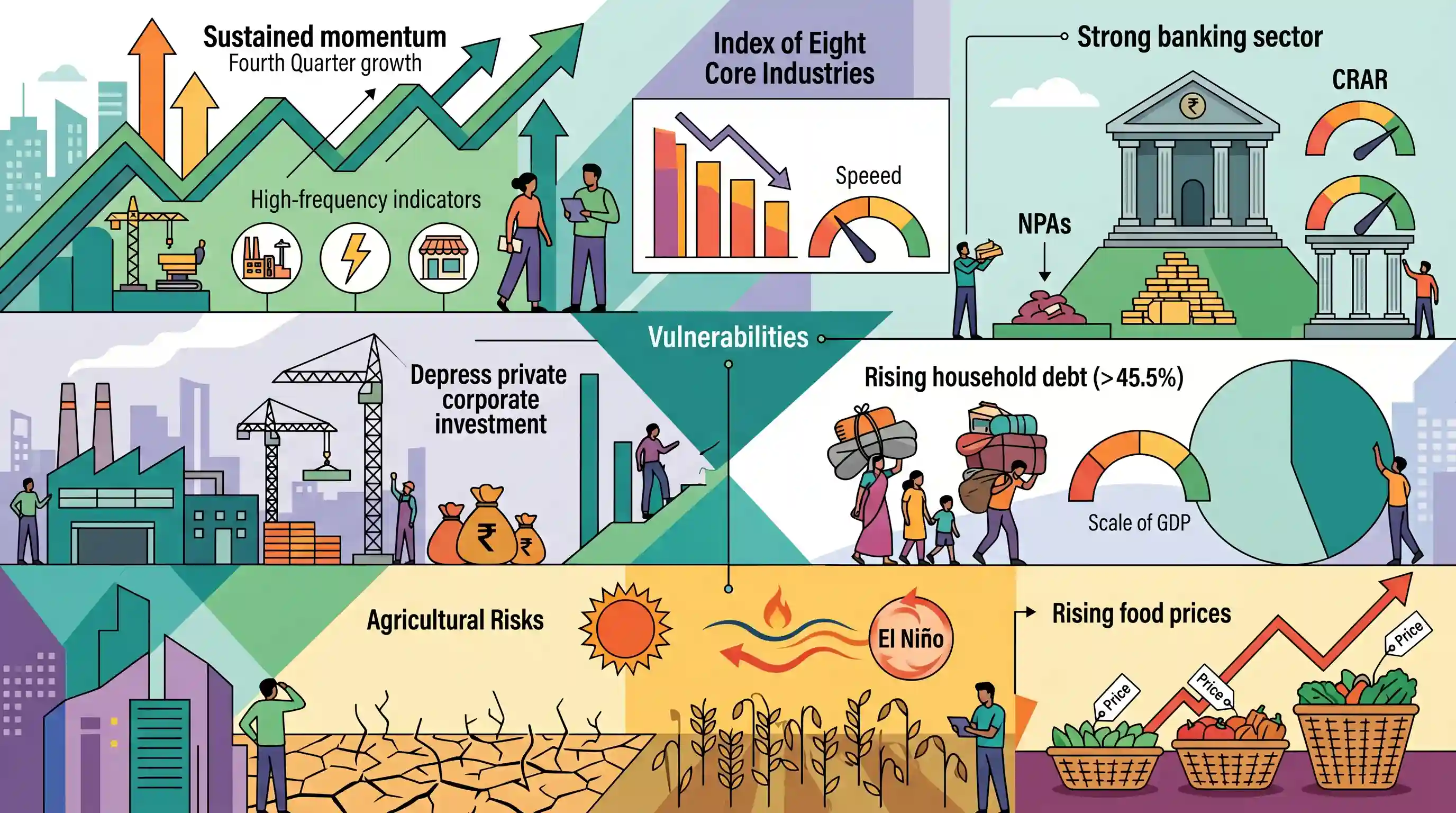
The article offers a balanced assessment of India's current economic state—juxtaposing strong financial indicators (low NPAs, high CRAR) against systemic challenges (consumption-led household debt, lagging private corporate CAPEX, and El Niño-induced inflation). It provides precise, updated data points crucial for GS3 Mains answers on macroeconomic policy, economic growth, and banking stability.
Summary
This article analyzes India's macroeconomic landscape, highlighting its overall resilience despite pressing domestic and external challenges. While fourth-quarter growth and high-frequency indicators suggest sustained momentum, the Index of Eight Core Industries has slowed. India's banking sector exhibits strong health, marked by low NPAs (1.8%) and a solid Capital to Risk-Weighted Assets Ratio (CRAR of 17.7%). However, critical vulnerabilities persist, such as depressed private corporate investment, rising household debt (45.5% of GDP) driven by consumption, and agricultural risks from a deficient monsoon and a strengthening El Niño, which could trigger food inflation reminiscent of the 8.5% average seen during 2023–2024.
Key Points
- Sustained Momentum vs. Moderation: While high-frequency indicators (PMI, e-way bills, electricity consumption) demonstrate ongoing economic momentum, the Index of Eight Core Industries registered a modest growth of just 1.1% in April-May, signalling signs of sector-specific moderation.
- Robust Banking Soundness: According to the RBI's Financial Stability Report, bank balance sheets are exceptionally healthy, with Gross NPAs dropping to 1.8% (March 2026), Capital to Risk-Weighted Assets Ratio (CRAR) standing strong at 17.7%, and stable profitability, though funding remains a structural challenge.
- Depressed Private CAPEX & Rising Household Debt: Despite deleveraged corporate balance sheets, private corporate investments remain stagnant. Concurrently, household debt has climbed to 45.5% of GDP (as of September 2025), driven primarily by consumption borrowing rather than asset creation.
- Dual Risk Factors: Macroeconomic stability is threatened by external shocks (geopolitical tensions in West Asia impacting global trade and energy markets) and domestic agricultural risks (deficient monsoons affecting Kharif crops and a strengthening El Niño threatening Rabi crops, risking a repeat of the high food inflation of 2023-24, which averaged 8.5%).
Important Terms
Non-Performing Assets (NPAs)

A loan or advance where interest or principal remains overdue for 90 days or more, indicating borrower default and halting the asset's income generation.
UPSC context
GS Paper III (Indian Economy). Tests knowledge of banking sector health, asset classification, and balance sheet stress.
Capital to Risk-Weighted Assets Ratio (CRAR)
A banking metric measuring a bank’s available capital against its risk-weighted assets, used to protect depositors and ensure financial stability under Basel norms.
UPSC context
GS Paper III (Indian Economy). Tests understanding of banking regulation, financial stability indicators, and Basel standards.
Index of Eight Core Industries (ICI)
A monthly production volume index tracking India's eight key infrastructure sectors, which together constitute 40.27% of the total weight of the Index of Industrial Production.
UPSC context
GS Paper III (Indian Economy). Tests knowledge of infrastructure growth, macroeconomic indicators, and industrial performance.
El Niño
The warm phase of the El Niño-Southern Oscillation, featuring unusual ocean warming in the equatorial Pacific that weakens the Indian Southwest Monsoon.
UPSC context
GS Paper I & III (Geography/Agriculture). Tests climate phenomena, monsoon variability, and agricultural risks like food inflation.
Reserve Bank of India (RBI)
India's central banking authority established in 1935, responsible for monetary policy formulation, currency issuance, banking regulation, and safeguarding financial system stability.
UPSC context
GS Paper III (Indian Economy). Tests statutory bodies, monetary policy frameworks, central bank autonomy, and inflation targeting.
Ministry of Finance
A Government of India ministry that acts as the nation's treasury, managing fiscal policy, public expenditure, taxation, capital markets, and preparing the annual Union Budget.
UPSC context
GS Paper III (Indian Economy). Tests fiscal administration, budgeting processes, division of economic affairs, and resource mobilization.
Prelims Trap
Under Basel III, the RBI mandates a minimum CRAR of 8% for Indian Scheduled Commercial Banks, in strict alignment with global standards.
The global Basel III minimum is indeed 8%, but the RBI applies a more conservative macroprudential norm, mandating a higher 9% minimum CRAR for Indian SCBs.
Static Concepts Connected
What is the Index of Eight Core Industries (ICI) and its composition?
- Weight in IIP: It comprises 40.27% of the weight of the items included in the Index of Industrial Production (IIP).
- Publishing Authority: Released monthly by the Office of the Economic Adviser, Department for Promotion of Industry and Internal Trade (DPIIT), Ministry of Commerce and Industry.
- Sector Rankings: Refinery products has the highest weight (28.04%), followed by Electricity, Steel, Coal, Crude Oil, Natural Gas, Cement, and Fertilizers (lowest at 2.63%).
What is the Capital to Risk-Weighted Assets Ratio (CRAR)?
- Core Purpose: Measures a bank's capital adequacy to ensure it can absorb a reasonable amount of loss before becoming insolvent, protecting depositors.
- Indian Mandate: Under Basel III, while the global minimum is 8%, the RBI mandates a higher CRAR of 9% for Indian Scheduled Commercial Banks.
- Tier Composition: Calculated by dividing Tier-1 (core capital) and Tier-2 (supplementary capital) by total risk-weighted assets.
Cross-Topic Patterns
El Niño + Inflation-targeting mandate
Pacific warming disrupts monsoons, triggering structural supply-side food inflation that complicates the RBI's CPI mandate, linking physical geography directly to monetary policy.
Consumption leverage vs Asset creation
Rising household debt driven by unsecured retail loans rather than capital assets highlights a structural shift, compromising long-term domestic savings available for private corporate CAPEX.

Expect a multi-statement 2026 prelims question pairing core industry weight rankings with RBI's stricter Basel III CRAR requirements.
Linked PYQs · 4
Linked PYQs · 4
- 2018PrelimsGS1
Consider the following statements: 1. Capital Adequacy Ratio (CAR) is the amount that banks have to maintain in the form of their own funds to offset any loss that banks incur if the account-holders fail to repay dues. 2. CAR is decided by each individual bank. Which of the statements given above is/are correct?
- 2015PrelimsGS1
In the 'Index of Eight Core Industries', which one of the following is given the highest weight?
- 2019MainsGS3
Do you agree with the view that steady GDP growth and low inflation have left the Indian economy in good shape? Give reasons in support of your arguments.
- 2014MainsGS1
Most of the unusual climatic happenings are explained as an outcome of the El-Nino effect. Do you agree?
