State Autonomy Debates and Coercive Federalism Concerns
Source:Indian Express ↗
Why It Matters
The evolving nature of Centre-State relations is a core component of the GS2 syllabus. The friction between the Union government and states—especially over themes of cooperative versus coercive federalism, fiscal autonomy, and the centralization of powers—frequently features in Mains questions. This political discourse illustrates the real-world tensions highlighted in constitutional theory and helps aspirants formulate answers on regional demands for autonomy.
Summary
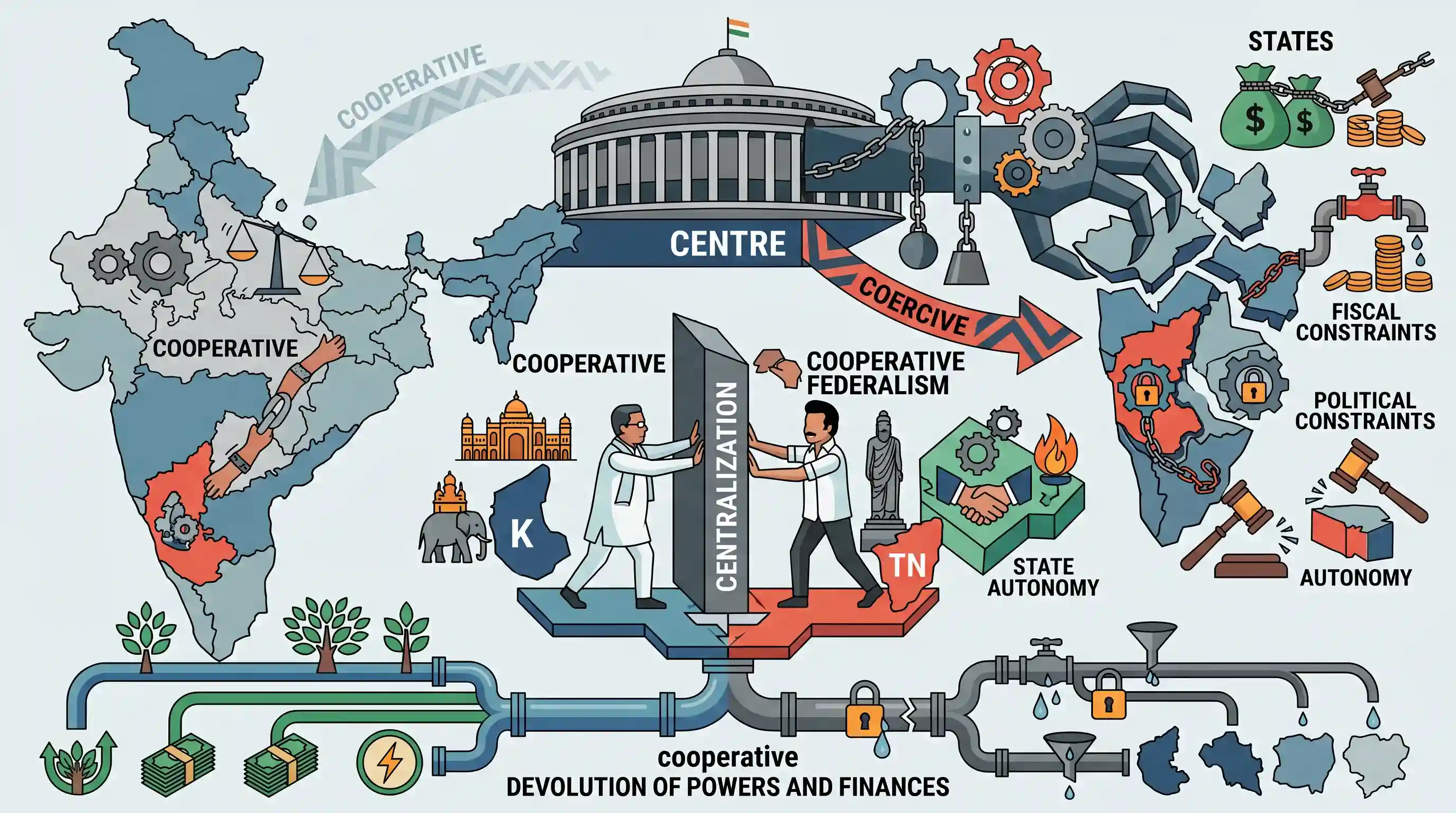
Karnataka Chief Minister Siddaramaiah has backed Tamil Nadu CM M.K. Stalin's push for greater state autonomy, alleging that India's federal structure is increasingly turning "coercive." This alignment of opposition-ruled southern states underscores deepening concerns over centralization, perceived erosion of cooperative federalism, and the need to protect the fiscal and political autonomy of state governments in the broader context of Centre-State relations.
Key Points
- Karnataka Chief Minister Siddaramaiah has supported Tamil Nadu CM M.K. Stalin's demand for greater autonomy for states.
- Siddaramaiah criticized the Union government, stating that the federal structure is shifting from 'cooperative' to 'coercive' federalism.
- The stance highlights growing friction in Centre-State relations, particularly regarding the centralization of power, fiscal devolution, and policy impositions on states.
- The demand aligns with the traditional positions of regional parties advocating for stronger decentralization and more autonomy to address state-specific development and governance needs.
Important Terms
Coercive Federalism

A model where the Union government exerts dominance over States by using financial mandates, conditional grants, or legislative overreach to enforce national priorities, often bypassing state-level concurrence.
UPSC context
GS II: Challenges to Federal Structure. Tests critical analysis of centralisation trends and their impact on constitutional balance.
Cooperative Federalism
A partnership-based federalism where the Centre and States collaborate to address national issues through consensus-building bodies like the GST Council or NITI Aayog.
UPSC context
GS II: Indian Constitution—Features. Essential for questions on harmonious governance and inter-governmental coordination.
Fiscal Devolution
The statutory transfer of financial resources (tax proceeds and grants) from the Union to the States, aimed at correcting vertical and horizontal fiscal imbalances.
UPSC context
GS II & III: Devolution of Finances; Indian Economy. Key for analyzing state financial health and regional equity.
State Autonomy
The constitutional right of State governments to exercise independent legislative and executive power over subjects within their jurisdiction (State List) without undue Union interference.
UPSC context
GS II: Federal Structure. Relevant to discussions on regionalism, decentralization, and the identity of the Union.
Finance Commission
A constitutional body under Article 280 that recommends the formula for sharing central taxes with States and the principles governing grants-in-aid.
UPSC context
GS II: Constitutional Bodies. A 'balancing wheel' frequently tested regarding fiscal parity and resource distribution.
Seventh Schedule
The constitutional framework that distributes legislative powers between the Union and States through the Union List, State List, and Concurrent List.
UPSC context
GS II: Separation of Powers. Fundamental for identifying jurisdictional overreach in Union-led legislations.
Centrally Sponsored Schemes (CSS)
Programmes funded largely by the Centre but implemented by States; they are often cited as tools of centralisation due to their rigid conditions.
UPSC context
GS II/III: Government Budgeting and Federalism. Relevant to debates on tied-grants vs. state spending freedom.
Inter-State Council
A constitutional forum (Article 263) mandated to investigate and discuss subjects of common interest to better coordinate policy and resolve disputes between tiers of government.
UPSC context
GS II: Statutory and Quasi-judicial Bodies. Critical for answers on institutional mechanisms for federal dispute resolution.
Prelims Trap
"Cesses and surcharges levied by the Union form a part of the divisible pool of taxes."
Under Article 270, cesses and surcharges are explicitly excluded from the divisible pool. States argue this heavily reduces their actual share below Finance Commission recommendations.
Static Concepts Connected
What are the key Constitutional provisions for Centre-State financial devolution?
- Article 270: Details the distribution of net proceeds of taxes between the Union and the States (excluding cesses and surcharges).
- Article 275: Empowers Parliament to provide statutory grants-in-aid to specific states in need of assistance, outside the general tax devolution.
- Article 280: Mandates the constitution of a Finance Commission every five years to recommend the distribution of tax revenues.
What defines the shift from cooperative to coercive federalism?
- Cooperative Federalism: Centre and states collaborate horizontally on policy and development goals, exemplified by institutions like the GST Council and NITI Aayog.
- Coercive Federalism: The Union centralizes power and imposes mandates on states via overriding Concurrent List laws, conditional scheme funding, and central agencies.
Cross-Topic Patterns
Fiscal Devolution + Delimitation Freeze
Southern states link their lower population growth to impending delimitation penalties, arguing they are being financially and politically punished for demographic success.
State Bills + Governor's Assent
The stalling of state legislative bills by Governors under Article 200 is increasingly cited by states like Tamil Nadu and Kerala as a primary tool of coercive federalism.

Expect a mains question linking the rise of 'coercive federalism' allegations to the expanding use of cesses and Governor friction.
Linked PYQs · 3
Linked PYQs · 3
- 2015MainsGS2
The concept of cooperative federalism has been increasingly emphasized in recent years. Highlight the drawbacks in the existing structure and the extent to which cooperative federalism would answer the shortcomings.
- 2024MainsGS2
What changes has the Union Government recently introduced in the domain of Centre-State relations ? Suggest measures to be adopted to build the trust between the Centre and the States and for strengthening federalism.
- 2022MainsGS2
“While the national political parties in India favour centralisation, the regional parties are in favour of State autonomy.” Comment.
