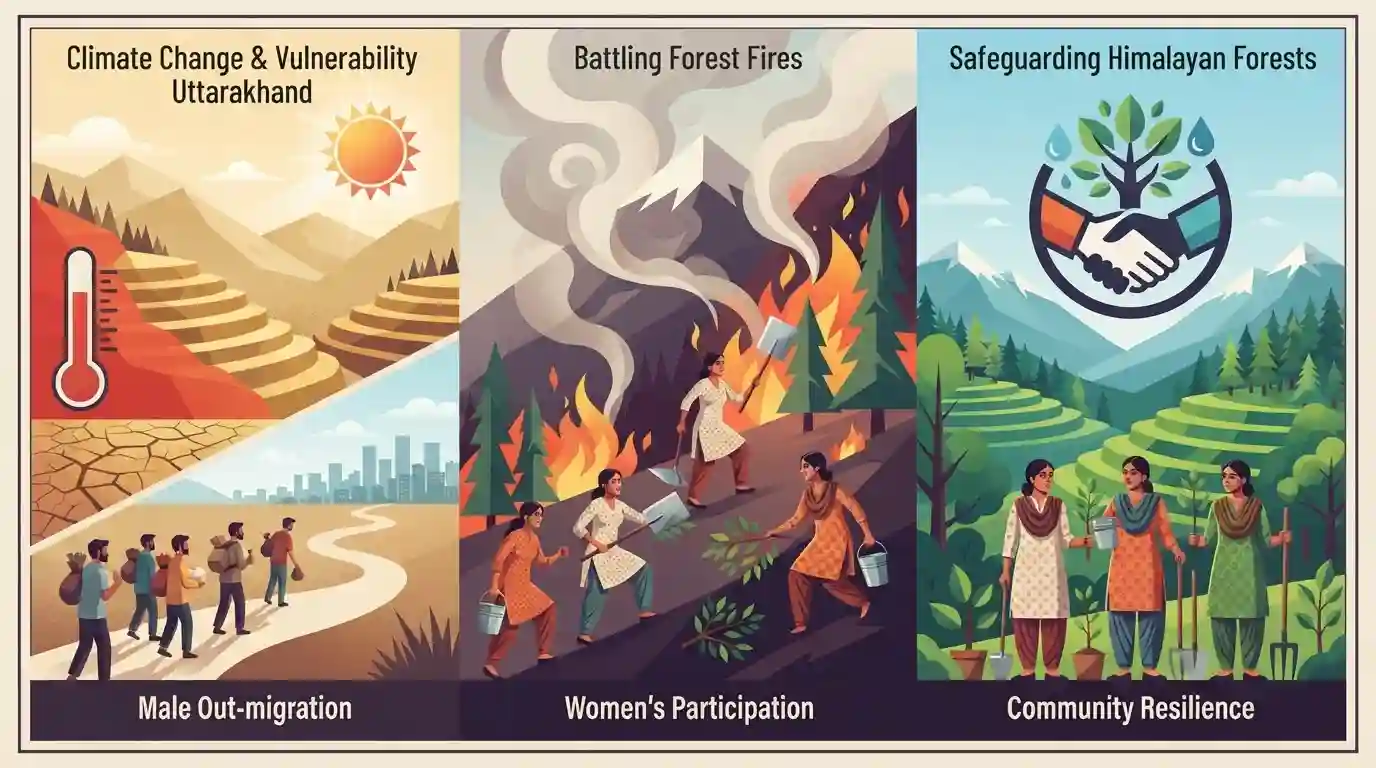
Women tackling forest fires in rural Uttarakhand
Source:news-mongabay ↗
Why It Matters
It sheds light on the gendered impacts of climate change and environmental hazards in the fragile Himalayan ecosystem of Uttarakhand, making it highly relevant for questions on environmental management and local governance.
Summary
This article highlights the crucial role of women on the frontlines of battling forest fires in Uttarakhand, addressing how climate change, dry spells, and male out-migration intersect with rural women's efforts to safeguard Himalayan forests.
Key Points
- Women in rural Uttarakhand play a frontline role in tackling seasonal forest fires amidst male out-migration.
- Climate change, rising temperatures, and dry spells have intensified forest vulnerability and fire risks in the Himalayan ecosystem.
- Local communities, particularly women, bear the heavy burden of managing environmental degradation and protecting local forest resources.
Important Terms
Mongabay

An independent environmental science and conservation news platform reporting on ecological issues, climate change, and grassroots conservation efforts across global biodiversity hotspots, including the Indian Himalayan region.
UPSC context
Relevant for GS Paper III (Environment, Biodiversity and Climate Change). Frequently cited for in-depth regional reporting on Himalayan ecology and conservation challenges.
Static Concepts Connected
What are Van Panchayats in Uttarakhand and how are they structured?
- Historical Origin: Established under colonial rule in 1931, Van Panchayats give local hill communities decentralized management rights over notified civil and soy forest lands.
- Democratic Body: Villagers elect a executive body (Van Panchayat Sarpanch and members) to regulate grazing, timber extraction, and protection against fires.
- Women's Role: Uttarakhand is notable for having thousands of functional Van Panchayats, empowering rural women who constitute the majority of active forest users.
Cross-Topic Patterns
Himalayan Migration and Feminization of Agriculture
Male out-migration across Himalayan districts forces a structural shift in agricultural and environmental management, making rural women the primary stewards of natural resources and frontline responders to ecological disasters.
Community Forestry and Van Panchayat Governance
Forest fires in Uttarakhand directly disrupt the traditional Van Panchayats and community-based forestry models, threatening both local biodiversity and rural livelihoods dependent on non-timber forest produce.

Expect a statement-based question pairing male out-migration in Uttarakhand with women's unpaid climate adaptation roles and Van Panchayats.
Linked PYQs · 2
Linked PYQs · 2
- 2025UKPSC_PRELIMSGS1
Consider the following statements and select the correct answer from the options given below : Statement 1 : Uttarakhand is highly vulnerable to climate change. Statement 2 : Climate change is causing water stress and depleting biodiversity in Uttarakhand.
- 2025UKPSC_PRELIMSGS1
Consider the following statements with reference to animal husbandry in Uttarakhand. Select the correct answer from the codes given below : 1. Animal husbandry is a supplementary occupation of agriculture. 2. Sheep rearing in the mountainous areas has been affected by environmental degradation.
