Women lead frontline response to Uttarakhand forest fires
Source:news-mongabay ↗
Why It Matters
Crucial for understanding local environmental challenges, disaster response, and gender roles in Uttarakhand's ecological conservation.
Summary
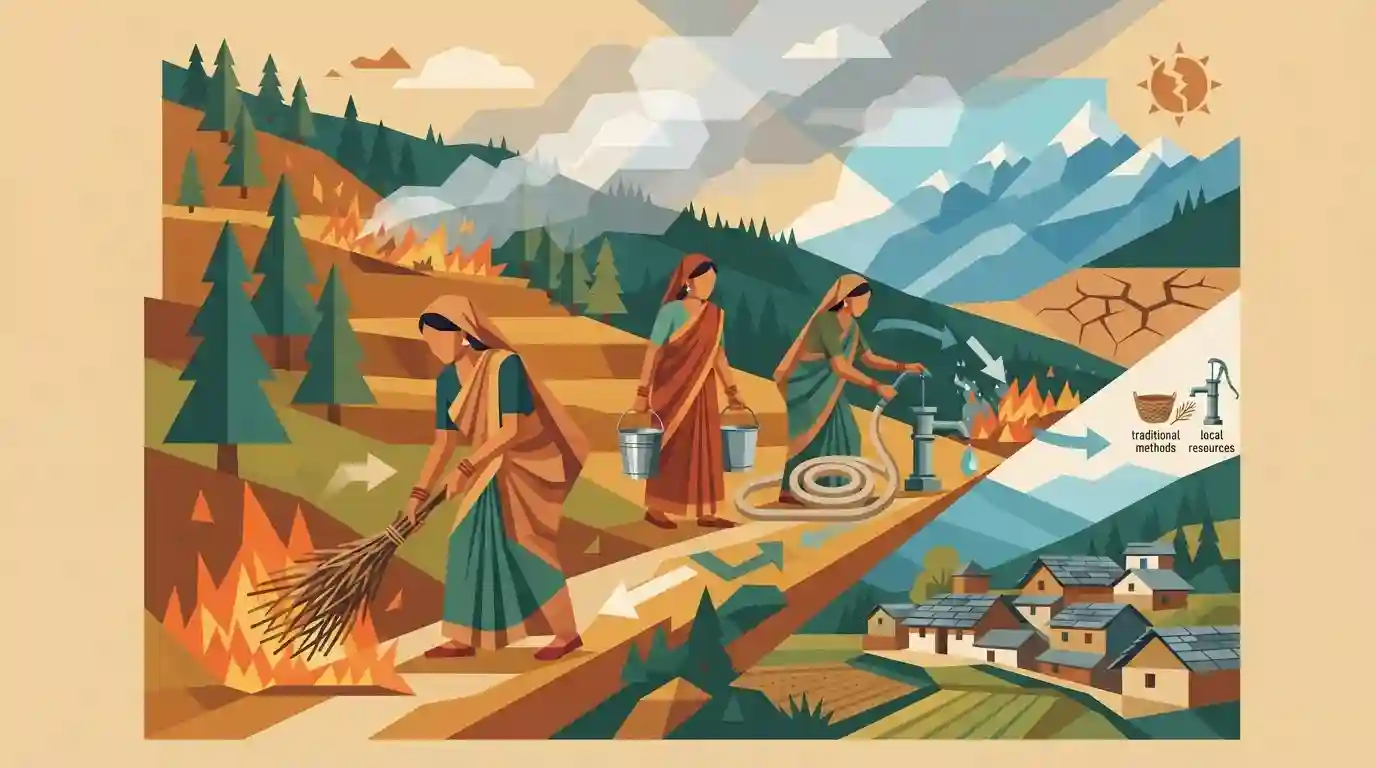
The article details how women in Uttarakhand act as frontline defenders against rampant forest fires, utilizing traditional methods and local resources to protect their village forests and livelihoods amidst escalating climate challenges.
Key Points
- Women in Uttarakhand are at the forefront of tackling seasonal forest fires, relying on traditional tools like sickles and local community networks.
- Forest fires in Uttarakhand pose severe threats to local biodiversity, rural livelihoods, and ecological security in the Himalayan region.
- The article highlights the vital gendered dimensions of environmental conservation and climate resilience in the hill state.
Important Terms
Mongabay

A digital platform and independent news media organization reporting on environmental science, conservation, and wildlife, providing in-depth investigative journalism on global ecological issues.
UPSC context
Important for environment, ecology, and current affairs sections (GS Paper III), providing case studies on grassroots conservation and climate change impacts.
Mahila Mangal Dal
Grassroots women's collectives in Uttarakhand villages actively engaged in local forest protection, environmental conservation, and mobilizing communities against illegal felling and wildfires.
UPSC context
Relevant for UKPSC and UPSC mains (GS Paper I/II - women's empowerment, decentralised governance, and community-led environmental movements in hill states).
Binsar Wildlife Sanctuary
A protected wildlife sanctuary in the Almora district of Uttarakhand, known for its rich biodiversity, oak forests, and tragically, a severe forest fire incident in June 2024.
UPSC context
Essential for UKPSC state-specific questions regarding geography, protected areas, biodiversity conservation, and disaster management challenges in Uttarakhand.
Prelims Trap
seasonal forest fires are purely natural climatic phenomena driven solely by rising summer temperatures.
Aspirants often assume forest fires in Uttarakhand are entirely natural; however, anthropogenic factors like Chir pine monocultures, resin tapping, and accumulated Pirul are primary drivers.
Static Concepts Connected
What are the ecological differences between Banj Oak (Quercus leucotrichophora) and Chir Pine (Pinus roxburghii) in Uttarakhand?
- Moisture Retention: Banj Oak forests retain high soil moisture, support rich undergrowth, and resist fires, whereas Chir pine needles (Pirul) are highly flammable and increase forest fire frequency.
- Litter Quality: Banj oak leaves decompose rapidly to form fertile humus, while Chir pine needles decompose slowly, creating an acidic, highly combustible surface layer.
- Ecological Status: Banj Oak is a climax broadleaf species critical for Himalayan spring hydrology, whereas Chir pine is a resin-rich conifer adapted to dry, disturbed slopes.
Cross-Topic Patterns
Male Out-migration and Feminisation of Agriculture/Disaster Response
The out-migration of male working-age populations from hill districts creates a distinct gendered burden in environmental resource management and disaster response across Himalayan states.
Chir Pine Monoculture vs. Banj Oak Ecology
The ecological dominance of Chir pine over native broadleaf oak illustrates the trade-off between commercial forestry revenues and ecological fire vulnerability in hill economies.

UKPSC frequently tests forest types, fire causes (Pirul), and social forestry in Uttarakhand; expect questions on Banj vs Chir pine ecology.
Linked PYQs · 2
Linked PYQs · 2
- 2025UKPSC_PRELIMSGS1
What were the duties of 'KAMIN' in Uttarakhand during the Colonial period?
- 2025UKPSC_PRELIMSGS1
Consider the following statements with reference to animal husbandry in Uttarakhand. Select the correct answer from the codes given below : 1. Animal husbandry is a supplementary occupation of agriculture. 2. Sheep rearing in the mountainous areas has been affected by environmental degradation.
