National Sickle Cell Mission Progress and Grassroots Challenges
Source:The Hindu ↗
Why It Matters
The article touches upon the intersection of public health policy, tribal welfare, and genetics. It highlights a major government mission (National Sickle Cell Anaemia Elimination Mission) and exposes grassroots implementation challenges like social stigma and lack of healthcare access, making it highly relevant for GS2 (Social Justice, Health) and GS3 (Science & Technology - Genetic Diseases).
Summary
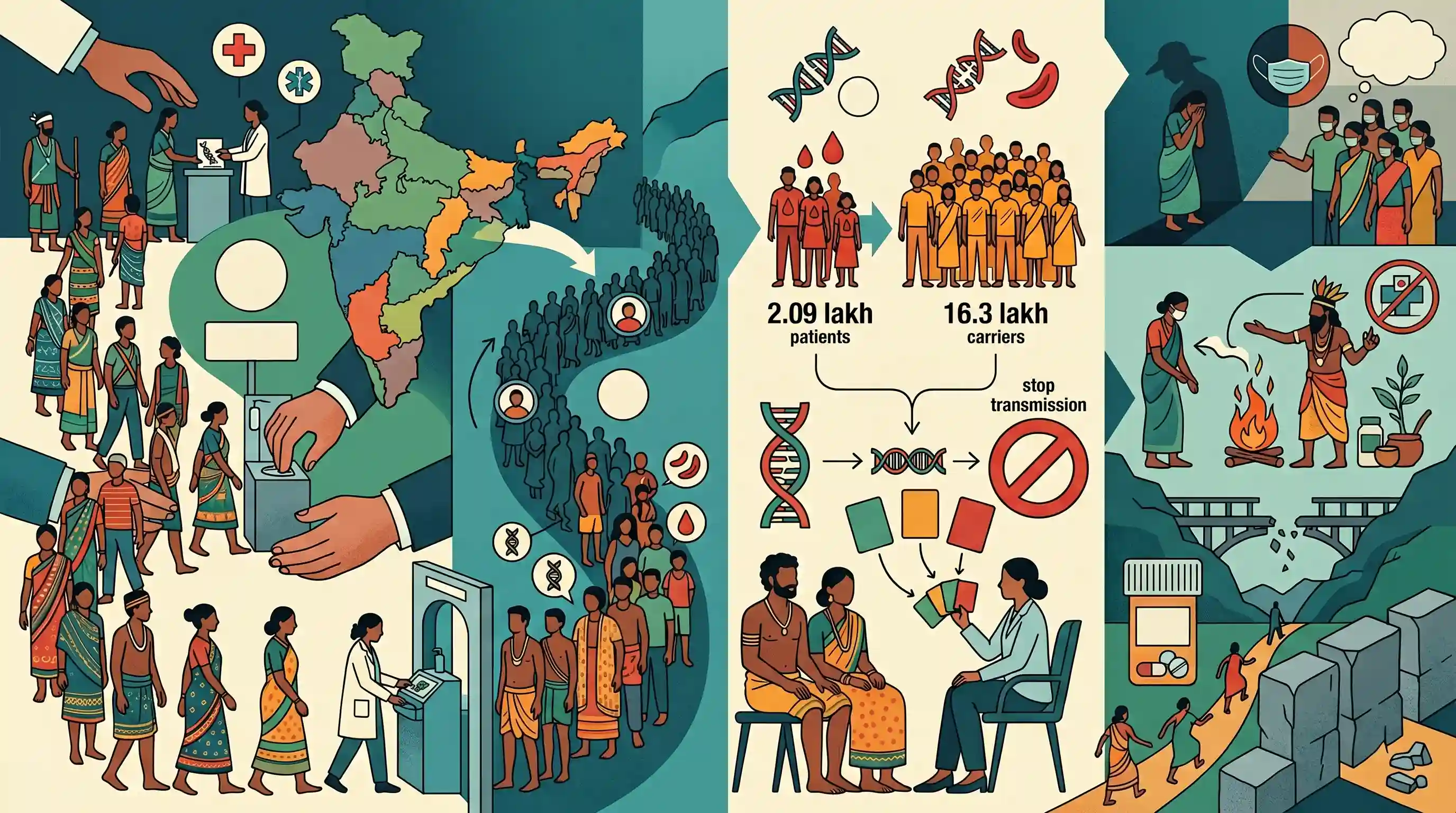
The National Sickle Cell Anaemia Elimination Mission has made significant progress by screening over 5.72 crore individuals, predominantly from tribal populations across 17 states. The initiative has successfully identified 2.09 lakh patients and 16.3 lakh carriers of the genetic blood disorder. The mission utilizes mass screening and colour-coded cards to facilitate genetic counselling before marriage to halt disease transmission. Despite these efforts, effective intervention is often hampered by social stigma, a strong reliance on traditional healers within tribal communities, and infrastructural barriers limiting the reach of essential treatments like Hydroxyurea at the grassroots level.
Key Points
- The National Sickle Cell Anaemia Elimination Mission has screened over 5.72 crore people out of a 7 crore target for 2025-26, identifying 2.09 lakh patients and 16.3 lakh trait carriers.
- The disease predominantly affects tribal populations in states like Maharashtra, Odisha, Chhattisgarh, Jharkhand, UP, Bihar, Gujarat, and Rajasthan.
- The mission distributes colour-coded cards post-screening to promote genetic counselling and prevent marriages between carriers that could result in diseased offspring.
- Key challenges in treating the tribal population include deep-rooted social stigma affecting marriage prospects, reliance on traditional medicine, and geographical barriers to accessing public healthcare.
- Hydroxyurea is highlighted as the primary accessible treatment for mitigating the severe symptoms of this genetic blood disorder.
Important Terms
National Sickle Cell Anaemia Elimination Mission

A mission-mode initiative launched in 2023 aiming to eliminate sickle cell disease by 2047 through universal screening of 7 crore people in 17 high-prevalence states.
UPSC context
GS Paper II (Social Justice/Health); tests knowledge of government interventions for vulnerable sections and health infrastructure.
National Health Mission (NHM)
India's flagship health program (launched 2013) that subsumes rural and urban missions to provide affordable, quality healthcare; it provides the funding framework for the Sickle Cell Mission.
UPSC context
GS Paper II (Governance/Schemes); essential for understanding India's public health architecture and universal health coverage.
Sickle Cell Disease (SCD)
An inherited genetic blood disorder where red blood cells become crescent-shaped, causing anemia, pain crises, and organ damage; highly prevalent in India's tribal belts.
UPSC context
GS Paper III (Science & Tech/Health); relevant for topics on genetic disorders and biological sciences.
Hydroxyurea
A cost-effective, oral disease-modifying drug used to increase fetal hemoglobin, reducing the frequency of painful crises and blood transfusions in sickle cell patients.
UPSC context
GS Paper III (Health/Science); tests awareness of therapeutic interventions and accessibility challenges in public health.
Genetic Counseling
A process of informing individuals about genetic risks and transmission; in the Mission, it specifically involves pre-marital counseling using color-coded cards to prevent disease inheritance.
UPSC context
GS Paper III (Science/Bioethics); significant for understanding preventive healthcare strategies in hereditary diseases.
Scheduled Tribes (STs)
Groups listed in the Constitution (Article 342) characterized by distinct culture and geographical isolation; they are the primary target group for the Sickle Cell Mission due to high disease prevalence.
UPSC context
GS Paper II (Social Justice); critical for analyzing developmental and health disparities among marginalized communities.
Prelims Trap
The Mission aims to biologically eradicate Sickle Cell Anaemia in India by the 2030 SDG deadline.
The mission's target year is 2047 (India's centenary), not the 2030 SDG deadline. It also aims to eliminate it as a public health problem, not biologically eradicate the genetic trait.
Static Concepts Connected
How is Sickle Cell Disease genetically transmitted?
- Autosomal Recessive: It requires two copies of the mutated gene (one from each parent) to manifest the disease. If only one parent passes the gene, the child is a carrier.
- Carrier Status: Individuals with only one mutated gene carry the trait but are generally asymptomatic. They can, however, pass the gene to their offspring.
- Malaria Resistance: Interestingly, carrying the sickle cell trait provides natural resistance to severe malaria, which explains the high prevalence of the gene in specific regions.
What are the therapeutic treatments for Sickle Cell Disease?
- CRISPR-Cas9 Therapy: Recent breakthrough gene-editing therapies (like Casgevy) modify a patient's own stem cells to produce fetal hemoglobin, effectively curing the symptoms.
- Stem Cell Transplant: Currently the only established cure. It replaces the diseased bone marrow with healthy, matching donor stem cells to produce normal red blood cells.
- Hydroxyurea: A standard, accessible oral medication that stimulates the production of fetal hemoglobin, reducing red blood cell sickling and painful vaso-occlusive crises.
Cross-Topic Patterns
Tribal Welfare (PM-JANMAN) + Genetic Health
The geographic overlap of SCD with Fifth/Sixth Schedule areas highlights how genetic health initiatives must integrate into broader tribal governance and welfare schemes like PM-JANMAN.
CRISPR Gene Editing vs. Healthcare Equity
While CRISPR therapies for SCD are breakthroughs, their multi-million dollar costs create a bioethics dilemma regarding equitable access and TRIPS patents for developing nations.

Expect a multi-statement question on SCD combining autosomal recessive genetics, Hydroxyurea's role, and the 2047 elimination target.
Linked PYQs · 4
Linked PYQs · 4
- 1998PrelimsGS1
Haemophilia is a genetic disorder which leads to
- 1999PrelimsGS1
Which one of the following genetic diseases is sex-linked?
- 2024MainsGS2
In a crucial domain like the public healthcare system the Indian State should play a vital role to contain the adverse impact of marketisation of the system. Suggest some measures through which the State can enhance the reach of public healthcare at the grassroots level.
- 2021MainsGS2
“Besides being a moral imperative of a Welfare State, primary health structure is a necessary precondition for sustainable development.” Analyze.
