Judicial Impeachment Procedures and Accountability
Source:The Hindu ↗
Why It Matters
The article illustrates the practical challenges and debates surrounding the removal of higher judiciary judges in India. It highlights the tension between statutory/constitutional mechanisms (Judges Inquiry Act, Parliamentary impeachment) and internal mechanisms (Supreme Court's in-house procedures) for judicial accountability, which is a frequent area of focus in UPSC GS-2 Polity and Governance.
Summary
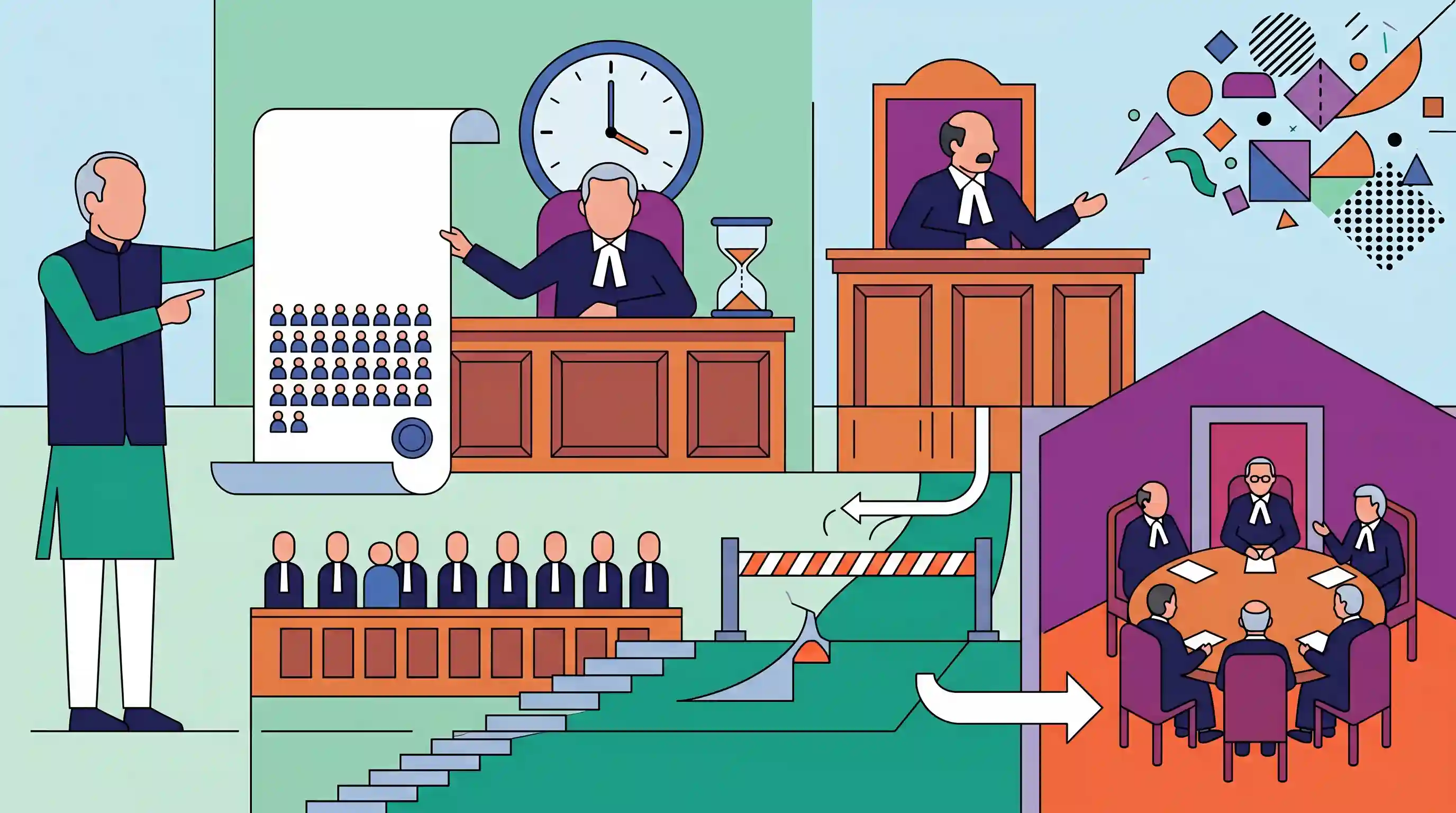
Former Union Law Minister Kapil Sibal has questioned Rajya Sabha Chairman Jagdeep Dhankhar's prolonged inaction on an impeachment notice moved by 53 MPs against Allahabad High Court Judge Shekhar Kumar Yadav over an allegedly communal speech. Sibal highlighted that the statutory procedure for judicial removal under the Judges (Inquiry) Act, 1968 is being ignored. He criticized the reliance on the Supreme Court's 'in-house procedure' as a substitute for constitutional impeachment, arguing that bypassing parliamentary mechanisms undermines judicial accountability, separation of powers, and judicial independence.
Key Points
- Former Law Minister Kapil Sibal criticized Rajya Sabha Chairman Jagdeep Dhankhar for inaction regarding an impeachment notice against Allahabad High Court Judge Shekhar Kumar Yadav.
- The impeachment notice, signed by 53 MPs, was filed under the Judges (Inquiry) Act, 1968, following an allegedly communal speech by the judge.
- Sibal asserted that bypassing the formal statutory impeachment process and relying solely on the Supreme Court's 'in-house procedure' to handle judicial misconduct is unconstitutional.
- He warned that circumventing parliamentary oversight mechanisms undermines judicial accountability, threatens the separation of powers, and compromises the independence of the judiciary.
Important Terms
Judges (Inquiry) Act, 1968

A 1968 law regulating the investigation and proof of "misbehaviour" or "incapacity" of superior court judges, providing the statutory framework for their removal process.
UPSC context
GS Paper II: Judiciary. Essential for understanding the legal procedure that operationalizes Article 124(5) for judicial removal.
Removal of Judges (Impeachment)
The constitutional process (Articles 124 and 218) where a judge is removed by the President after a special-majority address from both Houses of Parliament.
UPSC context
GS Paper II: Constitutional Provisions. Tests knowledge of safeguards for judicial independence and the mechanism for accountability.
In-House Procedure (Judiciary)
An internal disciplinary mechanism adopted by the Supreme Court in 1999 to address judicial misconduct that falls below the threshold for formal impeachment.
UPSC context
GS Paper II: Judicial Accountability. Relevant for debates on judicial self-regulation versus parliamentary oversight.
Rajya Sabha Chairman (Removal Power)
The presiding officer who has the statutory discretion under the 1968 Act to admit or reject an impeachment notice signed by 50 members.
UPSC context
GS Paper II: Parliament. Tests the role of presiding officers in judicial removal and their discretionary authority.
Proved Misbehaviour and Incapacity
The only two constitutionally mandated grounds for the removal of a Supreme Court or High Court judge under Article 124(4).
UPSC context
GS Paper II: Judiciary. Crucial for defining the legal threshold required to initiate removal proceedings.
Separation of Powers
A basic structure doctrine ensuring the Legislature, Executive, and Judiciary operate within distinct spheres, preventing one from encroaching on another's constitutional domain.
UPSC context
GS Paper II: Constitution. Fundamental for analyzing the tension between judicial independence and parliamentary accountability.
Prelims Trap
The Chairman is constitutionally bound to admit an impeachment motion if signed by 50 Rajya Sabha MPs.
The Speaker or Chairman holds discretionary power to either admit or reject a judicial removal motion, even if the requisite number of MP signatures is secured.
Static Concepts Connected
What is the statutory process for the removal of a High Court Judge?
- Initiation: Motion requires signatures of at least 100 members in the Lok Sabha or 50 in the Rajya Sabha.
- Investigation Committee: If admitted, the Presiding Officer forms a 3-member panel: a SC judge, a HC Chief Justice, and a distinguished jurist.
- Special Majority: Requires a special majority in both houses (majority of total membership + 2/3rd members present and voting).
- Constitutional Grounds: Limited strictly to 'proved misbehaviour or incapacity' under Article 124(4) and 217.
What is the Supreme Court's 'in-house procedure' for judicial misconduct?
- Nature: A peer-review mechanism adopted in 1999 to investigate allegations against judges internally, without public parliamentary inquiry.
- Limited Remedy: It can only result in peer pressure (advising resignation) or withdrawal of judicial work by the CJI, not formal removal.
- No Statutory Backing: It lacks statutory backing. Formal removal of a constitutional court judge can only happen via parliamentary impeachment.
Cross-Topic Patterns
Parliamentary Oversight vs Judicial Independence
The friction between the Judges (Inquiry) Act and the SC's internal peer-review procedures highlights the classic Polity tension between ensuring parliamentary accountability and preserving judicial independence.
Historical precedents of judicial impeachment
No judge has ever been successfully impeached in India. The discretionary admission power of the Presiding Officer was historically tested during the motions against Justice V. Ramaswami and CJI Dipak Misra.

Expect a 2026 multi-statement Polity question contrasting the statutory Judges (Inquiry) Act process with the SC's in-house procedure.
Linked PYQs · 3
Linked PYQs · 3
- 2023MainsGS2
“Constitutionally guaranteed judicial independence is a prerequisite of democracy.” Comment.
- 2019PrelimsGS1
Consider the following statements: 1. The motion to impeach a Judge of the Supreme Court of India cannot be rejected by the Speaker of the Lok Sabha as per the Judges (Inquiry) Act, 1968. 2. The Constitution of India defines and gives details of what constitutes 'incapacity and proved misbehaviour' of the Judges of the Supreme Court of India. 3. The details of the process of impeachment of the Judges of the Supreme Court of India are given in the Judges (Inquiry) Act, 1968. 4. If the motion for the impeachment of a Judge is taken up for voting, the law requires the motion to be backed by each House of the Parliament and supported by a majority of total membership of that House and by not less than two-thirds of total members of that House present and voting. Which of the statements given above is/are correct?
- 2012PrelimsGS1
What is the provision to safeguard the autonomy of the Supreme Court of India? 1. While appointing the Supreme Court Judges, the President of India has to consult the Chief Justice of India. 2. The Supreme Court Judges can be removed by the Chief Justice of India only. 3. The salaries of the Judges are charged on the Consolidated Fund of India to which the legislature does not have to vote. 4. All appointments of officers and staffs of the Supreme Court of India are made by the Government only after consulting the Chief Justice of India. Which of the statements given above is/are correct?
