Siang Dam project and indigenous concerns in Arunachal Pradesh
Source:The Hindu ↗
Why It Matters
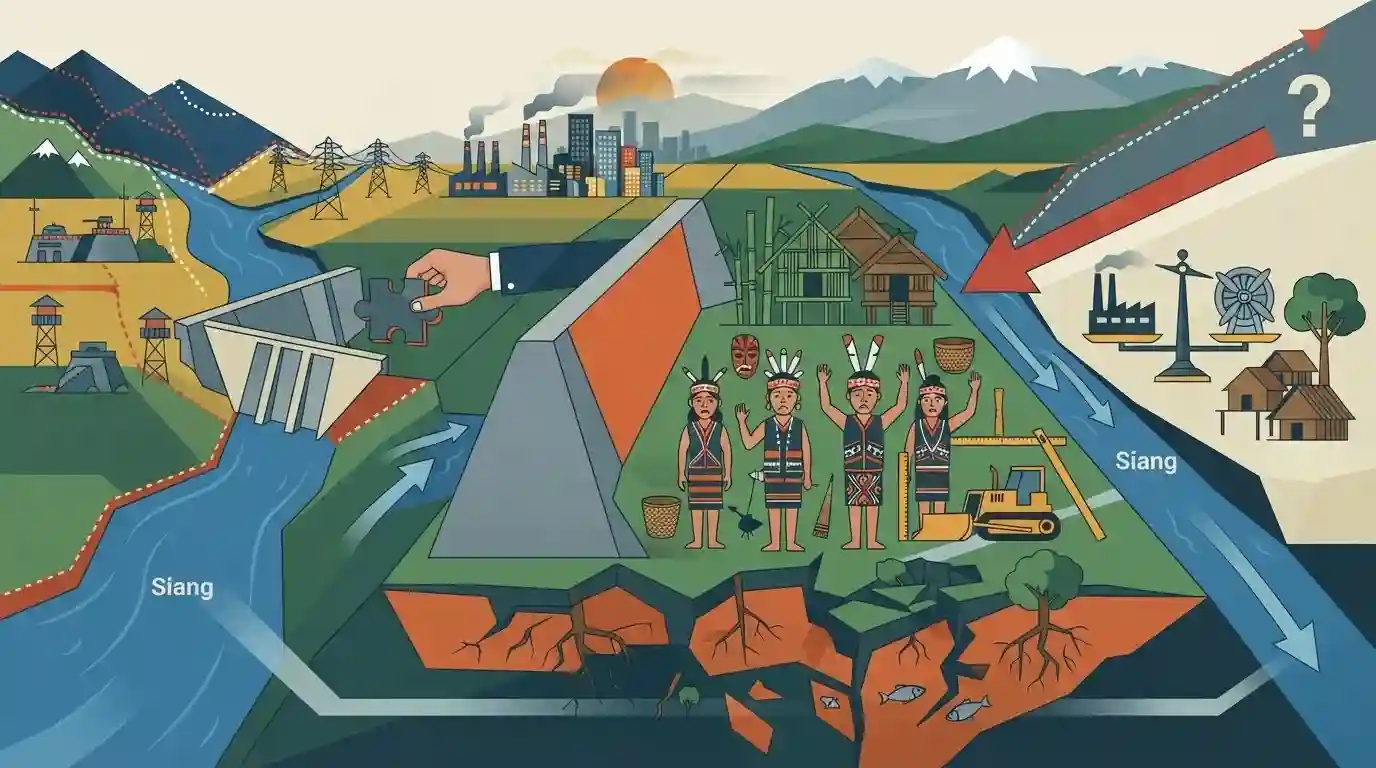
The controversy surrounding the Siang Dam encapsulates the core developmental dilemma in India's ecologically sensitive and strategic Northeast: balancing national infrastructure and trans-border hydro-diplomacy with local tribal sovereignty, displacement, and environmental protection.
Summary
The proposed mega Siang Dam project in Arunachal Pradesh has sparked severe anxiety and protests among indigenous communities in the Siang Valley, who fear losing their ancestral homelands, cultural heritage, and livelihoods. The article examines the complex interplay between strategic national infrastructure development, trans-boundary water geopolitics with China, and environmental conservation versus tribal rights and displacement concerns in India's Northeast.
Key Points
- The proposed Upper Siang hydroelectric project in Arunachal Pradesh has triggered massive local resistance and fear of displacement among indigenous communities.
- Local populations worry about the ecological destruction, loss of ancestral lands, cultural identity, and agricultural livelihoods in the Siang Valley.
- Concerns have also been raised regarding downstream security, trans-border river dynamics involving China's upstream diversion projects, and cumulative environmental impacts.
- The conflict highlights the friction between large-scale infrastructure and national security requirements versus localized tribal rights and ecological sustainability in Northeast India.
Important Terms
Upper Siang Hydroelectric Project

A massive proposed ~11,000 MW multipurpose dam project on the Siang River in Arunachal Pradesh, envisioned to counter Chinese upstream water diversion and secure strategic water resources.
UPSC context
GS Paper III (Infrastructure, Energy & Security). Tests understanding of trans-boundary water geopolitics, border infrastructure, and tribal displacement issues.
National Hydroelectric Power Corporation (NHPC)
A premier public sector undertaking under the Ministry of Power responsible for planning, executing, and operating major hydroelectric power projects across India.
UPSC context
GS Paper III (Economy & Infrastructure). Evaluates the role of central PSUs in renewable energy generation and large-scale infrastructure development.
Brahmaputra Board
An autonomous statutory body under the Ministry of Jal Shakti established to prepare master plans for flood control, drainage, and water resource management in the Brahmaputra valley.
UPSC context
GS Paper III (Environment & Water Resources). Tests knowledge of institutional frameworks governing river basin management and flood mitigation in Northeast India.
Static Concepts Connected
What are the key constitutional and legal safeguards for tribal populations in Northeast India?
- Sixth Schedule: Constitutional provisions granting district and regional councils legislative and judicial powers over land, forests, and social customs.
- LARR Act 2013: Requires free, prior, and informed consent (FPIC) and stringent social impact assessments for displacement and land acquisition.
- Forest Rights Act: Recognises community and individual forest rights, protecting traditional forest dwelling and livelihood dependencies.
Cross-Topic Patterns
Mega-Dams as Geopolitical Assets in the Himalayas
India's planned mega-dam on the Siang serves as both a renewable energy asset and a strategic water storage buffer against China's Yarlung Tsangpo diversion works, merging hydro-engineering with border defense.
Tribal Rights vs. Strategic Infrastructure in Northeast
Mega-dams in Arunachal Pradesh test the limits of the Fifth/Sixth Schedules, Forest Rights Act, and indigenous consent, pitching national security exemptions against customary tribal autonomy.

Siang/Brahmaputra hydro-geopolitics + fragile Eastern Himalayan ecology will appear in a multi-statement Prelims/Mains question.
Linked PYQs · 3
Linked PYQs · 3
- 2024MainsGS3
What role do environmental NGOs and activists play in influencing Environmental Impact Assessment (EIA) outcomes for major projects in India? Cite four examples with all important details.
- 2016MainsGS3
Rehabilitation of human settlements is one of the important environmental impacts which always attracts controversy while planning major projects. Discuss the measures to be adopted to mitigate the impact of the recent incidents of cloudbursts in many places of Uttarakhand.
- 2017MainsGS3
The North-East region of India has been infested with insurgency for a very long time. Analyze the major reasons for the survival of armed insurgency in this region.
