Siang Dam Controversy and Indigenous Resistance in Arunachal Pradesh
Source:The Hindu ↗
Why It Matters
It provides a classic case study for questions regarding 'Development vs. Displacement', the socio-environmental impacts of large hydroelectric projects in ecologically sensitive regions, and the rights of indigenous communities in Northeast India.
Summary
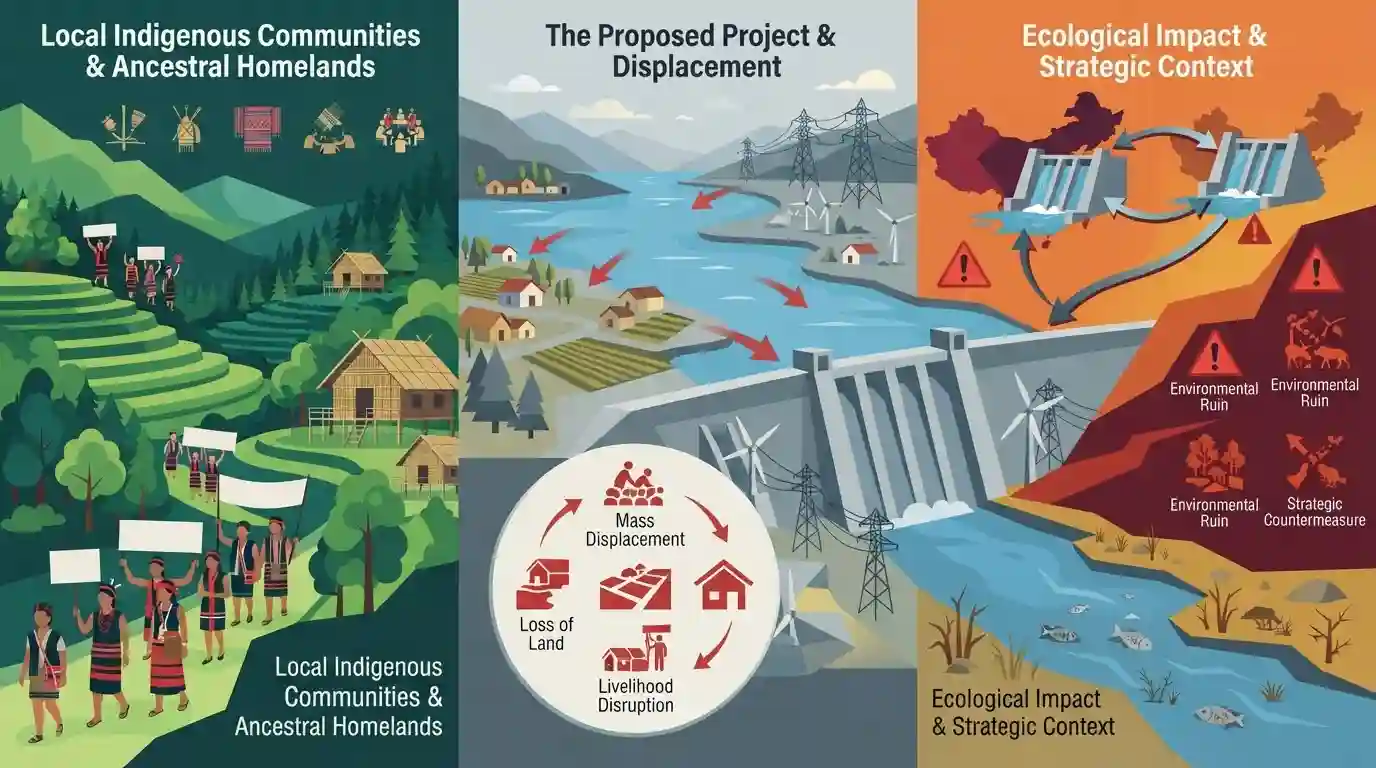
An analysis of the resistance by local indigenous communities in Arunachal Pradesh against the proposed massive Siang Upper Multipurpose Project. The project, touted as a strategic counter-measure against upstream Chinese dams on the Yarlung Tsangpo, faces deep local opposition due to impending mass displacement, ecological ruin, and loss of ancestral homelands.
Key Points
- Local indigenous communities in Arunachal Pradesh, particularly along the Siang River, are strongly opposing the proposed 11,000 MW Siang Upper Multipurpose Project.
- Residents fear massive displacement, loss of ancestral lands, destruction of sacred sites, and ecological devastation.
- Geopolitical arguments involving upstream Chinese infrastructure on the Yarlung Tsangpo are countered by local stakeholders who argue that a massive dam will submerge their own lands and communities rather than protect them.
- The project highlights the persistent tension between large-scale developmental/strategic energy infrastructure and the rights, livelihoods, and cultural identity of indigenous hill communities.
Prelims Trap
The Siang River originates in the glaciers of Arunachal Pradesh before entering Assam.
Aspirants often assume the Siang originates within Arunachal Pradesh, confusing its status as the prime headstream of the Brahmaputra with local rivers, whereas it enters India as the continuation of Tibet's Yarlung Tsangpo.
Static Concepts Connected
What are the core institutional and constitutional safeguards for tribal areas in Northeast India?
- Sixth Schedule: Constitutional framework protecting tribal autonomy through administrative decentralization in Assam, Meghalaya, Tripura, and Mizoram.
- Inner Line Permit: Historical regulatory mechanism restricting outsiders' entry to protect indigenous identity and resources, applicable in Arunachal Pradesh.
- EIA & Land Acquisition: Mandatory process for assessing socio-economic and environmental impacts of large infrastructure projects, heavily contested in tribal belts.
Cross-Topic Patterns
Border Infrastructure vs. Indigenous Rights
Strategic border infrastructure in Arunachal Pradesh repeatedly tests the delicate balance between national security imperatives and the ecological/cultural rights of indigenous hill tribes protected under constitutional safeguards.
Transboundary Hydro-Politics and Domestic Displacement
Mega-dams on transnational rivers like the Yarlung Tsangpo-Siang nexus entrench transboundary water hydro-politics, linking upstream diversion risks directly to downstream domestic displacement conflicts.

SUMP + Brahmaputra basin transboundary dynamics + Sixth Schedule / Inner Line Permit dynamics likely in Prelims/Mains.
Linked PYQs · 3
Linked PYQs · 3
- 2024MainsGS3
What role do environmental NGOs and activists play in influencing Environmental Impact Assessment (EIA) outcomes for major projects in India? Cite four examples with all important details.
- 2016MainsGS3
Rehabilitation of human settlements is one of the important environmental impacts which always attracts controversy while planning major projects. Discuss the measures to be adopted to mitigate the impact of the recent incidents of cloudbursts in many places of Uttarakhand.
- 2016PrelimsGS1
Which of the following is/are tributary/tributaries of Brahmaputra? 1. Dibang 2. Kameng 3. Lohit Select the correct answer using the code given below.
