Ethnic Shutdowns Disrupt Normal Life Across Manipur
Source:The Hindu ↗
Why It Matters
The persisting unrest in Manipur serves as a critical case study for UPSC aspirants regarding the complexities of internal security, the role of civil society organizations as non-state actors in governance and conflict, and the enduring impact of ethnic fault lines in Northeast India.
Summary
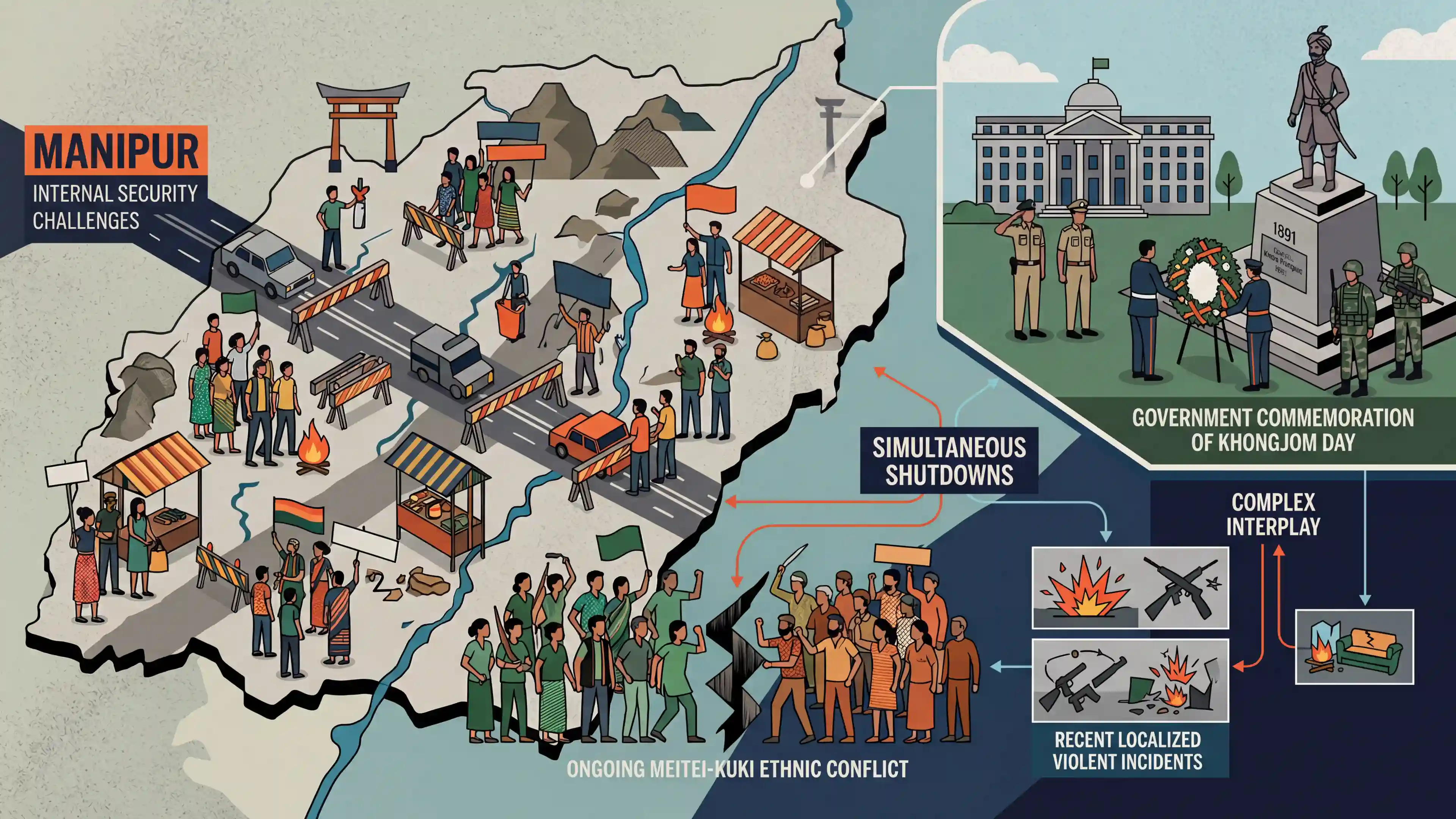
Normal life in Manipur has been severely disrupted by simultaneous shutdowns organized by various ethnic groups and civil society organizations. The protests, spearheaded by groups like the United Naga Council and Zomi Coordination Committee, are in response to recent localized violent incidents, compounding the instability caused by the ongoing Meitei-Kuki ethnic conflict that began in May 2023. In the midst of this contemporary crisis, the state government observed Khongjom Day to honor the martyrs of the 1891 Anglo-Manipuri War, highlighting the complex interplay between historical legacy and ongoing internal security challenges in Northeast India.
Key Points
- Multiple simultaneous shutdowns called by various ethnic groups and civil society organizations have disrupted normal life across Manipur.
- Protests were triggered by recent incidents, including the killing of two Tangkhul Naga individuals and a bomb attack in Bishnupur district.
- The ongoing ethnic violence between the Meitei and Kuki communities, which began in May 2023, continues to form the backdrop for escalating tensions.
- The state government observed Khongjom Day to commemorate the martyrs of the 1891 Anglo-Manipuri War, demonstrating the continued political relevance of regional history.
Important Terms
Coordination Committee on Manipur Integrity (COCOMI)

A unified coalition of over 50 Meitei civil society organizations formed in 2019. It primarily advocates for preserving the territorial integrity of Manipur and protecting the rights of indigenous communities during ethnic conflicts.
UPSC context
GS Paper III (Internal Security). Examines the role of civil society organizations (CSOs) in conflict resolution and managing ethnic tensions.
United Naga Council (UNC)
The apex representative organization for Naga tribes in Manipur. It advocates for Naga rights and territorial unification (Nagalim), while participating in peace talks with the Indian government to resolve long-standing Naga political issues.
UPSC context
GS Paper III (Internal Security). Tests understanding of ethnic sub-nationalism, the Naga peace process, and regional security in Northeast India.
Zomi Coordination Committee
A collective body representing the interests of the Zomi ethnic group in Manipur. It coordinates community-specific responses, protests, and negotiations with the government regarding justice and administrative grievances for the Zomi people.
UPSC context
GS Paper III (Internal Security). Tests knowledge of ethnic diversity, identity politics, and multi-layered conflict dynamics in Manipur’s hill areas.
Joint Action Committee (JAC)
Temporary, issue-based civil society platforms formed by local communities in Manipur to seek justice for specific violent incidents. They organize protests, issue demands, and negotiate with the state for administrative action.
UPSC context
GS Paper II (Governance). Covers pressure groups and informal organizations’ roles in public grievance redressal and localized conflict management.
Anglo-Manipuri War (1891)
A conflict between the British Empire and the Kingdom of Manipur triggered by internal palace disputes and British interference. It culminated in the Battle of Khongjom, ending Manipur's sovereignty and independence.
UPSC context
GS Paper I (Modern Indian History). Examines regional resistance to British expansionism and the historical evolution of Northeast India’s political status.
Khongjom Day
An annual state-level observance on April 23rd in Manipur honoring martyrs of the 1891 Anglo-Manipuri War. It specifically pays tribute to heroes like Paona Brajabashi who fought at the Battle of Khongjom.
UPSC context
GS Paper I (Modern History/Culture). Tests knowledge of regional historical events and state-level commemorations that shaped local identity and patriotism.
Prelims Trap
"Manipur's tribal Hill Areas are administered as Autonomous Districts under the Sixth Schedule of the Indian Constitution."
Aspirants often assume all Northeast tribal areas fall under the Sixth Schedule. Manipur is governed by Article 371C, providing a Hill Areas Committee, but lacks Sixth Schedule status (which is for AMTM).
Static Concepts Connected
How does Article 371C govern Manipur's Hill Areas?
- Hill Areas Committee: Constitutes a committee of the Manipur Legislative Assembly consisting of members elected from the Hill Areas to protect tribal interests.
- Governor's Role: The Governor has special responsibility to ensure proper administration of Hill Areas and submits annual reports directly to the President.
- Not Sixth Schedule: Unlike Assam, Meghalaya, Tripura, and Mizoram (AMTM), Manipur's tribal areas are not covered under the Sixth Schedule.
What was the significance of the 1891 Anglo-Manipuri War?
- Battle of Khongjom: Fought in 1891, it marked the last major resistance of the Kingdom of Manipur against British annexation.
- Major Paona Brajabasi: He is the legendary Manipuri military leader who was martyred during this battle, commemorated annually on Khongjom Day.
- Loss of Sovereignty: Resulted in the British taking direct control of Manipur, ending its independent sovereign status until Indian independence.
Cross-Topic Patterns
Geography as an internal security faultline
The Imphal Valley (10% land) versus Hill Ranges (90% land) demographic divide illustrates how topography directly dictates resource distribution and fuels complex internal security challenges in the Northeast.
Colonial buffer policies & modern ethnic conflict
British colonial policies of settling Kuki tribes as strategic buffers against Naga raids created demographic overlaps that continue to drive multi-cornered ethnic violence and land disputes today.

Expect a Prelims matching question on NE special provisions (Art 371A-G) or a Mains Q on how colonial topography dictates NE insurgencies.
Linked PYQs · 3
Linked PYQs · 3
- 2019MainsGS3
Cross-border movement of insurgents is only one of the several security challenges facing the policing of the border in North-East India. Examine the various challenges currently emanating across the India-Myanmar border. Also, discuss the steps to counter the challenges.
- 2017MainsGS3
The North-East region of India has been infested with insurgency for a very long time. Analyze the major reasons for the survival of armed insurgency in this region.
- 2025MainsGS2
Civil Society Organizations are often perceived as being anti-State actors than non-State actors. Do you agree? Justify.
