Legislative gridlock and Senate rules crisis in United States
Source:The Hindu ↗
Why It Matters
The article provides a real-world example of legislative gridlock in a Presidential system with strict separation of powers. It is highly relevant for GS Paper 2 questions comparing the US and Indian constitutional schemes, particularly regarding legislative rules (like the filibuster) and parliamentary sovereignty. It also highlights the impact of governance failures on vulnerable populations dependent on welfare schemes.
Summary
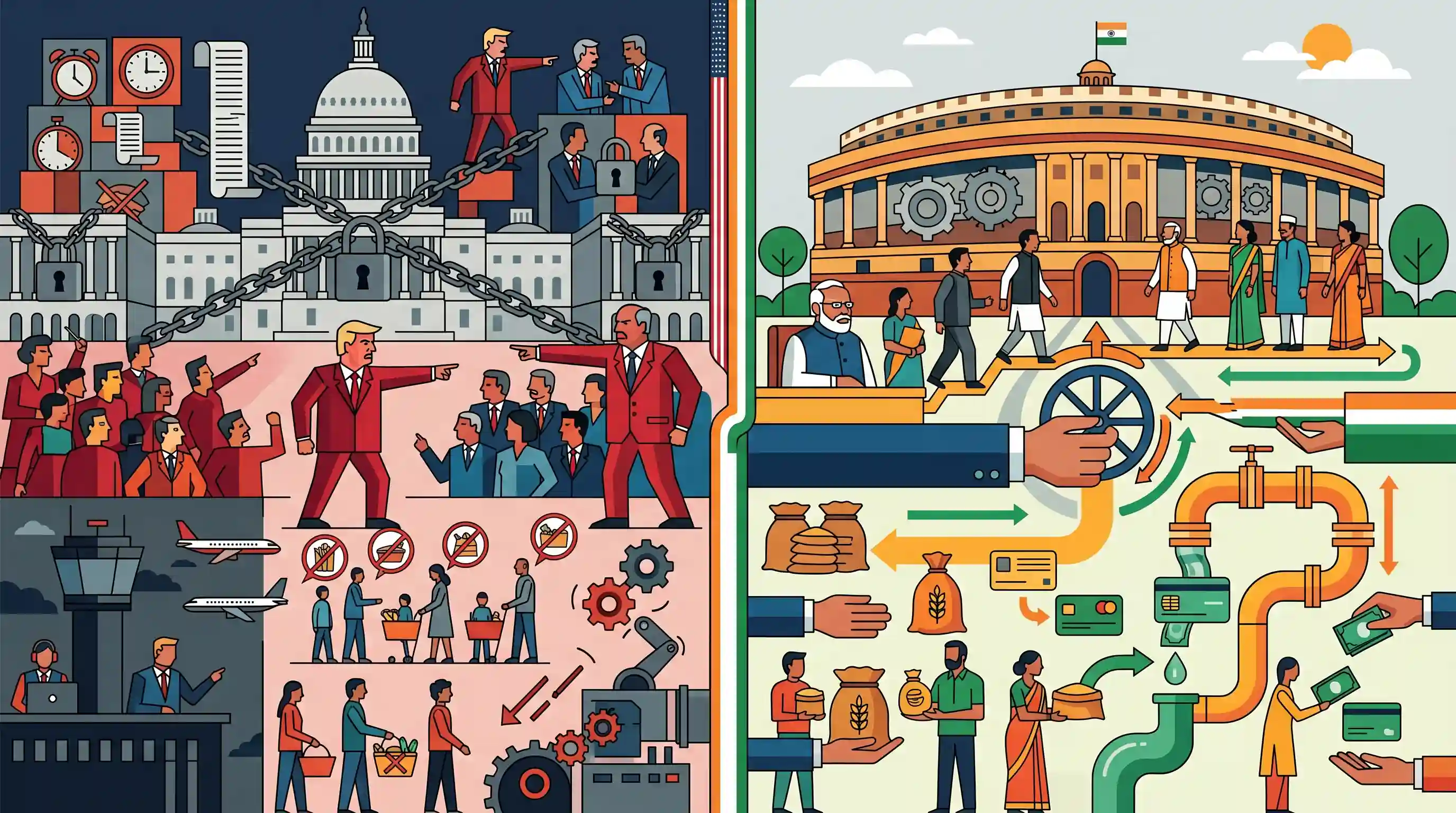
The United States government shutdown has dragged into its sixth week amid a political stalemate over government healthcare subsidies. President Donald Trump is urging Senate Republicans to eliminate the legislative filibuster to pass a funding bill without Democratic support. The ongoing impasse has halted pay for critical federal workers, including air traffic controllers, and threatens essential welfare programs like SNAP (food assistance), highlighting the systemic vulnerabilities and potential for gridlock in the US constitutional setup.
Key Points
- The US government shutdown has entered its sixth week, nearing the 35-day historical record set in 2018-2019.
- President Trump is pressuring Senate Republicans to eliminate the filibuster, a rule requiring 60 votes to pass most legislation, to bypass Democratic opposition.
- Democrats refuse to negotiate on extending government healthcare subsidies until the government is fully reopened.
- The shutdown is severely impacting critical services and welfare, leaving air traffic controllers unpaid and threatening SNAP (food aid) benefits for 42 million Americans.
Important Terms
Government Shutdown

A situation where US federal agencies halt non-essential operations because Congress has not passed funding legislation, halting pay for federal workers and threatening welfare services.
UPSC context
GS Paper 2: Comparison of Indian (Parliamentary) and US (Presidential) budget processes and executive-legislative relations.
Legislative Filibuster
A procedural tactic in the US Senate where a minority can block or delay legislation by extending debate, effectively requiring a 60-vote supermajority to "cloture" or end it.
UPSC context
GS Paper 2: Legislative procedures and the protection of minority rights in bicameral legislatures.
Affordable Care Act (ACA)
The 2010 US healthcare reform ('Obamacare') that introduced subsidies and health insurance exchanges to increase coverage for the uninsured and low-income individuals.
UPSC context
GS Paper 2: Social justice and government policies on health; comparative study with India's Ayushman Bharat.
Supplemental Nutrition Assistance Program (SNAP)
The largest US federal food assistance program, providing monthly benefits to low-income individuals for grocery purchases via Electronic Benefit Transfer (EBT) cards.
UPSC context
GS Paper 2 & 3: Issues relating to poverty and hunger; comparison with India's National Food Security Act (NFSA).
United States Senate
The upper house of the US Congress, where each state has two representatives regardless of population; it holds significant power over treaties and executive appointments.
UPSC context
GS Paper 2: Comparison of Indian and US constitutional schemes, specifically the Rajya Sabha vs the Senate.
House of Representatives
The lower house of the US Congress, with 435 members elected every two years; it holds the primary power to initiate revenue-related legislation.
UPSC context
GS Paper 2: Functions and responsibilities of the legislature; comparison with India's Lok Sabha.
Prelims Trap
"Failure to pass the Appropriation Bill in India leads to a government shutdown where non-essential services are suspended."
In India's parliamentary system, defeating a money bill leads to the government's resignation (loss of confidence), not a US-style shutdown. Advance funding is handled via Vote on Account.
Static Concepts Connected
How does the Indian Constitution prevent US-style administrative paralysis over funding?
- Vote on Account: Article 116 allows the Lok Sabha to grant advance money for estimated expenditure for part of the year, pending full budget passage.
- Fall of Government: In India's parliamentary system, failure to pass the budget implies a loss of confidence, leading to the government's resignation rather than a prolonged shutdown.
- Charged Expenditure: Article 112(3) lists non-votable expenditures (e.g., President's salary) drawn from the Consolidated Fund, unaffected by legislative voting deadlocks.
What is the difference between US Senate 'Filibuster' and Indian Parliament 'Guillotine'?
- Filibuster (US): A procedural tactic used in the US Senate by a minority to delay or block a vote on a bill by extending debate indefinitely.
- Guillotine (India): A time-saving tool where the Lok Sabha Speaker clubs all outstanding demands for grants and puts them to vote at once, ending debate.
Cross-Topic Patterns
Separation vs Fusion of Powers
The US shutdown exemplifies gridlock caused by strict separation of powers. In India, fusion ensures executive accountability; blocking funds means the government falls rather than shutting down.
US Filibuster vs Indian Guillotine
Contrast the US Senate's debate-extending filibuster with India's debate-ending guillotine closure motion used to expedite the budget passage.

Expect a GS-2 comparative constitution question contrasting systemic causes of US government shutdowns with India's parliamentary accountability.
Linked PYQs · 4
Linked PYQs · 4
- 2024MainsGS2
Discuss India as a secular state and compare with the secular principles of the US constitution.
- 2021MainsGS2
Analyze the distinguishing features of the notion of Right to Equality in the Constitutions of the USA and India.
- 2025MainsGS2
Compare and contrast the President's power to pardon in India and in the USA. Are there any limits to it in both the countries? What are 'preemptive pardons'?
- 2023MainsGS2
Compare and contrast the British and Indian approaches to Parliamentary sovereignty.
