Microgravity Adaptation: ISRO Protocol for Astronaut Rehabilitation
Source:The Hindu ↗
Why It Matters
Shubhanshu Shukla's participation in the Ax-4 mission is a critical precursor and learning opportunity for India's upcoming indigenous human spaceflight mission, Gaganyaan. Understanding the health impacts of microgravity and post-mission rehabilitation is essential for establishing robust astronaut training and recovery protocols for future ISRO missions.
Summary
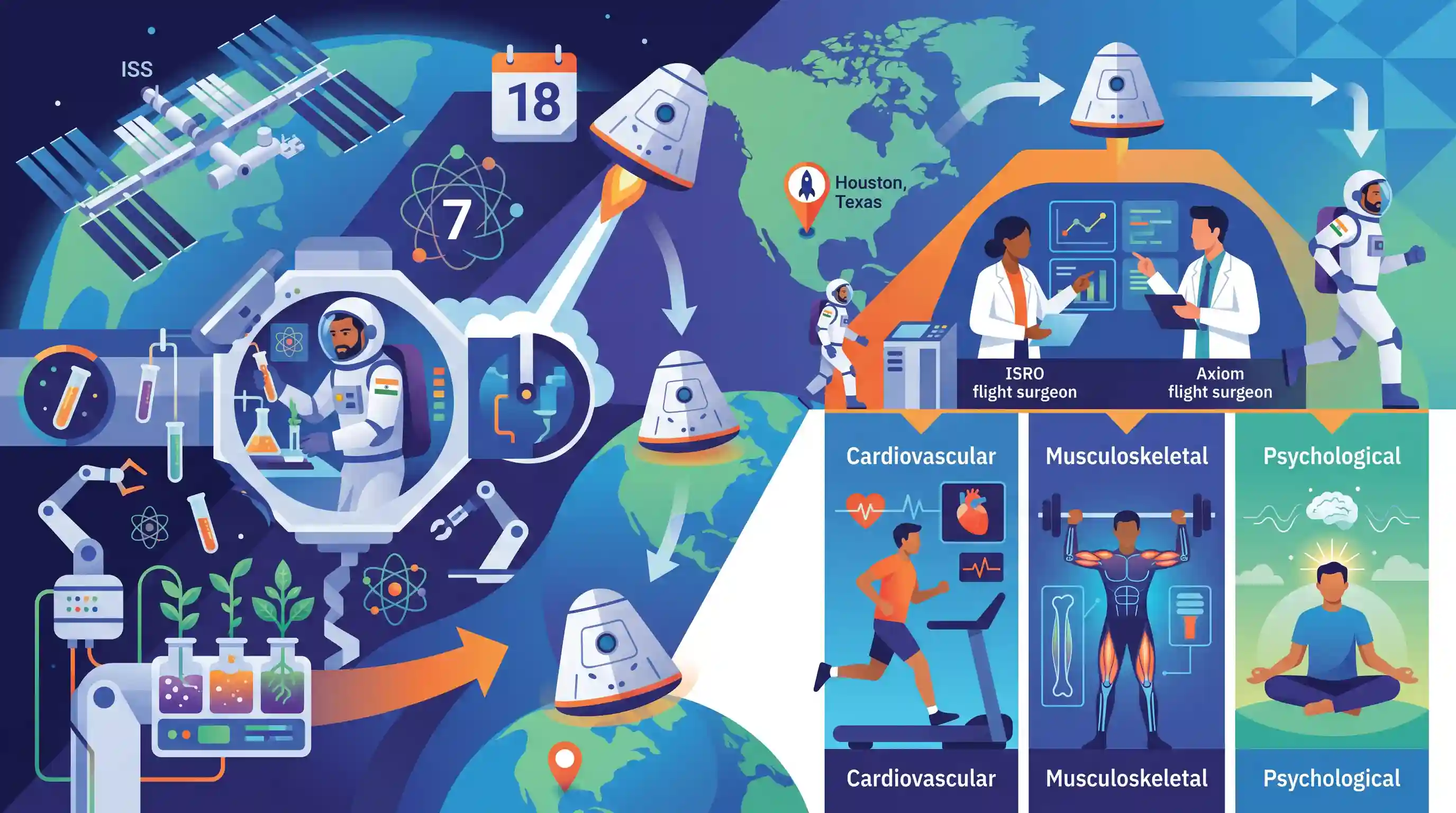
Indian astronaut Group Captain Shubhanshu Shukla has commenced a week-long rehabilitation program in Houston, Texas, following his successful 18-day stay on the International Space Station (ISS) as part of the Axiom Mission 4 (Ax-4). As the first Indian to visit the ISS, Shukla completed seven microgravity experiments during the mission. The rehabilitation, jointly monitored by ISRO and Axiom flight surgeons, aims to mitigate any adverse physical and mental impacts of microgravity, encompassing cardiovascular, musculoskeletal, and psychological evaluations before his return to regular activities.
Key Points
- Group Captain Shubhanshu Shukla, the first Indian to visit the International Space Station (ISS), has returned to Earth after an 18-day stay aboard as part of the Axiom Mission 4 (Ax-4).
- He is currently undergoing a week-long rehabilitation program in Houston, Texas, to mitigate the adverse effects of microgravity on his body.
- The rehabilitation includes cardiovascular assessments, musculoskeletal tests, and psychological debriefing, jointly administered by flight surgeons from Axiom and ISRO.
- During his time on the ISS, Shukla successfully completed all seven designated microgravity experiments as the mission crew achieved over 60 research activities and 23 outreach events.
- The mission concluded with a splashdown of the SpaceX Dragon capsule off the coast of San Diego, USA.
Important Terms
Axiom Mission 4 (Ax-4)

The fourth private crewed mission to the International Space Station (ISS), involving collaboration between Axiom Space, NASA, SpaceX, and ISRO. It marked the first visit by an Indian astronaut (Shubhanshu Shukla) to the ISS.
UPSC context
GS III: Space Technology. Tests knowledge of international collaborations and India’s growing role in the commercial space economy.
Gaganyaan Mission
India’s flagship human spaceflight program aiming to demonstrate indigenous capability by sending a three-member crew to a 400-km Low Earth Orbit for a three-day mission.
UPSC context
GS III: Indigenization of technology. A high-priority topic for Mains (Space Missions) and Prelims (Technical Specifications).
Microgravity
The condition in which people or objects appear weightless. It is a key research area for understanding long-term physiological impacts on astronauts and developing space-based manufacturing/medicine.
UPSC context
GS III: Science and Technology. Important for understanding biological and physical challenges of deep-space exploration.
Axiom Space
A private American aerospace company that facilitates commercial missions to the ISS and is developing the first commercial space station (Axiom Station) to succeed the ISS.
UPSC context
GS III: Space Technology. Relevant to the shift from government-led to private-led space exploration (Space 2.0).
Astronaut Rehabilitation
The process of physical and psychological recovery for astronauts post-spaceflight, focusing on reversing muscle atrophy, bone density loss, and cardiovascular changes caused by a lack of gravity.
UPSC context
GS III: Life Sciences/Space Tech. Highlights the health challenges and human-centric aspects of manned space missions.
ISRO (Indian Space Research Organisation)
The premier national space agency of India, responsible for space-based applications, exploration, and the development of indigenous launch vehicles and satellites.
UPSC context
GS III: Major Institutional achievements. Central to all space-related questions in UPSC.
Prelims Trap
Shubhanshu Shukla became the first Indian citizen to travel to space under a fully indigenous ISRO mission.
Rakesh Sharma was the first Indian in space. Shukla is the first Indian to visit the ISS. Also, Ax-4 is a private Axiom mission, not indigenous Gaganyaan.
Static Concepts Connected
What are the physiological impacts of prolonged microgravity on the human body?
- Fluid Shift: Fluids move to the upper body, increasing intracranial pressure which can cause Spaceflight-Associated Neuro-ocular Syndrome (SANS) and vision issues.
- Musculoskeletal Decline: Prolonged weightlessness leads to significant muscle atrophy and a steady loss of bone mineral density, requiring intensive post-mission rehabilitation.
- Cardiovascular Deconditioning: The heart works less vigorously because it does not have to pump blood against Earth's gravity, leading to cardiovascular deconditioning.
What characterizes Low Earth Orbit (LEO) where the ISS operates?
- Altitude Range: LEO encompasses Earth-centered orbits with an altitude ranging from 160 km to 2,000 km (the ISS orbits at approximately 400 km).
- Short Orbital Period: Objects in LEO have short orbital periods (roughly 90-120 minutes), allowing for frequent and rapid orbits around the Earth.
- Free-fall Microgravity: Objects in orbit are in constant free-fall, creating a sensation of weightlessness (microgravity), even though Earth's gravitational pull is still about 90% as strong as on the surface.
Cross-Topic Patterns
Commercialization of Low Earth Orbit (LEO)
Axiom-4 exemplifies the global shift from state-led space exploration to private commercial entities operating in Low Earth Orbit, mirroring India's own space sector privatization reforms through IN-SPACe and NSIL.
Stepping stones to Gaganyaan and BAS
Joint international commercial missions like Ax-4 provide crucial human spaceflight protocols, such as post-flight rehabilitation and microgravity medicine, essential for India's upcoming Gaganyaan and Bharatiya Antariksha Station (2035).

Microgravity impacts (SANS, bone density) combined with LEO commercialization likely forms a multi-statement prelims question in 2026.
Linked PYQs · 2
Linked PYQs · 2
- 2025PrelimsGS1
Consider the following space missions : I. Axiom-4 II. SpaDeX III. Gaganyaan How many of the space missions given above encourage and support micro-gravity research?
- 2019MainsGS3
What is India's plan to have its own space station and how will it benefit our space programme?
