भारतीय अंतरिक्ष यात्री ISS पर बीज प्रयोग करेंगे
स्रोत:द हिंदू ↗
क्यों मायने रखता है
This highlights India's increasing footprint in human space exploration and microgravity research. Understanding plant biology and stem cell behavior in space is critical for long-duration missions and feeds directly into GS3 topics like biotechnology, space missions (Gaganyaan), and sustainable technologies (microalgae for biofuel).
सारांश
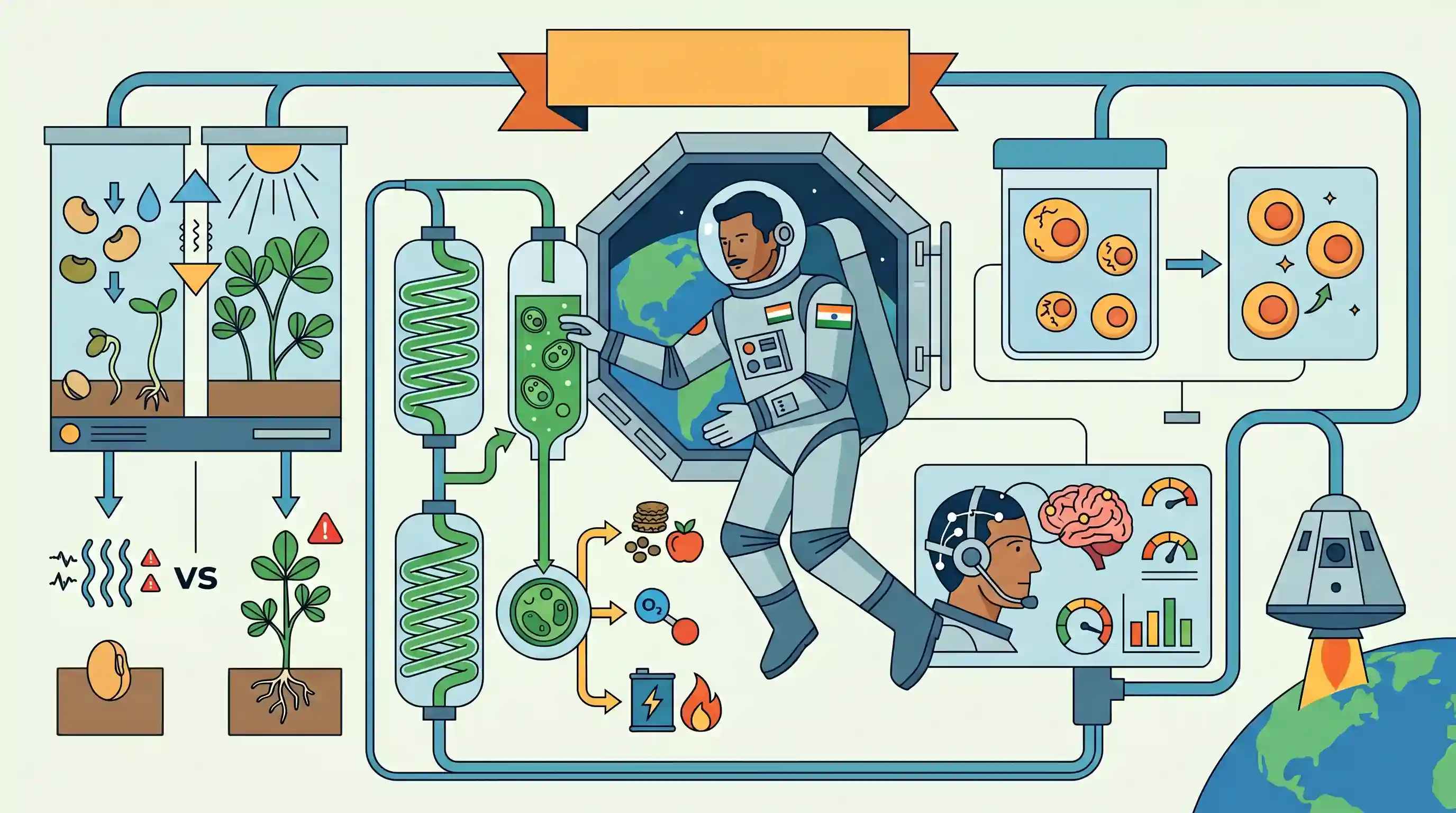
Indian astronaut Group Captain Shubhanshu Shukla will engage in agricultural and biotechnological research aboard the International Space Station (ISS) during the upcoming Axiom-4 mission. Collaborating with Indian scientists, he will grow moong and methi seeds in microgravity to understand plant stress and survival in space. Other crucial experiments involve utilizing microalgae for life-support systems (food, oxygen, and biofuels), studying stem cell recovery under space conditions, and evaluating cognitive load on astronauts. These experiments are critical building blocks for India's indigenous Gaganyaan human spaceflight program.
मुख्य बिंदु
- Indian astronaut Shubhanshu Shukla will conduct microgravity experiments aboard the ISS during the commercial Axiom-4 mission.
- He will grow 'moong' and 'methi' seeds to study plant germination, survival, and stress responses in space, collaborating with researchers from UAS Dharwad and IIT Dharwad.
- The mission will also test the use of microalgae for food, oxygen generation, and biofuel production to build closed-loop life support systems for long-duration space travel.
- Biomedical experiments include evaluating the effect of microgravity on stem cell growth and the potential of specific supplements to accelerate recovery.
- Another experiment focuses on assessing cognitive load on astronauts to improve interface designs for future human spaceflight missions like Gaganyaan.
महत्वपूर्ण शब्द
Axiom-4 Mission (Ax-4)

A commercial human spaceflight mission to the International Space Station, involving a landmark collaboration between Axiom Space, NASA, and ISRO to conduct microgravity research.
UPSC context
GS III: Space Technology; signifies India's first participation in a private-public international orbital mission and preparatory steps for indigenous human spaceflight.
Gaganyaan Mission
भारत का प्रमुख मानव अंतरिक्ष उड़ान कार्यक्रम, जिसका लक्ष्य तीन सदस्यीय चालक दल को तीन दिनों के लिए 400 किमी की निचली पृथ्वी कक्षा (Low Earth Orbit) में भेजकर स्वदेशी क्षमता का प्रदर्शन करना है।
UPSC context
GS III: Achievements of Indians in Science & Tech; tests knowledge of mission architecture, launch vehicles (LVM3), and safety systems like the Crew Escape System.
Microgravity
The condition in which people or objects appear weightless, providing a unique environment for scientific experiments in physics, biology, and materials science.
UPSC context
GS III: Science & Tech Applications; fundamental to understanding the purpose of research conducted on the ISS and during the Gaganyaan precursors.
International Space Station (ISS)
A modular orbital research laboratory where international crews conduct experiments that cannot be performed on Earth, serving as a gateway for deep-space exploration.
UPSC context
GS III: Awareness in the fields of Space; important for international cooperation and the evolution of global space governance.
Axiom Space
A private American space infrastructure company that facilitates commercial missions to the ISS and is developing the first commercial space station.
UPSC context
GS III: Role of the private sector in space (NewSpace); reflects the global shift toward commercializing low Earth orbit.
Vyommitra
A female-looking humanoid robot developed by ISRO to simulate human functions and test life-support systems during uncrewed Gaganyaan test flights.
UPSC context
GS III: Robotics and Space Tech; specific technical milestones of India's indigenous human spaceflight program.
प्रारंभिक ट्रैप
Shubhanshu Shukla's visit to the International Space Station is the first crewed phase of ISRO's Gaganyaan mission.
Axiom-4 is a US-based commercial mission, not Gaganyaan. India is using this private partnership as a capacity-building precursor to train its astronaut before launching the indigenous Gaganyaan mission.
संबंधित अवधारणाएँ
How do plants navigate directional growth in a microgravity environment?
- Phototropism dominates: Without Earth's gravity dictating downward root growth (gravitropism), plants rely heavily on light sources (phototropism) to orient their shoot and root systems.
- Altered fluid dynamics: Water behaves differently due to surface tension dominating in microgravity. Standard soil watering drowns roots, forcing researchers to use specialized porous substrates or hydrogel to deliver nutrients.
What is the role of microalgae in Bioregenerative Life Support Systems (BLSS)?
- Closed-loop recycling: Microalgae like Spirulina absorb crew carbon dioxide, utilizing photosynthesis to convert it into breathable oxygen, effectively acting as an organic air scrubber.
- Biomass and biofuel: Beyond basic life support, rapidly dividing algae provide high-protein nutrition for astronauts and can be processed into biofuels for deep-space missions.
अंतर-विषय पैटर्न
Microgravity as an accelerated aging lab
Space accelerates muscle atrophy and bone loss. Stem cell research on the ISS provides a fast-track environment to develop regenerative treatments for osteoporosis and age-related muscle degeneration on Earth.
Commercial space diplomacy and Artemis Accords
India leveraging Axiom Space—a US private entity—reflects the shift toward public-private international space alliances, directly tied to India's recent signing of the US-led Artemis Accords.

Expect a Prelims multi-statement question on microgravity's specific biological effects on plant gravitropism, stem cells, and human cells.
संबद्ध PYQ · 3
संबद्ध PYQ · 3
- 2025PrelimsGS1
Consider the following space missions : I. Axiom-4 II. SpaDeX III. Gaganyaan How many of the space missions given above encourage and support micro-gravity research?
- 2017MainsGS3
India has achieved remarkable successes in unmanned space missions including the Chandrayaan and Mars Orbitter Mission, but has not ventured into manned space missions. What are the main obstacles to launching a manned space mission, both in terms of technology and logistics? Examine critically.
- 2017MainsGS3
Stem cell therapy is gaining popularity in India to treat a wide variety of medical conditions including Leukaemia, Thalassemia, damaged cornea and severe burns. Describe briefly what stem cell therapy is and what advantages it has over other treatments?
