Human Rights Panel Takes Note of Munnar Tribal Road Access
Source:The Hindu ↗
Why It Matters
This article provides a compelling real-world case study for the GS2 mains topics on vulnerable sections (tribals) and the role of statutory bodies like the SHRC. It also directly touches upon the GS3 dilemma of balancing strict environmental conservation (National Parks) with the basic developmental and infrastructure needs (roads, healthcare) of marginalized communities.
Summary
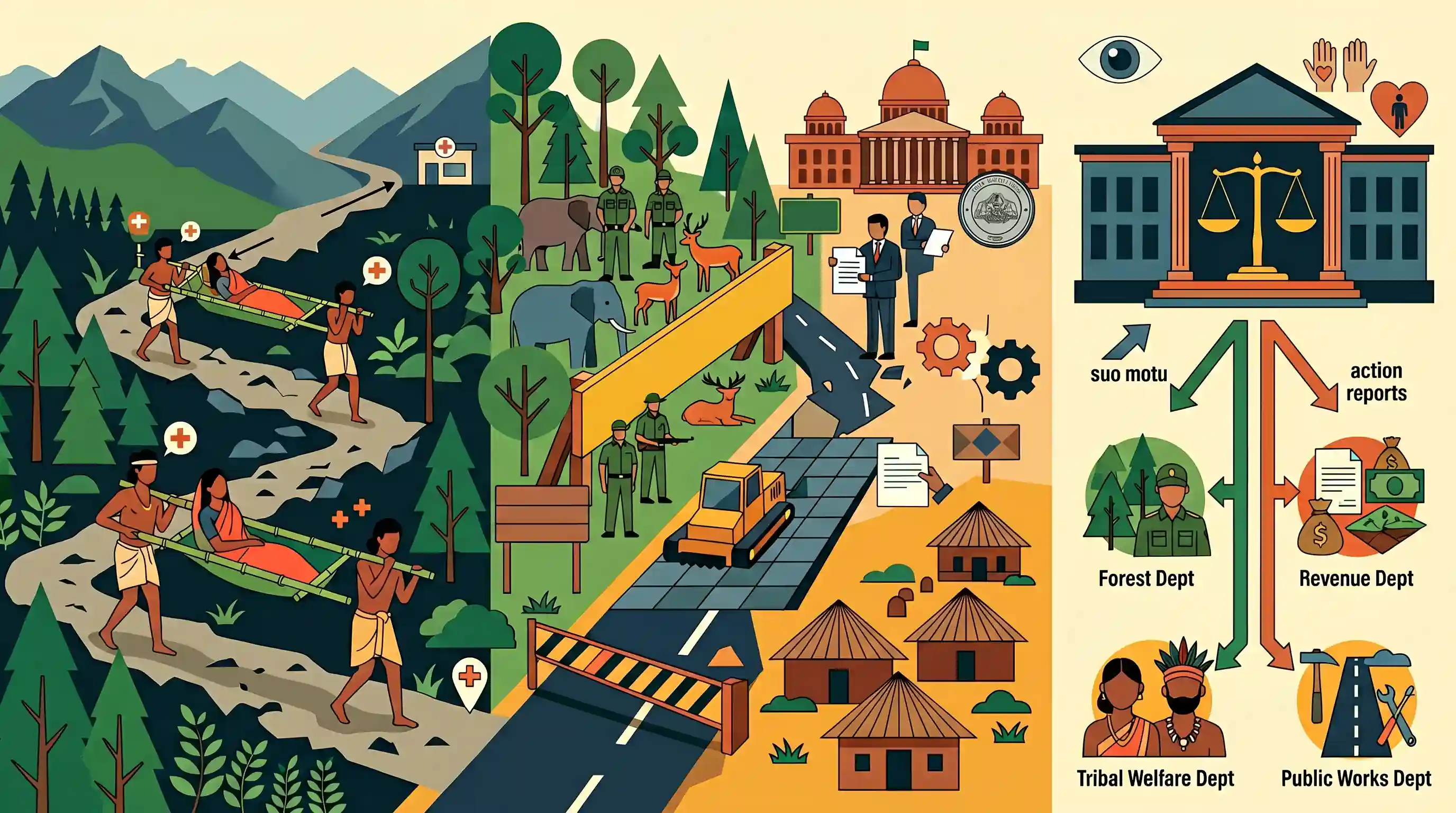
The Kerala State Human Rights Commission (SHRC) has registered a suo motu case concerning the lack of proper road infrastructure connecting five tribal settlements in Munnar. The action was prompted by an incident where a tribal woman from the Valsapettykudy settlement, located within the Anamudi Shola National Park, had to be carried for 6 km on a bamboo stretcher to access medical care. The Forest Department is accused of obstructing road construction projects sanctioned by the government, creating a severe governance deficit. The SHRC has demanded action reports from the Forest, Revenue, Tribal Welfare, and Public Works departments, bringing attention to the friction between environmental conservation and the basic human rights of indigenous groups.
Key Points
- The Kerala SHRC took suo motu cognizance of the lack of road access to five tribal settlements in Munnar after a tribal woman had to be carried on a bamboo stretcher for 6 km to reach a hospital.
- The affected settlements, including Valsapettykudy, are located inside the Anamudi Shola National Park in Idukki district.
- The incident highlights allegations that the Forest Department is obstructing government-sanctioned road projects meant to connect these isolated settlements.
- The SHRC has directed multiple departments (Forest, Revenue, PWD, Tribal Welfare) and local panchayats to respond with immediate steps to resolve the crisis.
- This situation exemplifies the classic policy conflict between strict wildlife conservation laws and the fundamental human rights and developmental needs of indigenous communities.
Important Terms
State Human Rights Commission (SHRC)

A statutory body established under the Protection of Human Rights Act, 1993, to inquire into and protect human rights violations within state-level jurisdictions.
UPSC context
GS Paper 2 (Statutory/Quasi-judicial bodies); tests understanding of the institutional framework for safeguarding fundamental rights.
Suo Motu
A legal term meaning 'on its own motion,' referring to cases where a court or authority initiates legal proceedings without a formal petition from an external party.
UPSC context
GS Paper 2 (Judiciary); tests knowledge of judicial activism and the proactive powers of statutory oversight bodies.
Anamudi Shola National Park
A protected area in the Western Ghats of Kerala featuring unique shola-grassland ecosystems, high biodiversity, and the highest peak in South India.
UPSC context
GS Paper 3 (Environment); relevant for protected area networks and the conflict between conservation and development.
Forest Department
The state agency responsible for managing forest resources, wildlife conservation, and enforcing environmental laws like the Forest Conservation Act, 1980.
UPSC context
GS Paper 3 (Environment/Conservation); tests understanding of ecological protection versus community infrastructure needs.
Revenue Department
The primary state authority responsible for land administration, land records, tax collection, and managing land-use transitions for developmental projects.
UPSC context
GS Paper 2 (Governance); highlights the role of executive machinery in land management and inter-departmental coordination.
Tribal Welfare Department
A specialized administrative body tasked with formulating and implementing welfare schemes and developmental projects for Scheduled Tribes (STs).
UPSC context
GS Paper 2 (Welfare schemes); tests knowledge of specific institutional mechanisms for marginalized group upliftment.
Public Works Department (PWD)
The state executive body responsible for the planning, construction, and maintenance of public infrastructure like roads and government buildings.
UPSC context
GS Paper 3 (Infrastructure); relevant for analyzing governance efficiency and regional connectivity challenges.
Prelims Trap
"The Forest Rights Act strictly prohibits any diversion of forest land within National Parks for developmental infrastructure."
Section 3(2) of the FRA explicitly allows diversion of up to one hectare of forest land for essential utilities like roads, pending Gram Sabha approval.
Static Concepts Connected
What are the key limitations on the powers of State Human Rights Commissions (SHRC)?
- Advisory nature: SHRC recommendations are purely advisory and not legally binding on the State government, though the state must inform them of action taken.
- Time limitation: An SHRC cannot inquire into any matter after the expiry of one year from the date on which the alleged human rights violation occurred.
- Armed forces: State commissions do not have the power to investigate human rights violations committed by members of the armed forces.
What characterizes the Shola forests of the Western Ghats?
- Altitude and Climate: They are unique high-altitude tropical montane wet temperate forests typically found at elevations above 1,500 meters.
- Topography: They exist in sheltered montane valleys and depressions, characteristically separated by extensive rolling montane grasslands.
- Vegetation: They feature dense canopies, stunted tree growth, and a high concentration of epiphytes like mosses, ferns, and lichens.
Cross-Topic Patterns
FRA Sec 3(2) + Protected Areas
The conflict between Forest Departments and tribal road access highlights the recurring governance hurdle in utilizing FRA's allowance for 1-hectare land diversion for public utilities.
Shola National Parks Mapping
Anamudi Shola lies in a contiguous protected block with Eravikulam, Pampadum Shola, and Mathikettan Shola, making it a prime candidate for North-South Prelims mapping questions.

Expect a Prelims question interlinking the mapping of Kerala's Shola national parks with the FRA provisions on forest land diversion.
Linked PYQs · 3
Linked PYQs · 3
- 2021MainsGS2
Though the Human Rights Commissions have contributed immensely to the protection of human rights in India, yet they have failed to assert themselves against the mighty and powerful. Analyzing their structural and practical limitations, suggest remedial measures.
- 2021MainsGS3
“Investment in infrastructure is essential for more rapid and inclusive economic growth.” Discuss in the light of India's experience.
- 2019PrelimsGS1
Which of the following are in Agasthyamala Biosphere Reserve?
