India Deploys MultiParty Delegations to Project Unified Foreign Policy
Source:The Hindu ↗
Why It Matters
The article provides a practical example of India using soft power and diplomatic delegations to influence global narratives, isolate state-sponsored terrorism, and demonstrate its democratic values, which are highly relevant for GS-2 (International Relations) and GS-3 (Security).
Summary
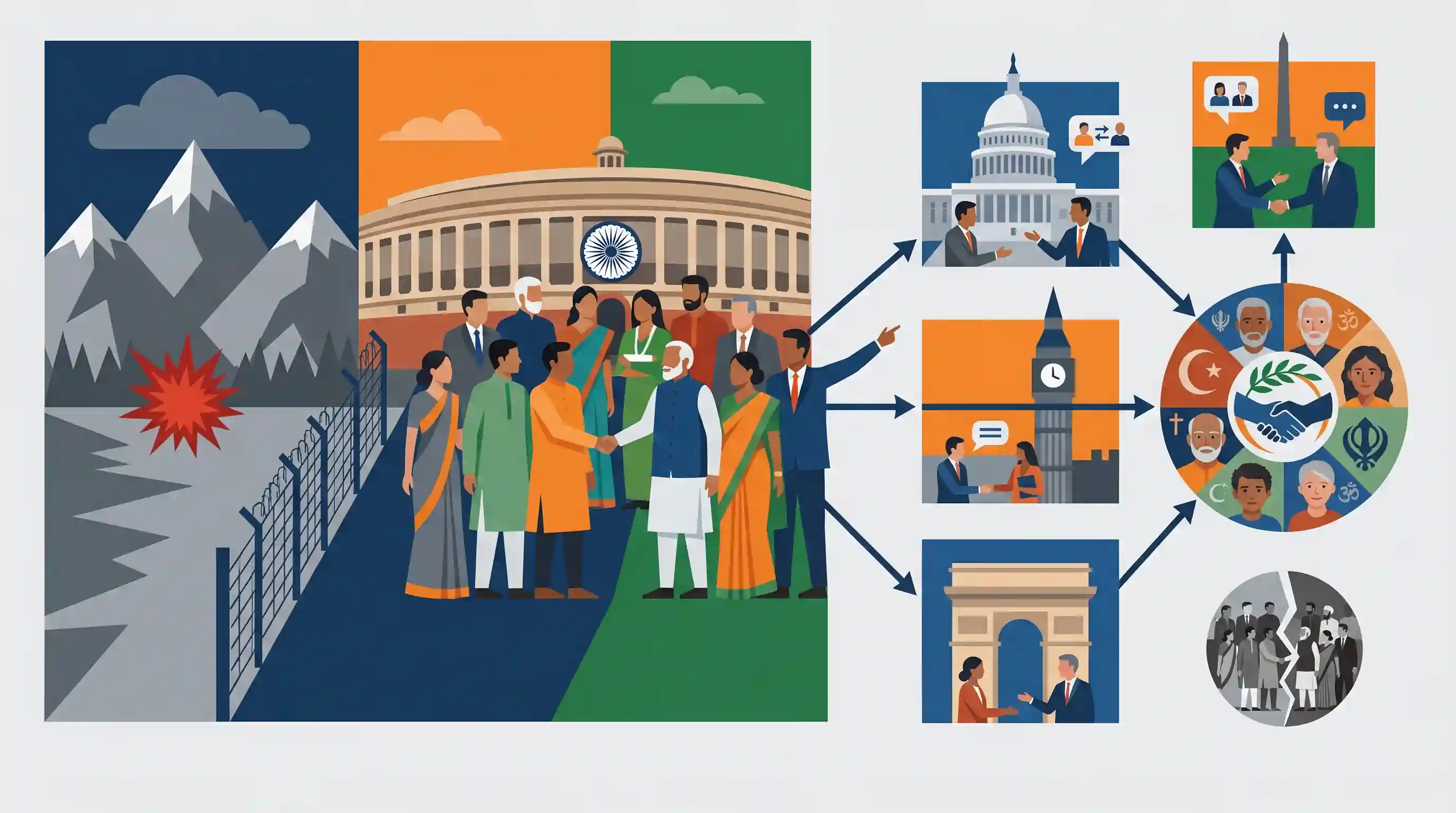
The editorial discusses the Indian government's deployment of multi-party delegations to global capitals following 'Operation Sindoor' and the Pahalgam terrorist attack. It emphasizes that these diplomatic missions, comprising diverse representatives, serve to project India's secular, pluralistic democracy in stark contrast to Pakistan's sectarian ideology, urging political parties to unite and avoid politicizing the nominations.
Key Points
- Following the April 2025 Pahalgam terrorist attack and subsequent 'Operation Sindoor', the Indian government announced seven multi-party delegations to canvas international support.
- The delegations are designed to showcase India's unity, pluralism, and secular democracy, contrasting sharply with Pakistan's state-sponsored sectarian terrorism.
- The editorial highlights the ideological divide between India's founding vision of coexistence and Pakistan's two-nation theory, recently echoed by its Army Chief Asim Munir.
- Despite initial controversies over candidate selections, including Congress MP Shashi Tharoor, the editorial urges all political parties to set aside domestic differences to project a unified national front abroad.
Important Terms
Operation Sindoor

India's 2025 retaliatory military offensive against Pakistan following the Pahalgam terrorist attack, involving precision strikes on terror infrastructure in Pakistan and PoK.
UPSC context
GS Paper III (Internal Security); GS Paper II (International Relations). Tests knowledge of India's 'proactive' counter-terrorism doctrine.
Pahalgam Terrorist Attack
A major security incident on April 22, 2025, where 26 civilians, primarily tourists, were killed by terrorists near Pahalgam, Jammu and Kashmir.
UPSC context
GS Paper III (Internal Security). Relevant for analyzing evolving terror tactics targeting tourism and civilian demographics.
All-Party Delegation
A diplomatic mission comprising representatives from various political parties, used to project national consensus and bipartisan unity on critical foreign policy or security issues.
UPSC context
GS Paper II (Governance/Diplomacy). Evaluates the use of 'Track 1.5' or multi-party diplomacy in international outreach.
Cross-Border Terrorism
Terrorism where perpetrators cross an international border to carry out attacks, often with state or non-state support from the neighboring country.
UPSC context
GS Paper III (Internal Security/Border Management). A core theme in India-Pakistan bilateral relations and security studies.
Zero-Tolerance Policy
India's firm policy stating that it will not compromise on national security or tolerate any acts of terrorism, inviting swift retaliation.
UPSC context
GS Paper III (Security). Tests understanding of India's strategic posture and its application in global diplomatic messaging.
Prelims Trap
Parliamentary delegations abroad are exclusively constituted and led by ruling party members or Cabinet Ministers.
India frequently employs "Parliamentary Diplomacy" using multi-party delegations (including opposition leaders) to project democratic pluralism and a unified domestic consensus on security issues.
Static Concepts Connected
What is Parliamentary Diplomacy and how does India utilize it?
- Track 1.5 Diplomacy: Interactions involving parliamentarians to influence foreign policy, complementing formal executive-level (Track 1) statecraft.
- Multi-Party Delegations: Groups like the Indian Parliamentary Group (IPG) or special ad-hoc delegations project domestic consensus on international stages.
- Democratic Projection: Showcases pluralism and bipartisanship, adding credibility to the nation's stance on critical security or sovereign issues.
What are the foundational differences between India's civic nationalism and the Two-Nation Theory?
- Secular Pluralism: Based on a composite culture where constitutional citizenship and rights are entirely independent of an individual's religious identity.
- Two-Nation Theory: Propounds that Hindus and Muslims form distinct, mutually exclusive nations, making religion the primary basis for statehood.
- Ideological Conflict: This historical cleavage continues to drive state-sponsored sectarian terrorism and proxy wars aimed at disrupting India's secular fabric.
Cross-Topic Patterns
Track 1.5 Diplomacy + Internal Security
Using opposition leaders to advocate for national security abroad mirrors India's historic 1994 UN delegation led by Atal Bihari Vajpayee under the Narasimha Rao government.
Democratic Pluralism as Soft Power
Highlighting internal diversity against a neighbor's sectarian military doctrine leverages India's constitutional secularism as a direct strategic asset in global perception management and foreign policy.

Expect a GS-2 Mains question linking 'Parliamentary Diplomacy' and soft power to consensus-building in foreign policy during crises.
Linked PYQs · 4
Linked PYQs · 4
- 2015MainsGS2
Terrorist activities and mutual distrust have clouded India-Pakistan relations. To what extent the use of soft power like sports and cultural exchanges could help generate goodwill between the two countries? Discuss with suitable examples.
- 2016MainsGS2
Increasing cross-border terrorist attacks in India and growing interference in the internal affairs of several member-states by Pakistan are not conducive for the future of SAARC (South Asian Association for Regional Cooperation)." Explain with suitable examples.
- 2017MainsGS3
The scourge of terrorism is a grave challenge to national security. What solutions do you suggest to curb this growing menace? What are the major sources of terrorist funding?
- 2022MainsGS1
Are tolerance, assimilation and pluralism the key elements in the making of an Indian form of secularism? Justify your answer.
