UNSC Permanent Membership and Veto Power Reform Debates
Source:The Hindu ↗
ఇది ఎందుకు ముఖ్యం
The functioning and reform of the United Nations Security Council are central to India's foreign policy goals, multilateral diplomacy, and global governance reform, making it a recurring theme for UPSC Mains GS2.
సారాంశం
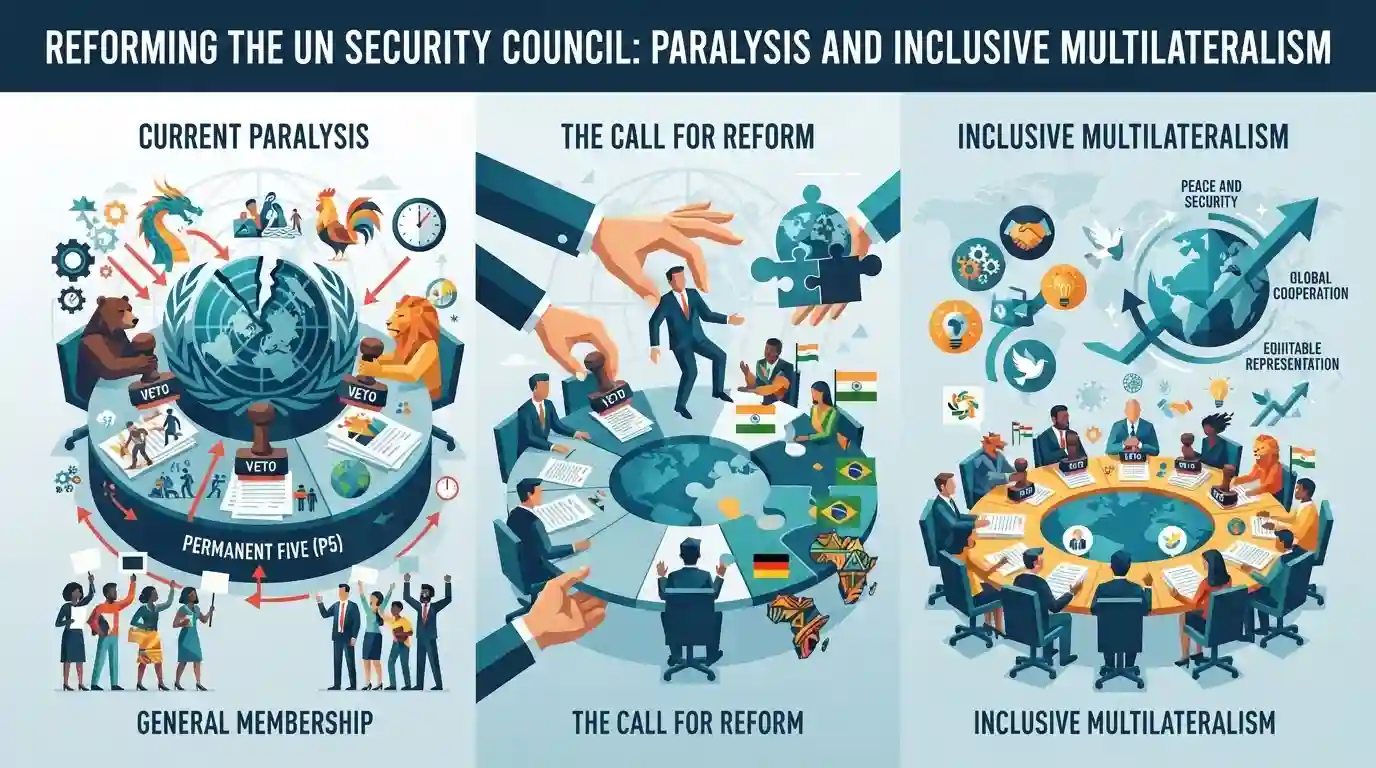
An analytical discussion on whether the permanent membership and veto powers of the United Nations Security Council (UNSC) should be reformed or abolished, examining the paralysis of global governance and the arguments for inclusive multilateralism.
ముఖ్య అంశాలు
- The debate surrounding the permanent membership and veto powers of the United Nations Security Council (UNSC) has intensified due to institutional gridlocks in handling global crises.
- Criticism of the veto power centers on its misuse by the P5 nations, rendering the UNSC ineffective in maintaining international peace and security.
- Proposals for reform range from abolishing the veto power or restricting its use in mass atrocities to expanding both permanent and non-permanent seats to reflect contemporary geopolitical realities.
- India and other aspiring nations advocate for comprehensive reforms to make global governance structures more representative, democratic, and accountable.
ముఖ్యమైన పదాలు
United Nations Security Council

The principal organ of the United Nations tasked with maintaining international peace and security, comprising 15 members including five permanent members with veto power.
UPSC context
GS Paper II: Important International Institutions, Agencies and Fora. Tests understanding of global governance structures and India's multilateral diplomacy.
Veto Power
The exclusive power of the five permanent members of the UNSC (P5) to block any substantive resolution, often criticized for causing institutional paralysis in global crises.
UPSC context
GS Paper II: International Relations and Global Groupings. Evaluates structural reform debates and equitable representation in international organizations.
United Nations
An international organization founded in 1945 to maintain international peace and security, develop friendly relations, and promote international cooperation.
UPSC context
GS Paper II: Important International Institutions and Multilateral Fora. Tests the framework of post-WWII global governance and international law.
ప్రిలిమ్స్ ఉచ్చు
G4 nations demand immediate, unconditional veto powers for all newly inducted permanent members of the UNSC.
Aspirants often assume new permanent members in G4 proposals would instantly receive full veto powers, overlooking the proposed 15-year deferral compromise.
అనుసంధానమైన స్థిర భావనలు
What is the composition, veto power, and reform process of the UN Security Council?
- Composition: Comprises 15 members: 5 permanent (P5) and 10 non-permanent elected for two-year terms by the UN General Assembly.
- Veto Power: Held by US, UK, France, Russia, and China; any negative vote by a P5 member blocks a substantive resolution (Article 27 of UN Charter).
- Charter Amendment: Requires an amendment of the UN Charter under Article 108, needing a two-thirds majority of UN member states and ratification by all five P5 nations.
అంతర-అంశ నమూనాలు
UNSC Reform + UN Peacekeeping Operations
UNSC paralysis directly hampers UN peacekeeping missions and international humanitarian law enforcement, linking institutional reform to India's role as a major troop-contributing country.

UNSC reform + G4 models + veto deferral compromise is a high-yield area for Mains GS-2 institutional governance questions.
అనుసంధాన PYQలు · 2
అనుసంధాన PYQలు · 2
- 2015MainsGS2
Discuss the impediments India is facing in its pursuit of a permanent seat in UN Security Council.
- 2024MainsGS2
‘Terrorism has become a significant threat to global peace and security.’ Evaluate the effectiveness of the United Nations Security Council's Counter Terrorism Committee (CTC) and its associated bodies in addressing and mitigating this threat at the international level.
